Rules for yachts in the Balearics: what captains need to know
Speed near beaches, discharge, buoy fields, clearance and drones in the Balearics, each rule linked to the Spanish or Balearic source.

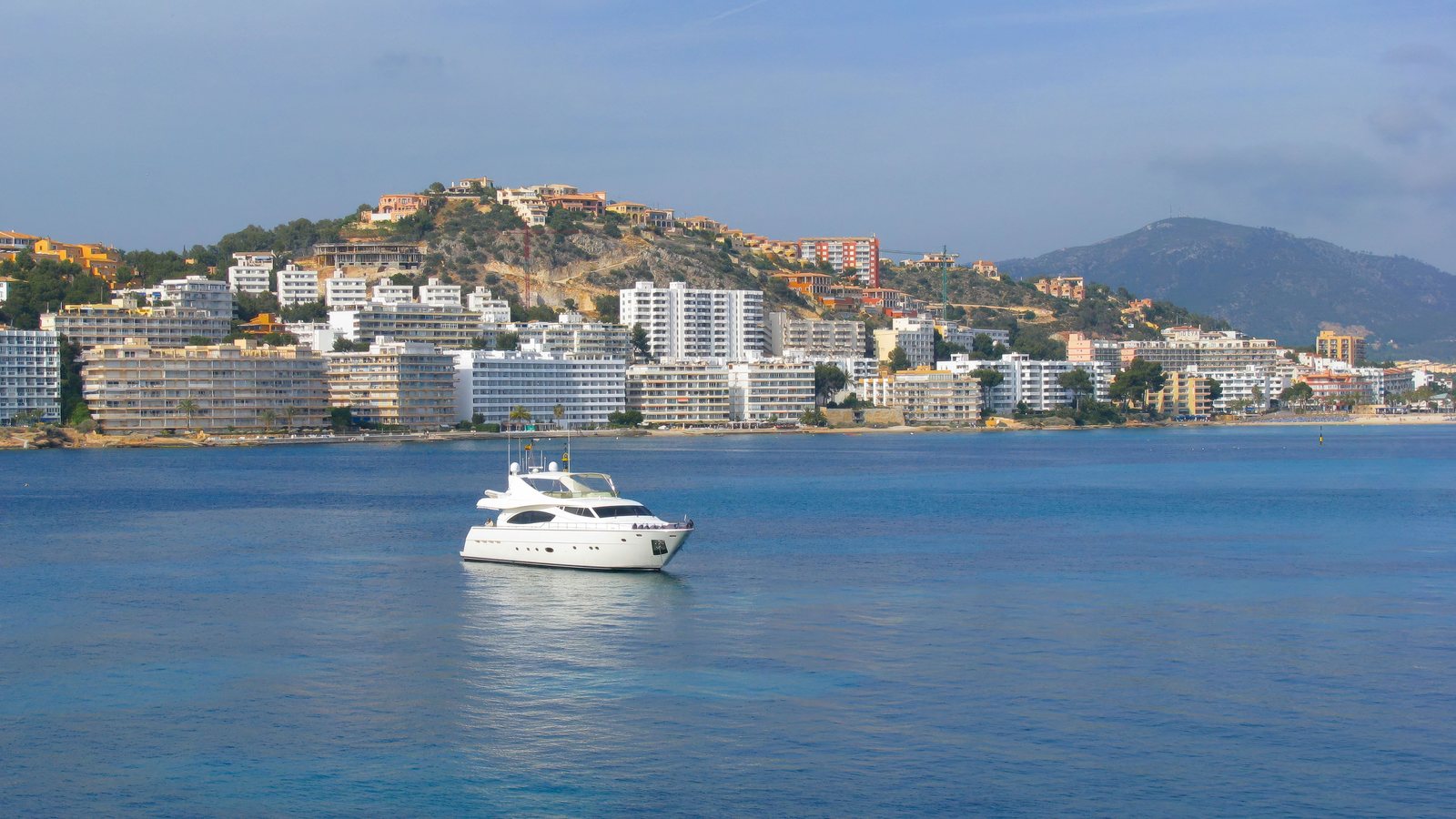
Within 200 metres of a beach and 50 metres of the rest of the coast, yachts may not go faster than 3 knots unless the area is buoyed differently. Marked swimming zones are closed to boats, nothing may be discharged there, and in regulated buoy fields you must use a buoy instead of your anchor.
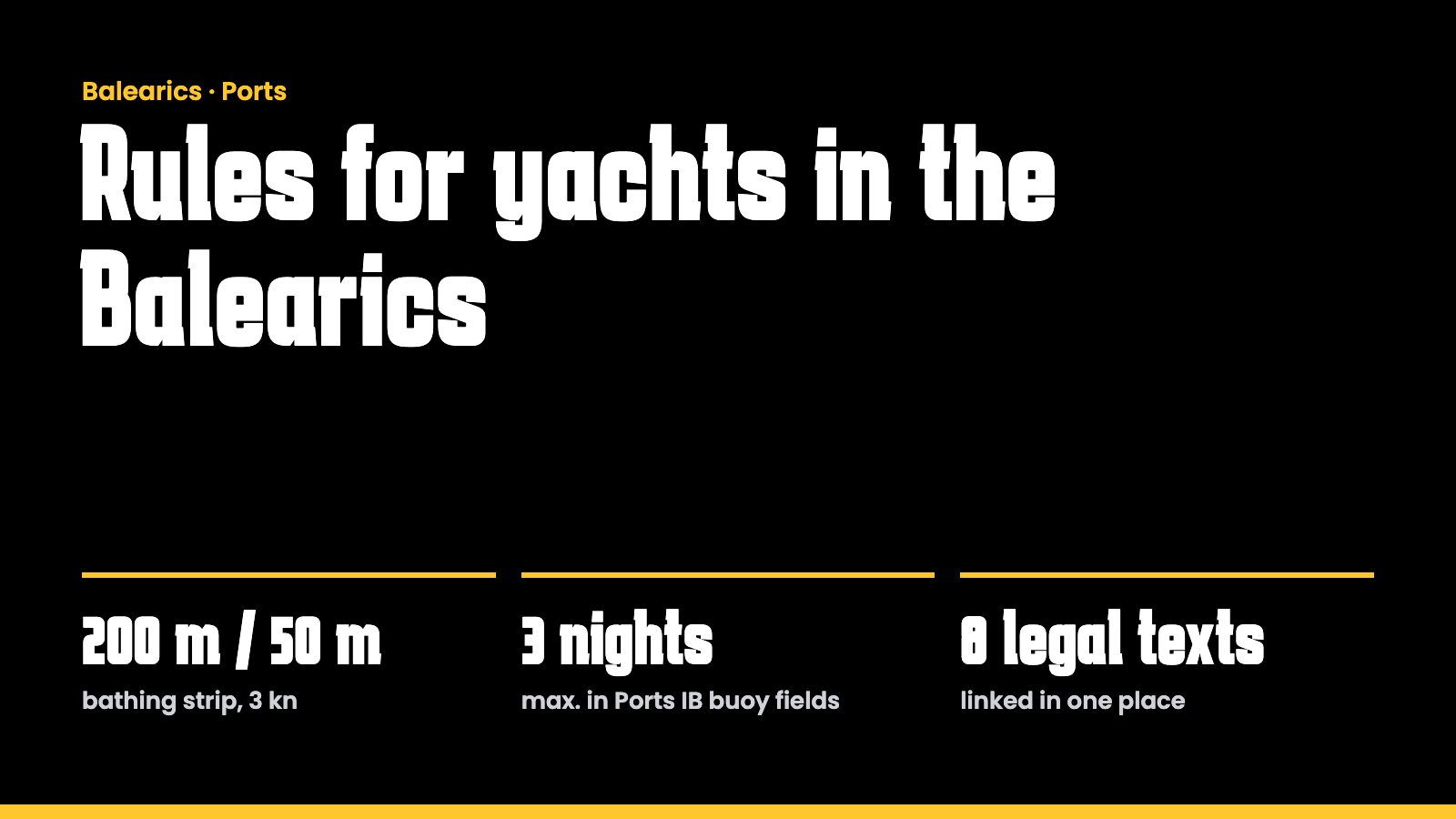
These rules are spread across several Spanish royal decrees, Balearic regulations and port rules. We collected the ones a captain needs most and linked each to its official source.
How fast may you go near the beach?
Where there is no buoyage, a strip of 200 metres in front of beaches and 50 metres along the rest of the coast counts as a bathing area, with a speed limit of 3 knots (Real Decreto 876/2014, Art. 73). In marked swimming zones, recreational navigation under sail or engine is not allowed at all (same article).
Ports have their own limits. At Club de Mar in Palma, for example, boats may only enter and leave the basin, at no more than 3 knots or the minimum speed needed to steer (Club de Mar port regulations, Art. 32).
What may you discharge, and where do you leave your waste?
- In bathing areas, no discharge of any kind from boats is allowed (Real Decreto 876/2014, Art. 73).
- Recreational craft may only discharge sewage in Spanish waters under the conditions in Real Decreto 339/2021, Art. 23, among them treated and more than 3 nautical miles from the coast.
- Before leaving a Spanish port, all ship waste must be delivered to the port reception facility (Real Decreto 128/2022, Art. 17).
- The advance waste notification applies to ships of 300 GT and above; recreational craft and yachts under 45 metres are exempt (Real Decreto 128/2022, Art. 16).
Where may you anchor?
In the regulated buoy fields you must moor to a buoy; anchoring on the seabed is not allowed there (Balearic Government, buoy field rules). In the buoy fields run by Ports IB, you can book a maximum of three consecutive nights (Ports IB booking conditions, 4.3.4).
Outside the buoy fields, the Balearic Posidonia decree (Decreto 25/2018) sets where anchoring is restricted. We could not check its full text for this article, so we do not summarise it here. The Balearic Government explains it on its site Cuidamos la Posidonia.
Do you need to clear in and out?
- Privately used recreational boats without a professional crew are exempt from clearance (despacho), as are jet skis and recreational floating devices (Real Decreto 186/2023, Art. 2). Yachts with a professional crew are not covered by this exemption.
- Chartering a yacht under an EU or non-EU flag in Spanish waters for the first time needs an express clearance authorisation (Real Decreto 186/2023, Art. 9).
- People from outside the EU must enter through an authorised border crossing point during its opening hours (Real Decreto 1155/2024, Art. 1).
- Crew with a valid seafarer's identity document who are on the crew list may move around the port and within 10 km of it during the stay without a border check (Real Decreto 1155/2024, Art. 1(3)).
Which licence does the skipper need?
Whoever runs a yacht under a foreign flag in Spanish waters needs a certificate of competence that is valid for it (Real Decreto 875/2014, additional provision 5).
Can you fly a drone from the yacht?
Drone operators must be at least 16 years old (Real Decreto 517/2024, Art. 6). Remote pilots may be younger in Spain: 12 for subcategory A1 with a class C0 drone, and 14 for A1 with C1, A2 and A3 with C2, and A3 with C3 or C4 or home-built drones under 25 kg (Real Decreto 517/2024, Art. 7). A lowered age applies only in the country that set it; elsewhere in the EU the minimum is 16 (Regulation (EU) 2019/947, Art. 9, via EASA). Drones with a take-off mass of 20 kg or more must be insured under EU Regulation 785/2004; below 20 kg, liability insurance is compulsory in subcategory A2 and in the specific and certified categories (Real Decreto 517/2024, Art. 8).
Sources
All sources were checked on 4 October 2026. Each rule above links to the exact legal text or official page.
Sources and image rights
- Images
- Erik Karits / Pexels (conditions)
- Checked
- 4 October 2026 by Andreas Lakeberg
Disclaimer. We research every article carefully and to the best of our knowledge. Salaries, prices, rules and port regulations change, and we cannot guarantee that all information is complete, current or correct. Please check anything important with the original source or the responsible authority before you rely on it. To the extent permitted by law, we accept no liability for errors or omissions.