Flags and registries for yachts: Red Ensign, Cayman, Malta and the Marshall Islands compared
Who may own, registration types, fees and yacht codes: the UK, Cayman, Malta and Marshall Islands registers side by side, from official sources.

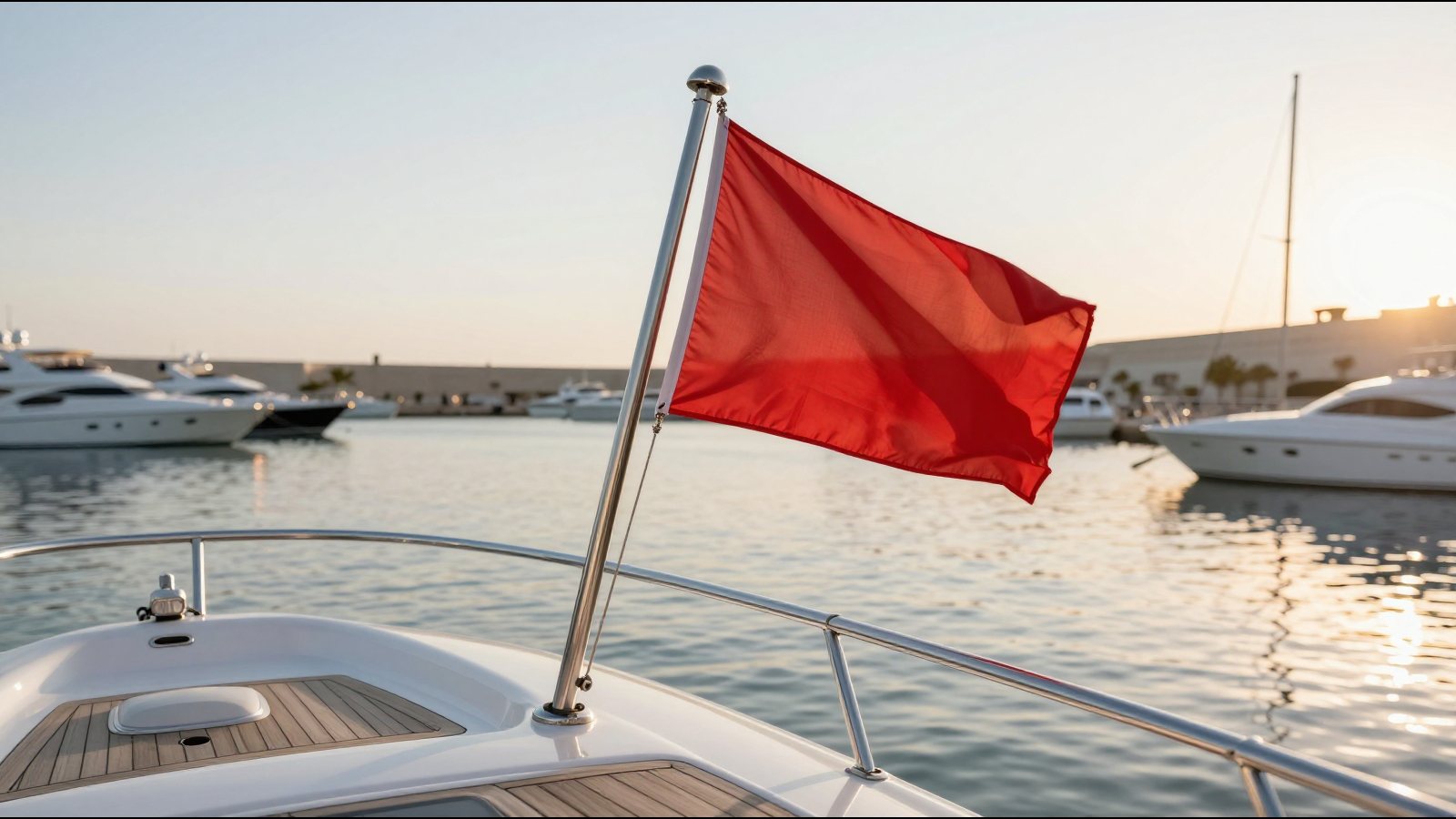
The UK and the Cayman Islands both belong to the Red Ensign Group, a group of British Shipping Registers. Both run Category 1 registers that can register vessels of all sizes. Malta and the Marshall Islands register yachts under their own laws. All four registers do three things:
- Ownership: they set out who may own a registered yacht.
- Short-term registration: they offer a provisional or short-term registration.
- Fees: they publish their fees.
Examples of those fees: £153 for five years on Part 1 of the UK register, US$1,750.00 on the Cayman register for vessels up to 400 GT, €255 for a Maltese pleasure yacht of 24 m LOA and over, and a total of US$2,550 for a Marshall Islands private yacht of 24 m or more up to 299 GT.
This guide is based on the Red Ensign Group, the UK Ship Register and GOV.UK, the Cayman Islands Shipping Registry, Maltese legislation and the Marshall Islands (RMI) Yacht Registry. All sources were checked on 10 November 2026. Each fee below carries the date of the document it comes from. The guide summarises published rules; it is not legal advice. What a flag means for charter in a given country is covered in chartering in Croatia and chartering on the Côte d'Azur.
What is the Red Ensign Group?
"The Red Ensign Group (REG) is a group of British Shipping Registers" (Red Ensign Group, About). It is made up of three groups:
- The United Kingdom.
- The Crown Dependencies: Isle of Man, Guernsey and Jersey.
- The UK Overseas Territories: Anguilla, Bermuda, British Virgin Islands, Cayman Islands, Falkland Islands, Gibraltar, Montserrat, St Helena and the Turks & Caicos Islands.
Malta and the Marshall Islands are not in that list.
The British ship rule. Any vessel registered in the UK, a Crown Dependency or a UK Overseas Territory is a "British ship". It is entitled to fly the Red Ensign.
The two categories. The REG divides its registers into two categories:
- Category 1 registers ships of unlimited tonnage and type. The members are Bermuda, British Virgin Islands (BVI), Cayman Islands, Gibraltar, Isle of Man and the United Kingdom.
- Category 2 registers commercial ships and pleasure vessels of up to 150 gross tons (GT). This limit can be extended to 400GT with an agreement in place with the UK. The members are Anguilla, Falkland Islands, Guernsey, Jersey, Montserrat, St Helena and the Turks & Caicos Islands.
Legal basis. The categories are established by the Merchant Shipping (Categorisation of Registries of Relevant British Possessions) Order 2003. This is SI 2003/1248, as amended by SI 2008/1243 and SI 2013/1115 (REG, FAQ).
Fees and secretariat. Individual REG members are responsible for setting their own registration fees. The REG Secretariat is based at the Maritime & Coastguard Agency (MCA) in Southampton (REG).
How does the UK Ship Register work for yachts?
The UK Ship Register is a Category 1 register, "which means it can register vessels of all sizes" (REG, UK). According to GOV.UK, there are 4 different parts of the register (GOV.UK, The UK Ship Register). GOV.UK describes three of them as follows:
- Part 1 is for commercial or pleasure boats. It costs £153 to register for 5 years and £72 to renew for another 5 years.
- Part 3: the conditions listed include that your boat is less than 24 metres long and that you live in the UK for at least 185 days of the year. It costs £35 for 5 years.
- Part 4 is the part to use "if you plan to hire out (charter) your boat". It costs between £35 and £196 for 5 years.
The UK Ship Register gives the same Part 1 fee. Registering a pleasure vessel or small commercial vessel on Part 1 costs £153 and lasts five years (UK Ship Register, Fees). On its bareboat charter page, the register says Part 4 lets you fly the Red Ensign for the duration of the charter contract (UK Ship Register, Part 4).
Who may own. Qualified owners on Part 1 and qualified charterers on Part 4 include (UK Ship Register, Eligibility):
- British citizens;
- bodies corporate incorporated in the United Kingdom or one of the European Economic Area (EEA) countries.
If none of the qualified owners lives in the UK, a representative must be appointed. One option is an individual resident in the UK. For Part 3, "ordinarily resident" means the owner lives in the UK for at least 185 days each year.
Pleasure vessel. The register defines a pleasure vessel as "wholly owned by an individual or individuals and used only for the sport or pleasure of the owner or the immediate family or friends of the owner" (UK Ship Register, Pleasure Part 1).
Large yachts. The register has a separate service for owners of large yachts over 24 metres in registered length. That page refers to compliance with the Red Ensign Group Large Yacht Code, Large Yacht Code 3 and the Passenger Yacht Code (UK Ship Register, Large Yacht).
For a new large yacht registration, the document list includes a Large Yacht Certificate for commercially operating yachts greater than 24 metres. The fee is £153, paid online via GOV.UK, for a five-year period (UK Ship Register, New registration).
According to the register, the REG Yacht Code came into force on 1 January 2019. An updated version was brought into force in 2024 (UK Ship Register, Codes).
Provisional registration (large yachts, Part 1) (UK Ship Register, Provisional registration):
- Length: a 3-month provisional registration is available.
- Fee: £175 for three months, paid through GOV.UK.
- No commercial use: whilst a vessel is provisionally registered, "regardless of its intended future use it cannot operate commercially".
- Waiting period: once a provisional registration has been granted, the vessel cannot be provisionally registered again within one year of the date of the original certificate.
The MCA's quick guide to fees (November 2018) lists the same £153 for the registration of a ship and £175 for the provisional registration application (MCA fees, page 5).
What does the Cayman Islands register offer?
The Cayman Islands Shipping Registry is a Category 1 register, "which means it can register vessels of all sizes" (REG, Cayman Islands). The registry describes itself as a member of the Red Ensign Group with Category 1 status. Its ports of registration are George Town, The Creek and Bloody Bay (Cayman Registry, Registration).
Who may own. Under the Merchant Shipping Act 2024, the ownership criteria for Cayman Islands ships have been widened. Qualified owners now include nationals or citizens of a Member State of the European Union (Guidance Note 03/2024 Rev 01 of 12 March 2024, sections 2.1 and 2.2(g), CIGN 03/2024).
Owners who are not qualified "may still own up to 31 of the 64 shares in a vessel (either individually or collectively)". The registry's page on ownership structures also sets out when a Representative Person resident on the Islands must be appointed. That person acts on behalf of the owner(s) on matters within the Cayman Islands (Cayman Registry, Ownership structure).
Registration types. The registry offers full, interim, term, under construction and demise charter (bareboat) registration (Cayman Registry, Yacht). Two of them have specific limits (Types of registration):
- Term: a "one-time" Certificate, valid for up to 90 days, with no extension provisions.
- Interim: available during a transfer of ownership, when a "foreign" owned and flagged ship is transferring to an individual who is qualified to own a Cayman vessel.
Under normal circumstances, transactions are completed within 24 hours once all forms, supporting documentation and fees have been received (Cayman Registry, FAQ).
Fees. Shipping Notice 04/2026 (Rev 1.1) has been in force since 01 April 2026. It quotes all fees in US Dollars (CISN 04/2026):
- Registration fee (Item 1): US$1,750.00 up to 400 GT, and US$2,250.00 for 400 GT and above.
- Optional initial 3-Year Term Registration for pleasure vessels under 24 m length (TL): US$2,750.00. According to the notice, this includes the initial registration fee.
- Change of vessel type (for example Pleasure Yacht, Commercial Vessel, Yacht Engaged in Trade): US$800.00.
- Minimum annual fee for vessels up to 400GT: US$600.00. The annual fee is paid to the Maritime Authority of the Cayman Islands (MACI) before the 31st day of January in each year (section 4.1).
What does Maltese law say?
The provisions below come from the Merchant Shipping Act (Cap. 234), consolidated up to Act I of 2025, and two sets of subsidiary legislation (Merchant Shipping Act).
Who may own. Article 4(1) names the qualified owners:
- (a) citizens of Malta;
- (b) bodies corporate established under the terms of that paragraph.
The Ships Eligible for Registration Regulations (S.L. 234.23) add the "international owner". Regulation 2 refers to persons "not residing in Malta". Regulation 4(1) states that "an international owner shall be qualified to own" a vessel. Regulation 5(1) deals with the resident agent (S.L. 234.23).
Provisional registration. Article 12 allows a ship to be provisionally registered as a Maltese ship for six months. The proviso allows further periods not exceeding six months in the aggregate. Article 13(1) sets a period of one month from provisional registry, extendable, for the follow-up requirements it lists.
Fees. The First Schedule of the Act was last amended by L.N. 127 of 2018. It lists:
- Pleasure yacht of 24 m LOA and over: a fee on registration of 25 cents per net tonnage, subject to a minimum of €187.50. The €255 listed for pleasure yachts is the basic fee in the annual fee columns.
- Commercial yacht under 24 m LOA: €115, €150 and €250 in the schedule's three columns (registration fee, basic fee and register fee).
Commercial yachts. The Merchant Shipping (Certification of Commercial Yachts and Commercial Cruising Vessels) Regulations (S.L. 234.45, L.N. 38 of 2006) cover certification. Regulation 3(1) links certification to compliance "with the Safety and Load Line" provisions it names. Regulation 4(1) provides for measures to develop a Code of Practice (S.L. 234.45).
How does the Marshall Islands registry sort yachts?
The RMI Yacht Registry registers private yachts, private yachts limited charter, commercial yachts and passenger yachts. The current code is the RMI Yacht Code 2026, effective 1 January 2026. Yacht owners can choose Bikini or Jaluit as their home port (RMI, Yacht general information).
Who may own. Ownership of yachts registered in the RMI "must be through an RMI corporation, limited or general partnership, limited liability company, or a qualified foreign maritime entity".
Eligibility. Under section 203 of the Maritime Act, seagoing vessels of any tonnage engaged in foreign trade, and yachts, are eligible for registration. The registry's general eligibility page adds that vessels should not be more than 20 years old at the time of registration (RMI, Eligibility).
First document. Under §214 of the Maritime Act, the Provisional Certificate of Registry is the initial navigational document the RMI issues to a vessel (RMI, Registration transactions).
Yacht categories:
- Private yacht: 12 m or more in length. RMI-flagged private yachts may carry more than 12 guests on board, provided additional flag State requirements are met (RMI, Private yachts).
- Commercial yacht: any yacht engaged in trade, commerce or on charter, carrying no more than 12 passengers. Registration is limited to yachts of 24 m or more (RMI, Commercial and passenger yachts).
- Passenger yacht (PAXY): may be engaged in trade, commerce or on charter, carrying up to 36 passengers.
- Private Yacht Limited Charter (PYLC): 18 m or more LOA and less than 500 GT. It holds a Compliance Certificate allowing limited chartering for no more than 84 days per calendar year, and carries no more than 12 passengers (RMI, PYLC and YET).
- Yacht Engaged in Trade (YET): a private yacht of 24 m or more may engage in temporary chartering for up to 84 days per calendar year. The registry lists the countries for this programme; they "currently include France, Monaco, Croatia, Greece, United Arab Emirates, and Saudi Arabia".
Fees. The fees in MN 1-005-2 (Jul/2025) apply from 1 January 2025 (MN 1-005-2):
- Private yacht under 24 m: a total of US$1,600, with an annual tonnage tax of US$750.
- Private yacht of 24 m and over: totals of US$2,550 (up to 299 GT), US$2,750 (300–399 GT), US$3,000 (400–999 GT) and US$3,450 (1,000 GT and over).
- PYLC: totals of US$4,100 (up to 299 GT), US$4,300 (300–399 GT) and US$4,550 (400–499 GT).
- Temporary YET Certificate of Registry: US$450, issued each time a yacht is permitted to engage in trade.
- Commercial yacht: a registration fee of US$1,800.
What changes when a private yacht goes on charter?
Each register handles this in its own terms. Only the wording of each source is given here.
- UK: "Chartering is a commercial use of a vessel, and therefore all yachts engaged in chartering activities must comply with the Code" (UK Ship Register, Codes). A provisionally registered vessel cannot operate commercially.
- Cayman Islands: "The Cayman Islands does not operate a Private Yacht Limited Charter Scheme." Guidance Note 04/2023 (Rev 01 of 25 April 2023) sets out three points (CIGN 04/2023):
- Section 4.3: under Regulation 4(3), yachts of 24m or more in load line length "shall comply with" the code requirements. A footnote names the REG Yacht Code Part A and the Cayman Yacht Code (CCA).
- Section 4.5: "a vessel must not engage in trade (in commercial use for sport or pleasure)" without meeting those requirements.
- Section 4.7: a breach can lead to a fine on summary conviction.
The Certificate of British Registry can show "Pleasure Yacht" or a "Commercial" type. A change of vessel type costs US$800.00 under CISN 04/2026.
- Malta: commercial yachts are certified under S.L. 234.45 (see above).
- Marshall Islands: a yacht can charter as a commercial yacht (24 m or more, up to 12 passengers) or as a PAXY (up to 36 passengers). Private yachts can charter under PYLC or YET for up to 84 days per calendar year each.
How do the four registers compare?
| Register | Who may own (examples from the source) | Provisional or short-term registration | Registration fee (example) | Codes named |
|---|---|---|---|---|
| UK (REG, Category 1) | British citizens; bodies corporate incorporated in the UK or an EEA country | 3 months (large yachts, Part 1), £175 | £153 for five years, Part 1 (GOV.UK, retrieved 10 Nov 2026) | REG Large Yacht Code, Large Yacht Code 3, Passenger Yacht Code |
| Cayman Islands (REG, Category 1) | Among others, nationals or citizens of an EU Member State; non-qualified owners up to 31 of 64 shares | Term Certificate up to 90 days, no extension; interim during a transfer of ownership | US$1,750.00 up to 400 GT (CISN 04/2026 Rev 1.1, from 1 Apr 2026) | REG Yacht Code Part A, Cayman Yacht Code (CCA) |
| Malta | Citizens of Malta; bodies corporate under Art. 4(1)(b); international owners (S.L. 234.23) | Six months, further periods up to six months in aggregate (Art. 12) | 25 cents per net tonnage, subject to a minimum of €187.50, pleasure yacht 24 m LOA and over (fee on registration, First Schedule, last amended L.N. 127 of 2018) | Code of Practice for commercial yachts (S.L. 234.45, reg. 4(1)) |
| Marshall Islands | RMI corporation, partnership, LLC or qualified foreign maritime entity | Provisional Certificate of Registry as the initial navigational document (§214) | US$2,550 total, private yacht 24 m and over, up to 299 GT (MN 1-005-2, from 1 Jan 2025) | RMI Yacht Code 2026, effective 1 Jan 2026 |
Further published figures
| Register | Item | Amount | Source and date |
|---|---|---|---|
| UK | Part 1 renewal, 5 years | £72 | GOV.UK, retrieved 10 Nov 2026 |
| UK | Part 3, 5 years | £35 | GOV.UK, retrieved 10 Nov 2026 |
| UK | Part 4 (charter), 5 years | £35 to £196 | GOV.UK, retrieved 10 Nov 2026 |
| Cayman Islands | Registration fee, 400 GT and above | US$2,250.00 | CISN 04/2026 Rev 1.1, from 1 Apr 2026 |
| Cayman Islands | Optional initial 3-Year Term Registration, pleasure under 24 m (TL) | US$2,750.00 | CISN 04/2026 Rev 1.1, from 1 Apr 2026 |
| Cayman Islands | Minimum annual fee, up to 400GT | US$600.00 | CISN 04/2026 Rev 1.1, from 1 Apr 2026 |
| Malta | Commercial yacht under 24 m LOA (three columns) | €115 / €150 / €250 | First Schedule, last amended L.N. 127 of 2018 |
| Marshall Islands | Private yacht under 24 m, total | US$1,600 | MN 1-005-2, from 1 Jan 2025 |
| Marshall Islands | Annual tonnage tax, private yacht under 24 m | US$750 | MN 1-005-2, from 1 Jan 2025 |
| Marshall Islands | PYLC, total, up to 299 GT | US$4,100 | MN 1-005-2, from 1 Jan 2025 |
| Marshall Islands | Temporary YET Certificate of Registry | US$450 | MN 1-005-2, from 1 Jan 2025 |
| Marshall Islands | Commercial yacht registration fee | US$1,800 | MN 1-005-2, from 1 Jan 2025 |
The fees are in three currencies and come from documents of different dates. They are listed as published, not converted.
Sources
- Red Ensign Group: About the REG, FAQ, start page and member pages for the UK and the Cayman Islands.
- UK: GOV.UK, The UK Ship Register; UK Ship Register (MCA) pages on fees, eligibility, pleasure vessels, bareboat charter and large yachts (registration, provisional registration, codes); MCA quick guide to fees (November 2018).
- Cayman Islands: Cayman Islands Shipping Registry pages on registration, ownership structure, types of registration and the FAQ; Guidance Notes 03/2024 Rev 01 and 04/2023 Rev 01; Shipping Notice 04/2026 Rev 1.1.
- Malta: Merchant Shipping Act (Cap. 234); S.L. 234.23; S.L. 234.45, all on legislation.mt.
- Marshall Islands: RMI Yacht Registry pages on general information, eligibility, registration transactions, private yachts, commercial and passenger yachts, PYLC and YET; MN 1-005-2 (Jul/2025).
All sources were checked on 10 November 2026 and are linked above.
Sources and image rights
- Images
- AI-generated image (illustrative) / Toys & Crew
- Checked
- 10 November 2026 by Andreas Lakeberg
Know something we missed – a rule, a fee, a marina detail? Write to editor@toysandcrew.com. We check every tip against the source and note updates at the top of the story.
Disclaimer. We research every article carefully and to the best of our knowledge. Salaries, prices, rules and port regulations change, and we cannot guarantee that all information is complete, current or correct. Please check anything important with the original source or the responsible authority before you rely on it. To the extent permitted by law, we accept no liability for errors or omissions.