Chartering on the Côte d'Azur and in Monaco: rules, VAT and fuel
Charter rules in France and Monaco: NUC status, 72-hour declaration, VAT on yacht hire, TAEMUP and duty-free fuel, with the changes due on 1 January 2027.

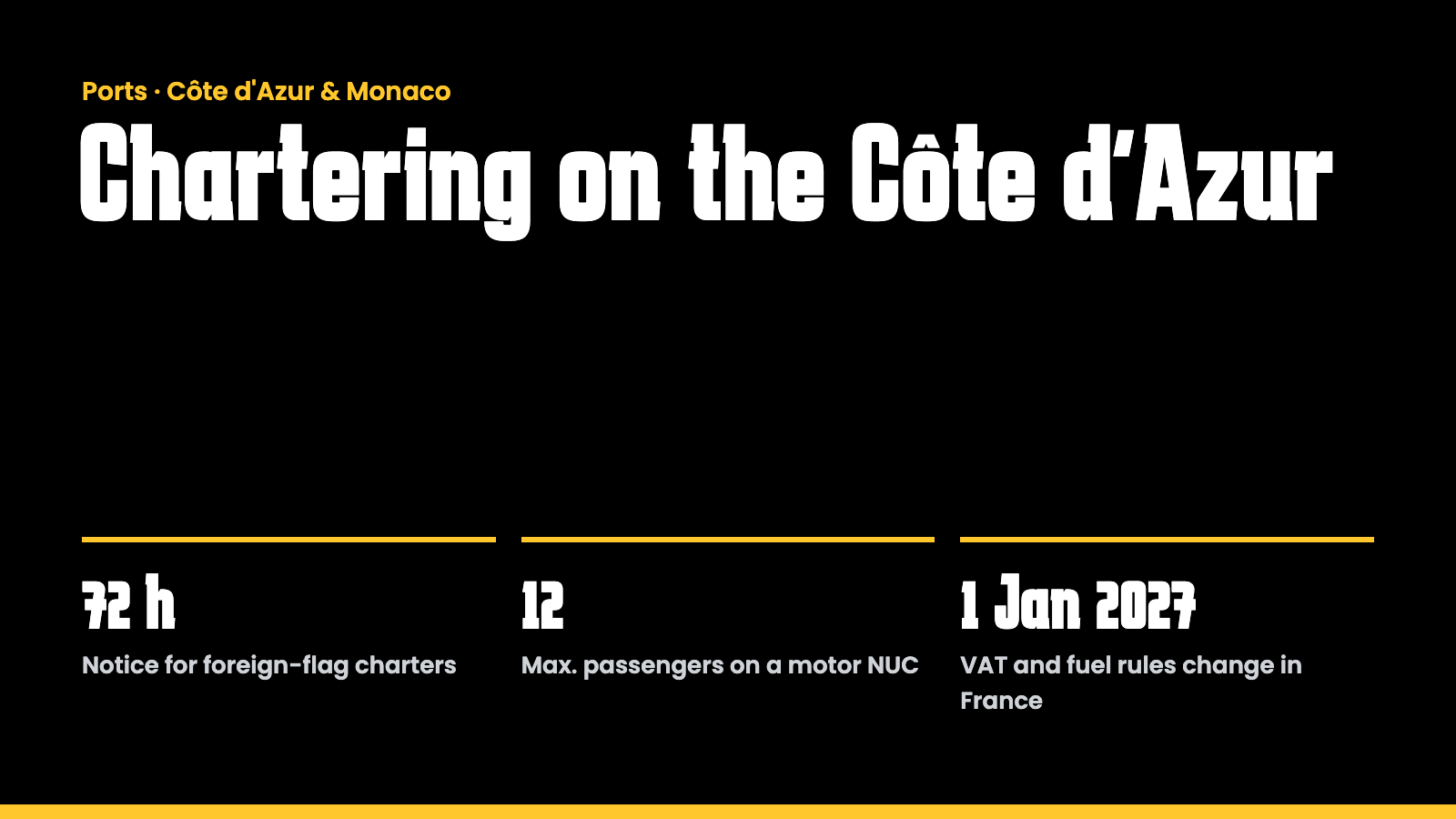
To charter a yacht on the Côte d'Azur, the yacht must be recognised as a commercially used pleasure vessel (NUC) with a navigation permit, carry no more than 12 passengers on a motor yacht, and a foreign-flagged operator must declare the activity at least 72 hours in advance. Hire handed over in France is subject to French VAT.
Monaco has its own maritime code and port rules. Below is what applies on each side of the border, with the official source for every point.
What does France require from a charter yacht?
A pleasure vessel that takes paying passengers on board must be recognised as a navire de plaisance à utilisation commerciale (NUC) and approved by a ship safety centre, which issues its navigation permit (French Ministry of the Sea).
- NUCs up to 24 metres hull length fall under Division 241. Above 24 metres (and under 3,000 GT), Division 242 applies, to private yachts and to yachts run with a professional crew for passengers alike (same page).
- Passengers are capped at 12 on motor vessels and on any vessel in international navigation, and at 30 on sailing vessels (same page).
- Carrying paying passengers without NUC status or without a command certificate is a serious offence and can be treated as undeclared work (same page).
Does a foreign-flagged charter yacht have to declare itself?
Yes. French host-state rules apply to vessels that provide a service mainly in French territorial or inland waters (Code des transports, Art. L5561-1). The operator declares the activity electronically, in French, at least 72 hours before it starts (Code des transports, Art. R5561-2). This applies to foreign flags; French-flagged vessels with a manning permit are exempt (French International Register).
Is there a passenger tax?
For trips to protected natural areas, including national parks, yes: 6.542 % of the net outbound fare, capped at €1.96 per passenger in 2026 (French customs).
How is VAT charged on a charter in France?
Hiring out a boat for pleasure trips is taxable in France if the boat is physically handed over to the client in France; signing the contract or handing over the keys is not enough (French tax doctrine, BOI-TVA-CHAMP-20-50-30).
- The share of the hire matching actual use outside EU territorial waters is exempt. The operator calculates it, subject to audit; for yachts with SOLAS-standard AIS, the AIS data are presumed valid evidence (same doctrine).
- Short-term hire of a sea-going vessel means up to 90 days of continuous use (CGI, Art. 259 A).
- For the exemptions under Art. 262 II CGI, a vessel must among other things be at least 15 metres long, registered as a commercial vessel, permanently crewed and spend at least 70 % of its navigation outside national waters. A crewed charter counts as one trip if no guests join or leave for good (French International Register).
How long can a non-EU yacht stay under temporary admission?
French customs gives no figure. Its information sheet only says that the time limits for means of transport are set in Article 217 of the delegated regulation to the Union Customs Code (French customs).
What is the TAEMUP and who pays it?
The TAEMUP (formerly DAFN) is the annual tax on vessels for personal use. Owners of French-flagged vessels that meet the criteria pay it, and so do French residents who own or use a foreign-flagged vessel that meets them (French Ministry of the Sea).
- Until 31 December 2026, every yacht of 30 metres or more with 750 kW or more is liable. From 1 January 2027, the hull charge is €900 for 15 to under 24 metres and €1,200 from 24 metres (same page).
- Yachts in the French International Register (RIF) as commercially used vessels are exempt (RIF).
- Towns can charge a tourist tax for marinas, per person and night, set by the local council (CGCT, Art. L2333-30).
Can a charter yacht buy duty-free fuel in France?
Only under strict conditions. Fuel for commercial activity at sea can be exempt from excise duty (French customs). The vessel must be registered as a commercial vessel, permanently crewed and used commercially (RIF).
- An owner who hands the yacht to a client under a charter contract does not get the exemption; the charterer is the end user (same page).
- Foreign operators apply at the regional customs directorate in Nice, and exempt fuel only comes from tax warehouses and special marine fuel depots (French customs).
What changes on 1 January 2027?
Three deadlines for the 2027 season:
- VAT: CGI Art. 259 A in its current version applies only until 1 January 2027; it is repealed by Ordinance 2025-1247 (Légifrance).
- Fuel: The current version of CIBS Art. L312-55, the reduced excise rate for maritime navigation, applies until 1 January 2027 (Légifrance).
- TAEMUP: A new scale applies from 1 January 2027 (French Ministry of the Sea).
Our sources do not say what replaces the VAT and fuel rules. Ask a tax adviser or French customs (Douane) before quoting 2027 prices.
What applies to charter in Monaco?
- In Monaco's ports, no commercial activity is allowed on berthed vessels except charter, cruises and special events, unless a temporary exemption is granted (port regulations, Art. 20.1).
- Vessels with salaried professional crew sail under a crew list (rôle d'équipage) (Code de la mer, Art. L. 412-2). Owners of Monaco-flagged yachts must declare a captain or crew to the Direction des Affaires Maritimes (Monaco Government).
- Berth fees follow a price list approved each year by the government and depend on length overall (port regulations, Art. 9.2).
How is VAT charged on a charter in Monaco?
Under the Franco-Monegasque tax convention of 1963, Monaco applies turnover taxes on the same bases and at the same rates as France (Monaco turnover tax code). Short-term hire (up to 90 days) is taxed in Monaco if the boat is handed over there (same code, Art. 12).
What are the fuel rules in Monaco?
- Diesel vessels in Monaco's waters and ports must use marine gas oil with at most 0.1 % sulphur (Code de la mer, Art. O. 225-6).
- Refuelling from jerrycans in the ports is prohibited. Vessels over 40 metres are refuelled only by approved tanker truck, with 48 hours' notice to the harbour master (port regulations, Art. 26.3 and 27.1).
- VAT-free supplies apply only to vessels listed in the turnover tax code, such as commercial vessels on the high seas (Art. 29). We found no rule on tax-free fuel for charter yachts.
What we could not confirm
- Whether charter under a non-EU flag is allowed in France: no official source found.
- An 18-month limit for temporary admission: not confirmed directly by any French source.
- A separate charter licence in Monaco: none found.
- Tourist tax rates of individual towns: not checked.
See also our Côte d'Azur rules for yachts, chartering in the Balearics and private or charter yacht crew.
Sources
All sources were checked on 4 October 2026 and are linked at each point above.
Sources and image rights
- Images
- Toys & Crew
- Checked
- 4 October 2026 by Andreas Lakeberg
Disclaimer. We research every article carefully and to the best of our knowledge. Salaries, prices, rules and port regulations change, and we cannot guarantee that all information is complete, current or correct. Please check anything important with the original source or the responsible authority before you rely on it. To the extent permitted by law, we accept no liability for errors or omissions.