Rules for yachts on the Côte d'Azur and in Monaco: what captains need to know
Anchoring limits by length, the 5-knot coastal strip, clearance, waste, drones and fuel on the Côte d'Azur and in Monaco, each linked to its source.

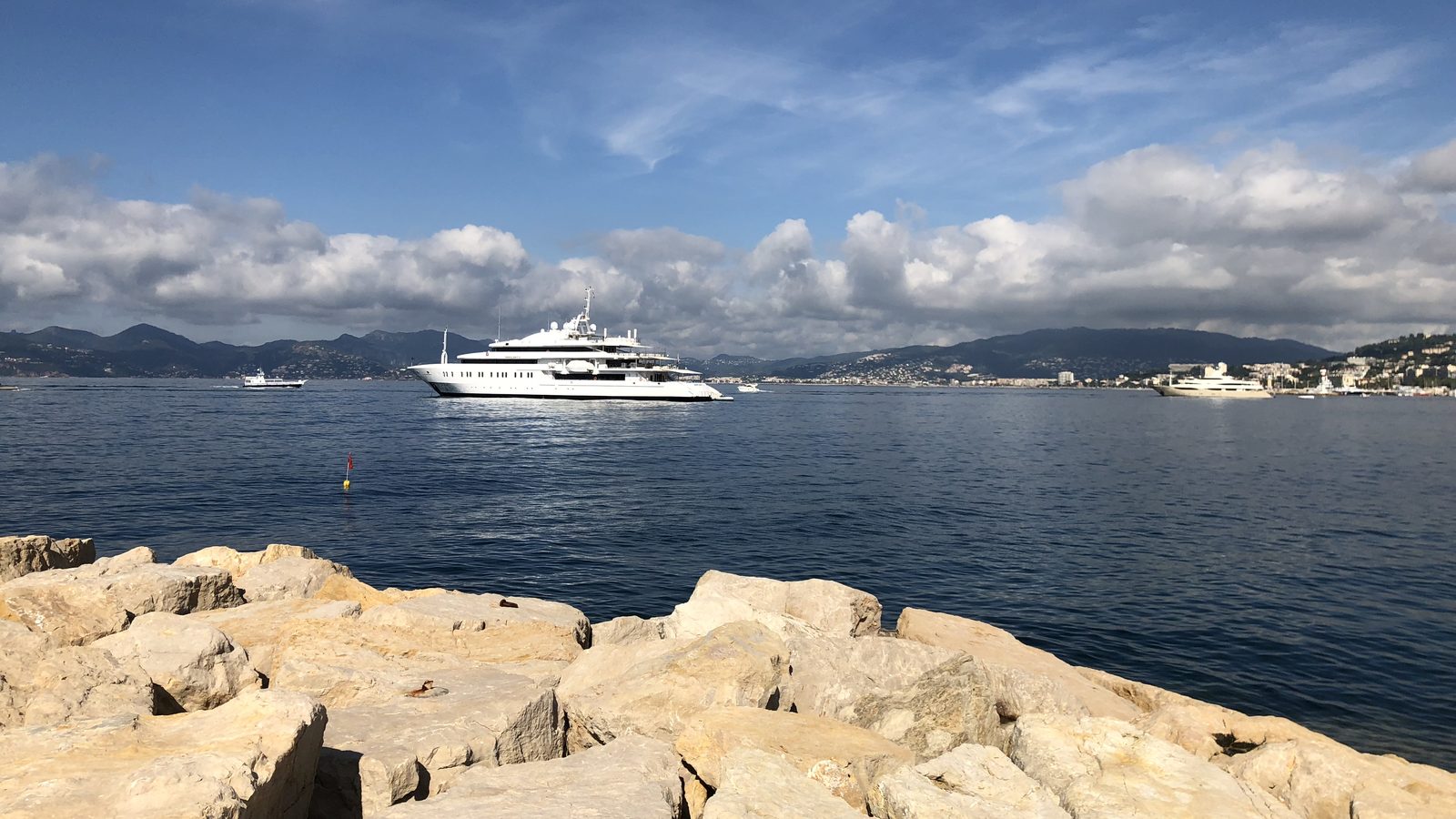
On the French Riviera, anchoring rules depend on length: local orders apply from 24 metres, east of Nice from 20 metres, and yachts of 45 metres or more must notify the semaphore, from 80 metres ask for authorisation. Within 300 metres of the coast, 5 knots is the limit in France and in Monaco.
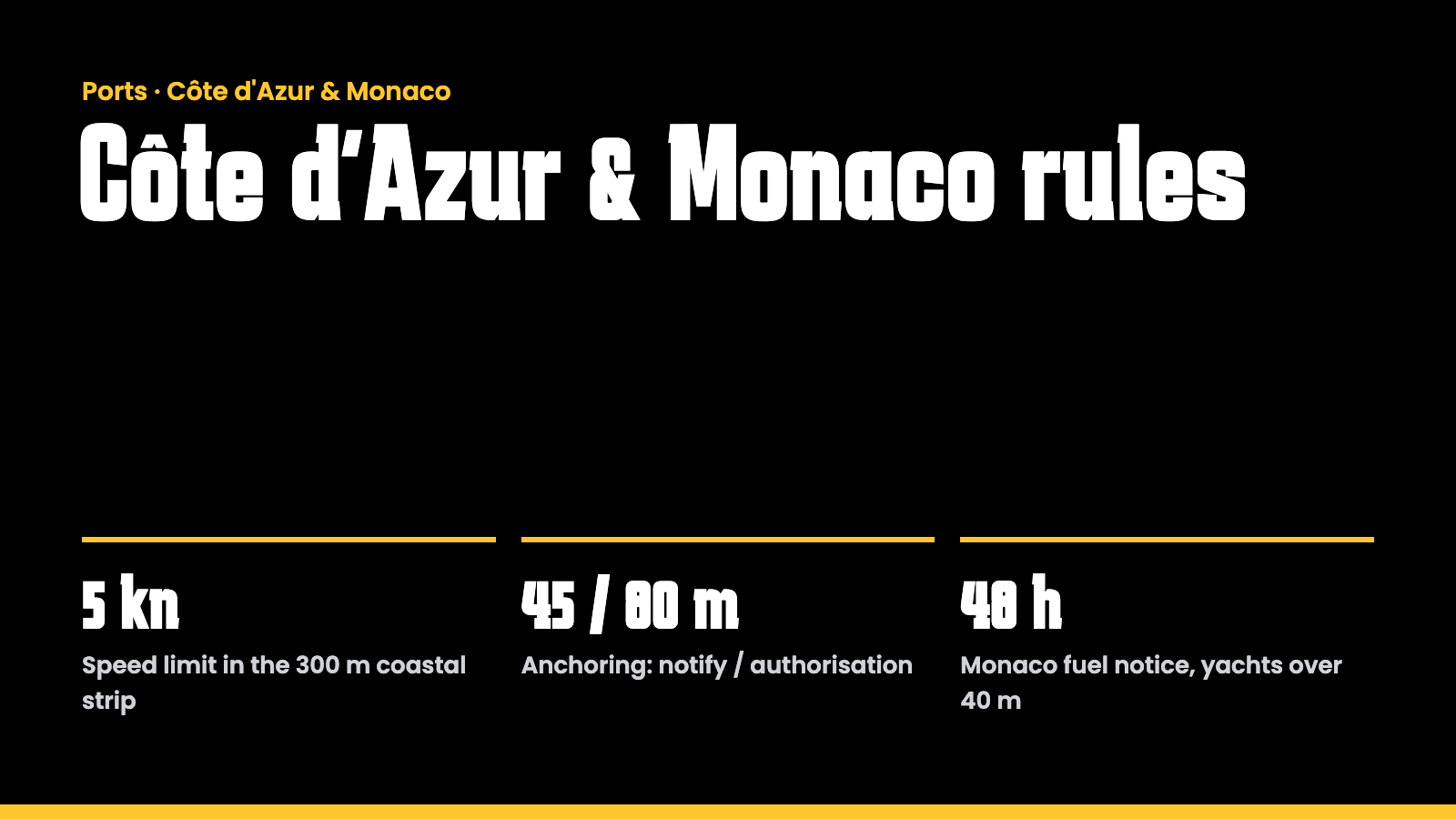
France and Monaco are treated separately; each rule links to its official source.
Where may a large yacht anchor in France?
A framework order bans anchoring wherever it may harm protected seagrass such as Posidonia, and in harbour approaches and beach channels (Préfecture maritime, AP 123/2019, Art. 6.2 and 4.2). At anchor, you must be reachable by VHF or phone from the semaphore or CROSS (Art. 3.5). Sector orders add rules by length:
| Length | Area | What applies |
|---|---|---|
| 20 m+ | Var river mouth to the Monaco/Italy border (Villefranche, Cap Ferrat, Menton) | Anchoring restricted (AP 204/2020) |
| 24 m+ | Pointe de l'Aiguille to the Var (Cannes, Lérins, Golfe-Juan, Antibes) | Anchor only seaward of a set line (AP 205/2020) |
| 24 m+ | Gulf of Saint-Tropez | Seaward of a set line, except three named sectors (AP 248/2020) |
| 24 m+ | Saint-Raphaël to Pointe de l'Aiguille (Esterel) | Own anchoring regime (AP 249/2020) |
| 24 m+ | Cap Bénat to Pointe de Bonne Terrasse | Port-Cros core-zone limit lowered from 30 m to 24 m (AP 247/2020) |
| 45 m to under 80 m | Whole coast | Declare to the semaphore at least one hour before arrival (AP 157/2024, Art. 4) |
| 80 m+ | Whole coast | Authorisation, requested via the semaphore at least one hour before arrival (AP 157/2024, Art. 3) |
Where mandatory anchoring zones (ZOM) exist, the vessels concerned may only anchor inside them; thresholds per sector are in Annex V (AP 157/2024, Art. 5.1). In the Baie de Pampelonne, the ZOM are reserved for them alone (Art. 5.2).
For yachts of 24 metres and above, dynamic positioning is banned within 500 metres of the shore and limited to two hours elsewhere in French waters (AP 248/2020, Art. 3.1; same wording in AP 204, 205 and 249/2020).
How long may you stay at anchor?
Vessels that need no authorisation may stay 72 hours at the same spot; yachts of 24 metres or more, or with AIS, can extend in 72-hour slots unless the authority decides otherwise (Préfecture maritime, AP 077/2025, Art. 4). Authorised anchorages, for example from 80 metres, run 24 hours at first and 72 hours at most (Art. 3.3).
Which local anchoring bans should you know?
- Cannes and Lérins: no anchoring in the no-anchoring zones off Cannes and south of Saint-Honorat (AP 251/2026). From 1 October 2026 to 31 May 2027, a works zone at the Ponton Carlton is closed daily 07:00–18:00 (AP 377/2026).
- Villefranche: permanent no-anchoring zones in the roadstead (AP 252/2022).
- Antibes, Anse du Croûton: anchoring permanently banned; the mooring buoys stay available (AP 316/2026).
- Porquerolles: no anchoring over 30 metres in the marine core area (AP 116/2023).
- Port-Cros: the 600-metre strip is a clean anchoring zone for vessels under 24 metres with a holding tank (AP 117/2023).
Destroying Posidonia oceanica is banned at all times throughout France (Arrêté of 19 July 1988). We found no separate anchoring rules for Natura 2000 areas.
How fast may you go near the coast?
In France, 5 knots within 300 metres of the shore, islets, rocks and outer harbour works, permanently and regardless of buoyage (Préfecture maritime, AP 109/2024, Art. 2.1). The same order sets 5 knots within 100 metres of a diver flag and closes zones without motor craft (ZIEM) to motor vessels, motorised tenders included. Later amendments and municipal bathing-zone orders were not checked.
Stricter: 5 knots also beyond 300 metres in the inner Villefranche roadstead (AP 252/2022) and 10 knots in a mandatory anchoring zone while a vessel subject to it is there (AP 157/2024, Art. 5.4).
Which rules apply in Monaco's waters?
Monaco also sets 5 knots within 300 metres of the shore and harbour entrances, without buoyage, and 3 knots in ports and fairways (Code de la mer, Art. O. 700-1). Anchoring is banned in three charted zones (Art. O. 700-3) and in all harbour basins and approaches except in an emergency or with an exemption (Monaco port regulations, Art. 34.5). Larvotto and the Tombant des Spélugues are marine protected areas (Art. O. 230-3). We found no official source on buoy fields or Posidonia when anchoring in Monaco.
How do you clear in and out?
France. Everyone on board, crew included, arriving directly from or leaving for a port outside Schengen is subject to border checks and uses a border crossing point during its opening hours (French customs). Alternatively, one of 53 listed marinas can be used: the skipper asks the harbour office for permission and sends a form listing everyone on board at least 24 hours before arrival, or on departure if the crossing is shorter. On this coast the list includes Saint-Tropez, Saint-Raphaël, Antibes Port Vauban, Cannes Port Pierre Canto and Cap d'Ail (customs list, May 2026).
The EU Schengen handbook names Cannes-Vieux Port, Nice and "Monaco-Port de la Condamine" as sea border crossing points in the French list (Annex 4). That is a list for border checks on people, not a customs list; we found no official customs list of entry ports. Vessels from outside Schengen, except Monaco, that intend to stop or anchor must report to the maritime authority on entering French waters (AP 123/2019, Art. 5.2).
Monaco. The Sûreté publique controls passengers and crew of all vessels except warships (Code de la mer, Art. L. 140-1). Call the Capitainerie before entering, VHF 12 for Port Hercule, VHF 9 for Fontvieille. Every visiting vessel files an arrival declaration online when booking and in original on arrival, and reports a change of departure date at least 48 hours ahead (port regulations, Art. 5). How Schengen and the customs union with France apply to yachts in Monaco is not set out in any official source we found.
What about waste and sewage?
- France: boats with a toilet built after 1 January 2008 need a holding tank or treatment system to enter ports and mooring areas (Code du tourisme, Art. L341-13-1). We found no specific rule on grey water.
- Monaco: discharging sewage contrary to MARPOL Annex IV is banned (Code de la mer, Art. O. 225-4). In port, sea-outlet toilets may not be used, vessels connect to the black and grey water network where possible, and waste goes ashore before departure, otherwise departure can be refused (port regulations, Art. 45–46).
Drones, fireworks and tenders
- Drones, France: no night flights, no flights over public space in towns, 120 metres maximum; operators of drones over 250 grams or with a camera must register (French government). Coastal no-fly zones exist only as a map.
- Drones, Monaco: only professional flights, each authorised by the civil aviation authority at least eight working days ahead; no night flights in principle (Arrêté ministériel 2021-532).
- Fireworks, France: 300-metre exclusion radius from 30 minutes before to 30 minutes after; the organiser notifies the maritime authorities 15 days ahead (AP 081/2009). For Monaco we found no rule on fireworks from yachts.
- Tenders: in France, non-motorised tenders may not use shore access channels (AP 109/2024, Art. 9.5.1.1). In Monaco, tenders may not be stored on pontoons or moored between vessels without approval (port regulations, Art. 25).
How do you refuel in Monaco?
Yachts over 40 metres are fuelled only by an approved tanker truck, with 48 hours' notice to the Capitainerie and written authorisation (Monaco port regulations, Art. 27.1). Jerrycans are strictly prohibited in the ports (Art. 26.3).
What are the penalties?
In France, ignoring navigation and anchoring orders of the Préfecture maritime can cost up to one year in prison and €150,000 (Code des transports, Art. L5242-2). Harming protected species or habitats carries up to three years and €150,000, the fine doubled in a national park core (Code de l'environnement, Art. L415-3). In Monaco's marine protected areas, offences carry three months to one year in prison plus a fine, and boats can be seized (Code de la mer, Art. L. 230-3).
Charter, VAT and water toys
These have their own articles: Chartering on the Côte d'Azur and Jet skis and water toys on the Côte d'Azur. In brief, foreign-flagged yachts working mainly in French waters declare their activity at least 72 hours ahead (Code des transports, Art. R5561-2), and Monaco levies turnover taxes on the same basis and at the same rates as France (Code des taxes sur le chiffre d'affaires). For comparison: rules for yachts in the Balearics.
Sources
All sources were checked on 4 October 2026. Each rule above links to the exact legal text or official page. Replaced orders, such as AP 167/2024 (Cannes), AP 254/2025 (Antibes), AP 258/2024 (anchoring time) and AP 19/2018 (navigation), are not cited as current.
Sources and image rights
- Images
- Toys & Crew
- Checked
- 4 October 2026 by Andreas Lakeberg
Disclaimer. We research every article carefully and to the best of our knowledge. Salaries, prices, rules and port regulations change, and we cannot guarantee that all information is complete, current or correct. Please check anything important with the original source or the responsible authority before you rely on it. To the extent permitted by law, we accept no liability for errors or omissions.