Drugs and alcohol on superyachts: legal limits, policies and testing
The legal alcohol limits for yacht crew under STCW and UK law, what a yacht's drug and alcohol policy must cover, and what the rules say about testing.


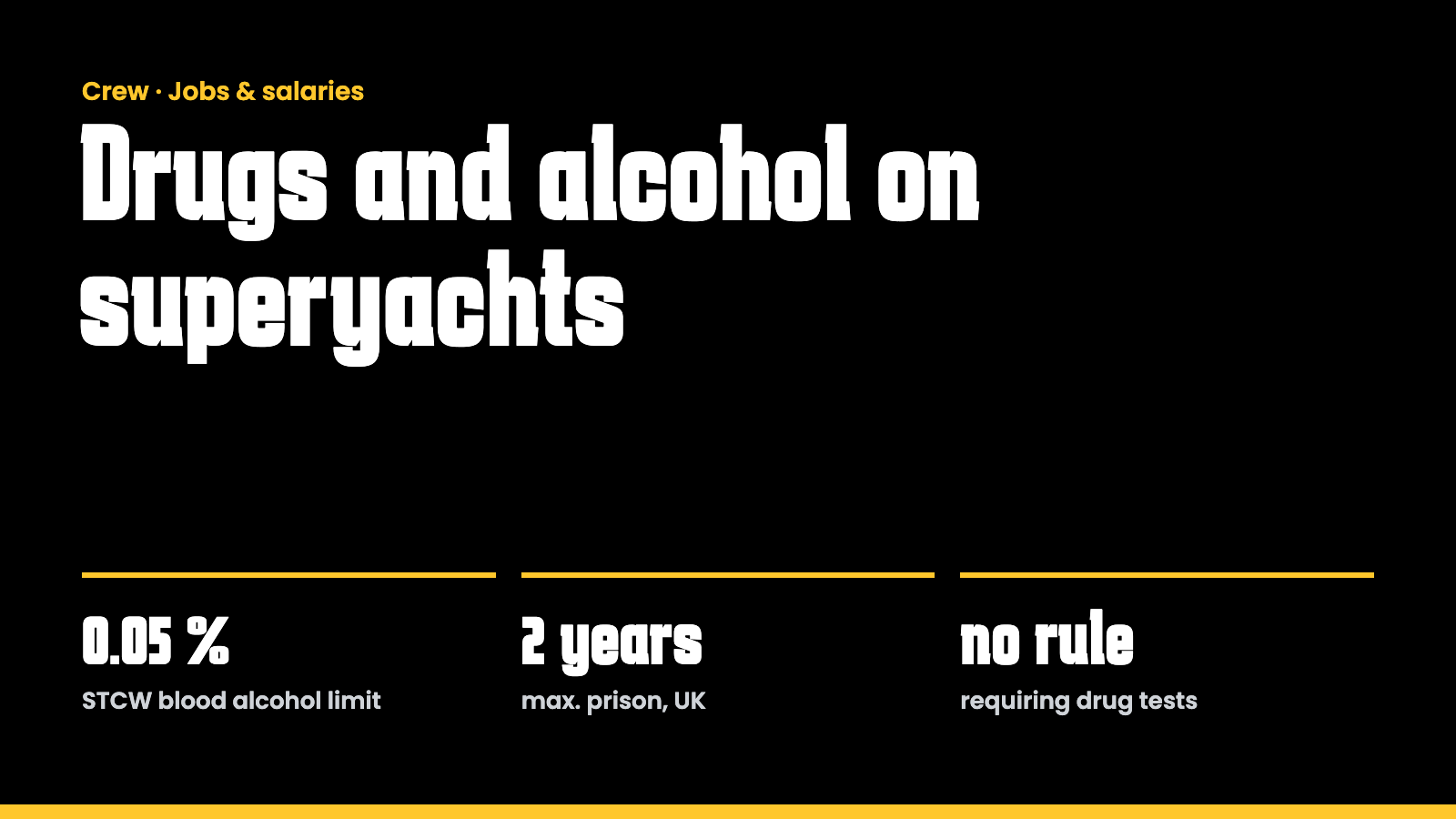
Under the STCW Convention, crew with safety duties must not exceed 0.05 % blood alcohol or 0.25 mg/l in breath, and UK law makes it a criminal offence for paid crew to be over these limits on duty. Yachts must have a written drug and alcohol policy. Drug testing on yachts, by contrast, is not required by any official rule we found; it depends on the yacht's own policy.
We use the STCW Convention, UK law and the REG Yacht Code as reference, and add the US rules where they reach foreign yachts.
What are the legal alcohol limits?
The STCW Convention, as amended in Manila in 2010, sets binding limits of 0.05 % blood alcohol and 0.25 mg/l in breath (MCA, MGN 590). The UK adopted these values on 20 October 2015 (S.I. 2015/1730):
| Measured in | UK limit |
|---|---|
| Breath | 25 micrograms per 100 ml |
| Blood | 50 mg per 100 ml |
| Urine | 67 mg per 100 ml |
Source: Railways and Transport Safety Act 2003, s. 81.
Who does UK law apply to?
- It is an offence for a professional master, pilot or seaman to be impaired by alcohol or drugs on duty, or to be over the limit, whether or not impaired (s. 78). "Professional" means working in the course of a business or employment, so paid yacht crew are covered.
- Off duty, it is also an offence if you would have to act in an emergency to protect passengers and are impaired or over the limit (s. 79).
- "Drug" means any intoxicant other than alcohol (s. 89).
- The rules apply on all UK ships and on foreign and unregistered ships in UK waters (s. 91).
- Penalty on indictment: up to two years in prison, a fine, or both (s. 82). Police can require breath, impairment and preliminary drug tests (s. 83), and harbour masters can detain a vessel until the police arrive (s. 84).
Must a yacht have a drug and alcohol policy?
Yes:
- The REG Yacht Code requires yachts under 500 GT to have a policy on preventing drug and alcohol abuse. From 500 GT, yachts follow the ISM Code, and the policy becomes part of the safety management system (REG Yacht Code, Part A, chapter 23).
- The MCA expects the master of a large UK yacht to run a strict drug and alcohol policy on board, referred to in the employment agreement (MCA, Master's Guide to the UK Flag).
- The Manila amendments recommend that companies ban alcohol for 4 hours before a watch; this is a recommendation, not a binding rule (MGN 590).
- The Cayman flag requires measures against drug and alcohol abuse on STCW ships; no seafarer over 0.05 % or 0.25 mg/l may carry out safety, security or environmental duties (CISR Shipping Notice 05/2011).
Is drug testing required on yachts?
We found no official rule that requires drug testing on yachts, in the UK, under the REG Yacht Code or internationally. According to the ILO, there are no internationally agreed conventions or procedures on drug and alcohol testing at sea; some countries require tests, others restrict or prohibit them (ILO handbook).
Where a company tests, the ILO recommends that its policy states who is tested, when, for what and how often, and what a positive result means, based on the 1993 ILO/WHO guiding principles on drug and alcohol testing in the maritime industry.
What about US waters?
- Under US rules for vessels in US waters, anyone operating a vessel that is not a recreational vessel counts as under the influence from 0.04 % blood alcohol; for recreational vessels the threshold is 0.08 %. These rules also apply to foreign vessels in US waters (33 CFR Part 95).
- The US drug testing rules for "marine employers" (46 CFR Part 16), with pre-employment, random and reasonable-cause tests, explicitly exclude recreational vessels (46 CFR Part 16).
Sources
UK Railways and Transport Safety Act 2003 (ss. 78–91), S.I. 2015/1730, UK MCA (MGN 590 Amendment 2, Master's Guide to the UK Flag), REG Yacht Code Part A (July 2024), Cayman Islands Shipping Registry, ILO handbook on drug and alcohol problems at sea, and the US Code of Federal Regulations (33 CFR 95, 46 CFR 16). All checked on 4 October 2026 and linked above.
Sources and image rights
- Images
- Airam Dato-on / Pexels (conditions)
- Checked
- 4 October 2026 by Andreas Lakeberg
Disclaimer. We research every article carefully and to the best of our knowledge. Salaries, prices, rules and port regulations change, and we cannot guarantee that all information is complete, current or correct. Please check anything important with the original source or the responsible authority before you rely on it. To the extent permitted by law, we accept no liability for errors or omissions.