EPIRB on a yacht: types, registration and service intervals
How an EPIRB works, which flag states require registration, the annual test, five-yearly shore-based maintenance and typical battery and release unit intervals.

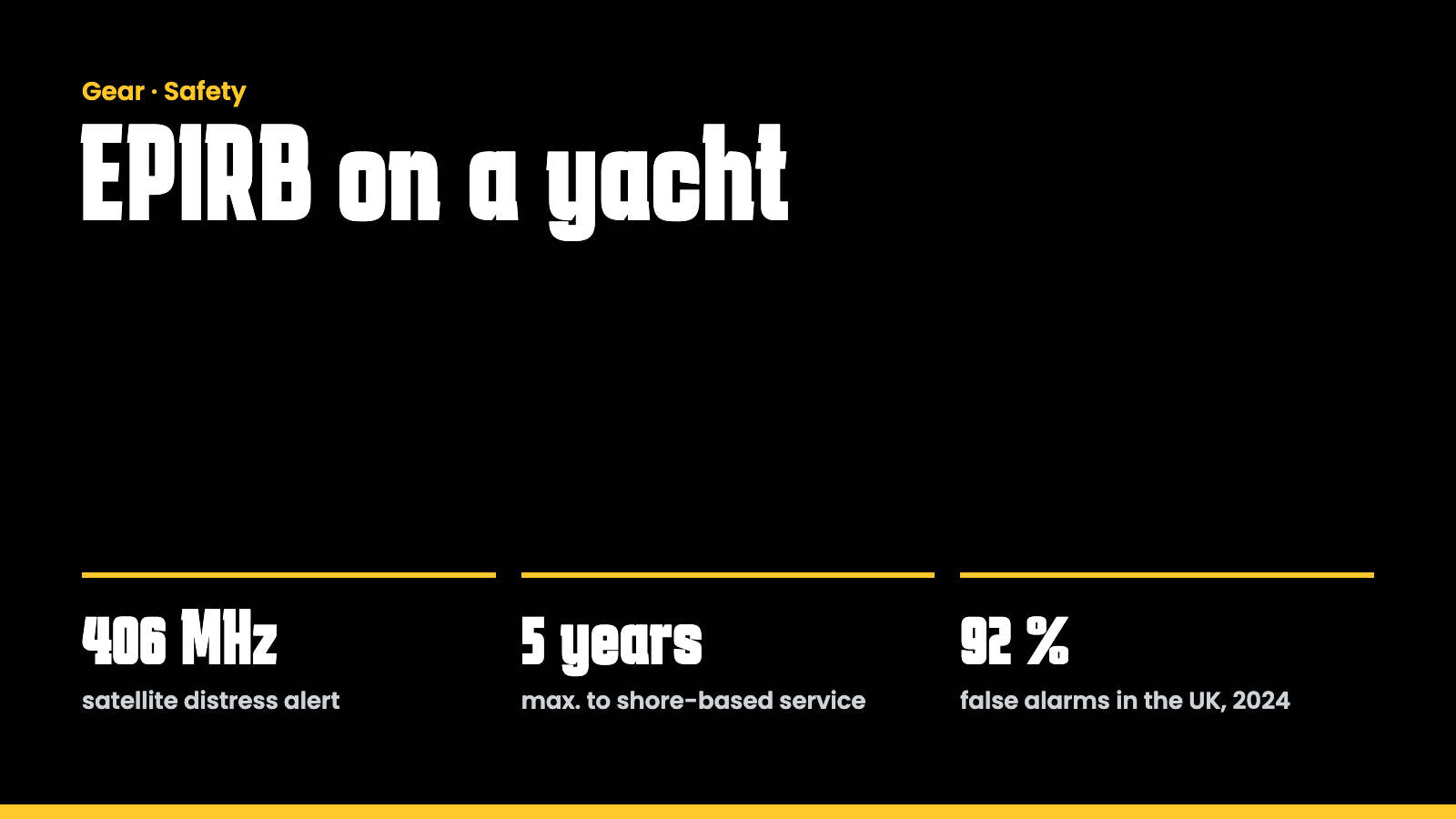
An EPIRB is the emergency beacon that sends a distress alert with your position to rescue services via satellite on 406 MHz. It must be registered with the authority of the country whose code is programmed into it, tested once a year on SOLAS ships and serviced ashore at least every five years. Manufacturers add a battery change every 10 years and a new hydrostatic release unit about every 2 years.
Rules depend on the flag state. Below we separate official requirements from manufacturer recommendations, with the source for each.
How does an EPIRB work?
- An EPIRB can be triggered automatically or manually (NOAA FAQ). An automatic EPIRB is usually released from its bracket by a hydrostatic release unit when the vessel sinks to about 3 metres.
- It must float upright to transmit, and its battery lasts at least 48 hours (MCA, MGN 665). A personal locator beacon (PLB) is only activated by hand and typically lasts 24 hours.
- Beacons with a GPS receiver include their position in the 406 MHz message. Satellites no longer pick up 121.5 MHz signals; that frequency is only used for homing at close range (NOAA FAQ).
- Beacons with Return Link Service (RLS) show, for example with a light, that the alert has been received and passed to the authorities. It does not mean that a rescue is already under way (NOAA FAQ).
- EPIRBs installed on SOLAS ships from 1 July 2022 must meet the newer IMO performance standard MSC.471(101), with a GNSS receiver and an AIS transmitter (Lloyd's Register).
The terms Category I (released and activated automatically when sinking) and Category II (taken out of the bracket by hand, activates on contact with water or by button) come from manufacturers, not from regulation (Ocean Signal).
Do you have to register an EPIRB?
Yes, with the country whose code is programmed into the beacon (McMurdo manual). The duty goes back to SOLAS chapter IV, regulation 5-1 (MGN 665).
| Flag | What applies | Source |
|---|---|---|
| United Kingdom | Registration with the UK Beacon Registry is required for 406 MHz EPIRBs on UK ships; free, online, about 15 minutes. Only country codes 232–235 are accepted. Failing to register is an offence and the ship can be detained. | MGN 665, GOV.UK |
| United States | Register with NOAA before installation; free, renew every two years, report changes of owner or vessel. | 47 CFR 80.1061, NOAA |
| Marshall Islands | Register with the Maritime Administrator; country code 538. For private yachts, a 406 MHz EPIRB and/or SART is mandatory and must be tested and serviced annually by an approved provider. | Marine Notice 4-033-5, Marine Notice 2-011-58 |
| Cayman Islands | No own database: register with the UK MCA or US NOAA and program the beacon with that country's protocol, never with the Cayman MMSI. | OfReg guide |
| Malta | Register with the Merchant Shipping Directorate of Transport Malta and program the vessel's MMSI. | Malta Communications Authority FAQ (2012) |
The UK figures show why registration matters: 92 % of the 406 MHz distress alerts received in the UK in 2024 were false alarms (MGN 665, section 3.2). A registered beacon lets the coastguard call the owner or emergency contact before launching a search.
How often must an EPIRB be tested and serviced?
Official requirements:
- On ships under SOLAS, the EPIRB is tested every year, within three months of the anniversary of the radio safety certificate, on board or at an approved station (MCA, MSN 1810). The IMO checklist for this test has 17 points, including the battery and release unit expiry dates and proof of registration (IMO MSC.1/Circ.1040/Rev.2).
- In addition, shore-based maintenance at an approved service station is due at least every five years (MSN 1810). The IMO recommends changing the battery at the same time (IMO MSC.1/Circ.1039/Rev.1).
- Even where no EPIRB is required, the MCA recommends fitting one and having it serviced every five years (MSN 1810).
Manufacturer recommendations (not law, but what the service station will check):
| McMurdo / Kannad | ACR | Ocean Signal | |
|---|---|---|---|
| Hydrostatic release unit | every 2 years | 2 years from installation, 3 from manufacture | – |
| Battery | every 10 years or after use | 10 years or after use | 10 years |
| Self-test | monthly, max. 12 times a year | monthly and before longer passages | – |
| Sources | McMurdo manual, Kannad manual | ACR | Ocean Signal |
Only use the self-test function or an authorised service agent to test a 406 MHz beacon (NOAA FAQ). And check the lanyard: it must not be tied to the ship or the bracket (IMO MSC.1/Circ.1040/Rev.2).
What does an EPIRB cost?
As one example, Ocean Signal lists its EPIRB3 Pro with a Category I float-free bracket at €1,079.99 in its EU shop, with GPS, AIS, 121.5 MHz homing and Return Link Service (Ocean Signal).
Sources
UK Maritime and Coastguard Agency (MGN 665, MSN 1810), IMO circulars MSC.1/Circ.1039/Rev.1 and 1040/Rev.2, US NOAA and 47 CFR 80.1061, Marshall Islands Maritime Administrator, Cayman OfReg, Malta Communications Authority, Lloyd's Register, and the manuals of McMurdo, Kannad, ACR and Ocean Signal. All checked on 4 October 2026 and linked above.
Sources and image rights
- Images
- Peter Xie / Pexels (conditions)
- Checked
- 4 October 2026 by Andreas Lakeberg
Disclaimer. We research every article carefully and to the best of our knowledge. Salaries, prices, rules and port regulations change, and we cannot guarantee that all information is complete, current or correct. Please check anything important with the original source or the responsible authority before you rely on it. To the extent permitted by law, we accept no liability for errors or omissions.