Chartering in Croatia: which flags may charter, cabotage, VAT and tax-free fuel
Charter in Croatia: EEA flags and the cabotage permit for others, crew lists, 13 % VAT on accommodation on board, tax-free diesel and temporary admission.

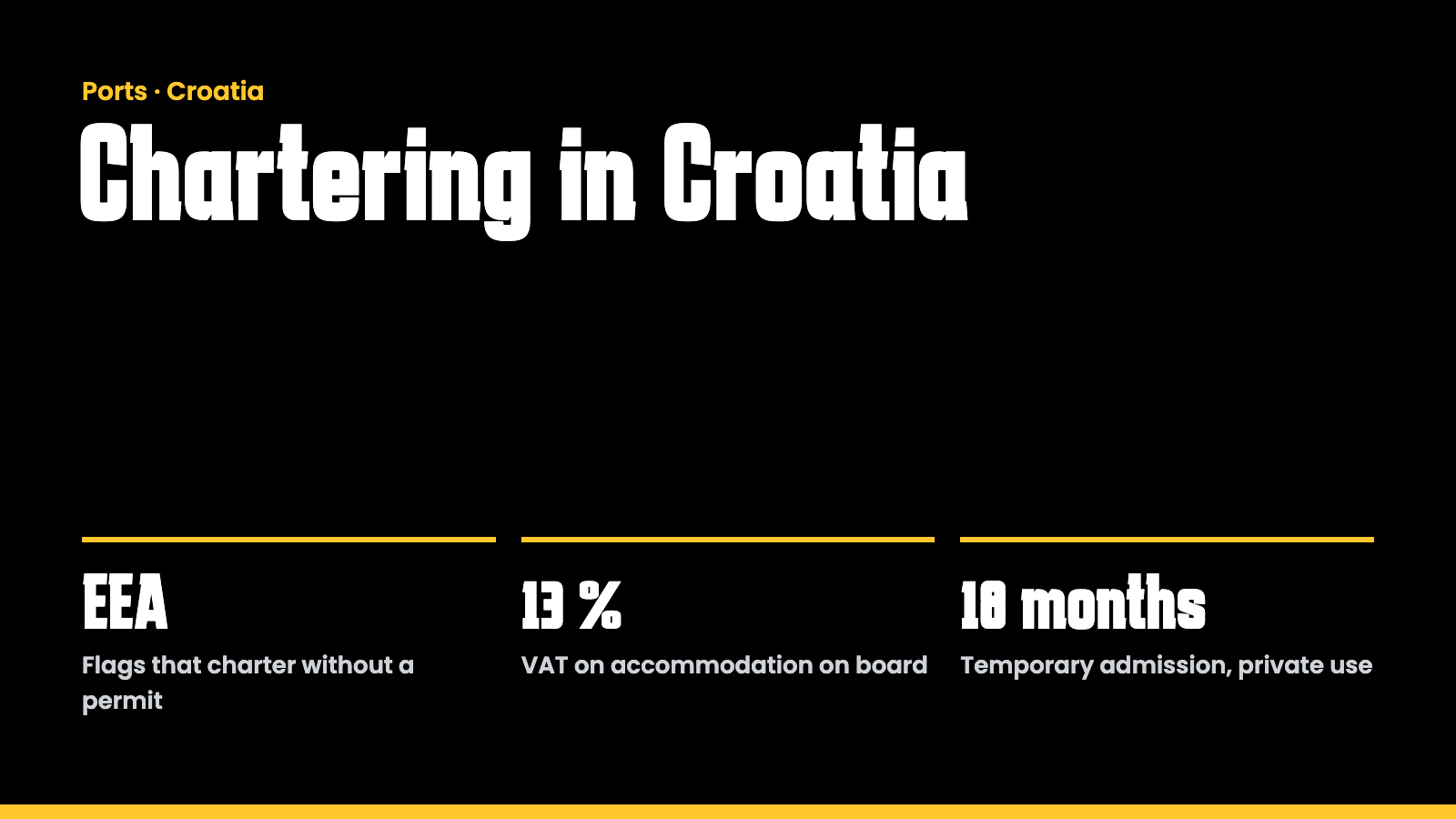
Yachts under the Croatian flag or the flag of an EEA country may charter in Croatia. A yacht under any other flag needs a cabotage permit from the minister, issued per calendar year. Before every departure, the charter company reports the crew and passenger list online. Accommodation on board is taxed at 13 % VAT.
Croatia's charter rules sit mainly in the Maritime Code (Pomorski zakonik) and the charter regulation of 2017, Pravilnik NN 42/2017. This is not tax advice: check VAT and customs questions with a tax adviser or a local agent.
When does Croatia treat a yacht as chartering?
Carrying people by yacht or boat in Croatian waters for payment counts as maritime cabotage. Cabotage follows the EU regulation on maritime cabotage; in exceptional cases, the minister may allow a vessel of a third country to carry it out (Maritime Code, Art. 9, as amended by NN 56/2013). Charter with or without crew is allowed only under the conditions of a separate ministerial regulation (Art. 9.a).
Which flags may charter in Croatia?
Charter may be carried out by a vessel under the Croatian flag, under the flag of an EEA member state, or under the flag of a third country that has a cabotage permit (Pravilnik NN 42/2017, Art. 3).
- Registration: the yacht must be registered for commercial use in its flag state. A yacht under a third-country flag also needs authorisation for temporary admission with partial relief from import duties, in Croatia or in another EU country (Art. 4).
- Cabotage permit: the minister issues it for one calendar year. The number of permits may be limited, and issuing them may be suspended for three months if the charter market is seriously disturbed (Art. 20).
- Without a permit: a third-country yacht may only sail with a professional crew and without stopping, to a port open to international traffic, a marina or a shipyard (Art. 27).
- Survey above 24 metres: the technical fitness of a foreign charter yacht is established by a survey. Above 24 metres hull length, the flag administration, a recognised organisation or the Croatian Register of Shipping can carry it out (Art. 6(2)).
- Agent: for a foreign-flagged yacht, a person entered in the Croatian register of maritime agents may take on the duties of the charter company (Art. 32).
What must be reported and carried on board?
- Crew and passenger list: the charter company reports it electronically to the ministry's central database for every trip, at the latest by departure. This applies even when the owner or close family uses the yacht (Art. 22).
- Documents on a foreign-flagged charter yacht: proof that the navigation safety fee is paid, the decision assigning a Croatian VAT number and, for a third-country flag, the cabotage permit (Art. 26(3)).
- Charter companies outside the EU need a Croatian personal identification number (OIB) and VAT ID, and must name a tax representative in Croatia (Art. 14).
Arriving with guests already on board: if the yacht was handed over to the client in another EU country, the skipper must go through border control, have the crew and passenger list certified by the harbour master, show the charter contract and pay the prescribed fees (Art. 29). If it was handed over outside the EU, the same applies on arrival (Art. 28), and before leaving Croatia the skipper must also present a document showing the calculation of the Croatian VAT due (Art. 31).
A commercial yacht under an EU flag that is not chartered to clients in Croatian waters, or under a third-country flag when guests do not embark and disembark between Croatian ports, follows the general rules for foreign pleasure yachts (Decree NN 97/2013, Art. 2). Those are in our guide to Croatian rules for yachts.
Who can work on board?
A charter yacht must carry the minimum crew set by its flag state. A crew member holding a certificate from another country must also have proof that the flag state recognises it (Pravilnik NN 42/2017, Art. 8–9). Foreign crew must meet the Croatian rules on residence and work of foreigners (Art. 10). On Croatian-flagged yachts with a professional crew, the crew list must show each crew member's seaman's book number (Art. 23). For crew contracts in general, see private or charter yacht crew.
How is VAT charged on a charter in Croatia?
- 13 % on accommodation: accommodation on vessels of nautical tourism is taxed at the reduced rate of 13 % (VAT Act, Art. 38(3)(a), as amended by NN 115/2016).
- Place of supply: short-term hire of a means of transport, for a vessel up to 90 days, is taxed where the vessel is actually put at the client's disposal (VAT Act, Art. 23).
- Days in Croatia: for a yacht hired to private clients and actually used outside the EU, the place of supply is outside the EU. The taxable amount is the share of the charter price for the days actually spent in Croatia, including the days of arrival and departure (VAT regulation, Art. 35 and 41(10), as amended by NN 41/2017).
Our sources do not show the VAT rate for charter without accommodation on board. The tax authority's guidance could not be checked, and later amendments to the VAT Act, including NN 32/2026, were not fully reviewed.
Do charter guests pay tourist tax?
Yes. Guests who stay overnight on a charter vessel pay tourist tax per night; the regulation states 10 kuna (Pravilnik NN 73/2020, Art. 3). The same rule applies to owners of foreign yachts from outside the EEA and Switzerland (Tourist Tax Act, Art. 10(3)). Croatia has used the euro since 2023, but the regulation still gives the amount in kuna, and we found no official euro amount.
Is fuel tax-free for charter yachts?
Only in a narrow case. Tax-free fuel is available, among others, to yachts with a permanently embarked professional crew holding valid seaman's books that directly and exclusively accommodate guests for payment (Pravilnik NN 1/2019, Art. 2(3)). It does not apply to sport and pleasure craft, including those chartered to third parties with or without crew (Art. 2(4)).
The tax-free diesel is dyed blue and marked, and is bought with a fuel card issued by the ministry (Art. 3). The application lists the crew with their seaman's books, their employment contracts and a declaration that the yacht is used exclusively commercially, "which excludes any private use" (Art. 9). Whether foreign-flagged yachts qualify, our sources do not say.
How long may a non-EU yacht stay?
A yacht without EU customs status can enter temporary admission if it is registered outside the EU in the name of a person established outside the EU and used by such a person (Croatian Customs). Ownership, an EU register or the flag do not prove EU customs status; customs names a T2L or the original invoice as evidence (same source).
For private use, temporary admission ends after 18 months, by re-export or another customs procedure (Customs instruction 9/17). If the user leaves the EU while the yacht stays in Croatia, customs must be told in writing the day before at the latest, and the yacht may stay only with a person registered to look after it (same source).
What we could not confirm
- The VAT rate for charter without accommodation, and the tax authority's guidance on charter VAT.
- Tax-free fuel for foreign-flagged yachts; the Excise Act itself was not read.
- Tourist tax and fees in euro: the texts we found give kuna.
- Whether later amendments to the Maritime Code (2015, 2019) changed Articles 9 and 9.a.
See also our superyacht marinas in Croatia, chartering in Italy and chartering on the Côte d'Azur.
Sources
All sources were checked on 7 October 2026 and are linked at each point above. Main texts:
Sources and image rights
- Images
- AI-generated (Magnific)
- Checked
- 21 October 2026 by Andreas Lakeberg
Know something we missed – a rule, a fee, a marina detail? Write to editor@toysandcrew.com. We check every tip against the source and note updates at the top of the story.
Disclaimer. We research every article carefully and to the best of our knowledge. Salaries, prices, rules and port regulations change, and we cannot guarantee that all information is complete, current or correct. Please check anything important with the original source or the responsible authority before you rely on it. To the extent permitted by law, we accept no liability for errors or omissions.