Chartering in the Caribbean: BVI licences since June 2025, Bahamas VAT and the rules island by island
Charter rules in the BVI, Bahamas, Antigua, St Barths and St Martin: licences, cruising permits, charter fees, VAT and the BVI reform of 1 June 2025.

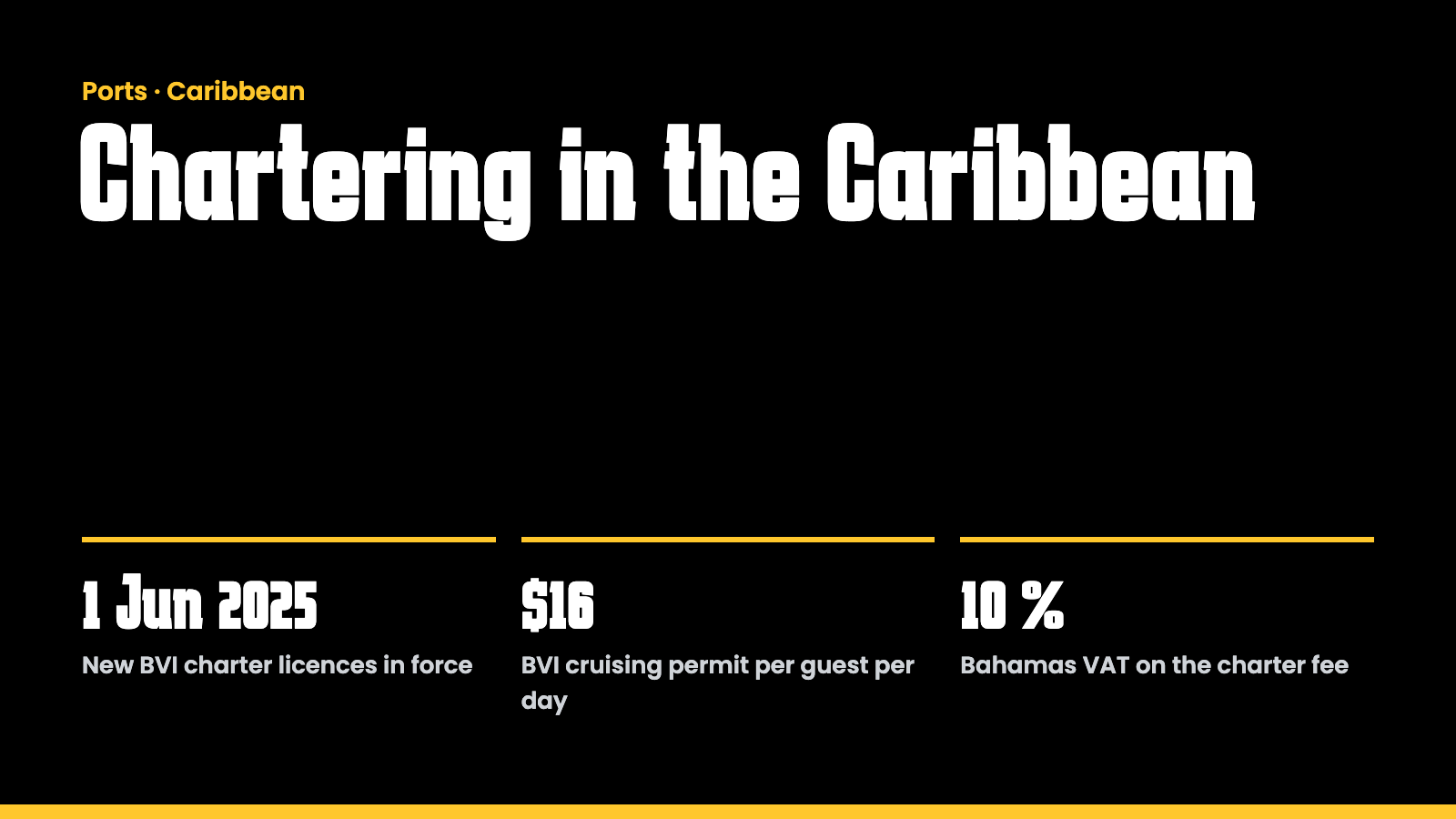
A foreign-based charter yacht in the British Virgin Islands needs a licence under rules in force since 1 June 2025: for 115 to 150 feet, $7,500 a year or $2,000 per cruise, plus a cruising permit of $16 per person per day. The Bahamas require a foreign charter licence, a 4 % charter fee and 10 % VAT.
Each island has its own system, and the rules below come from the laws and authorities of each destination. This is not tax advice: check VAT, customs and licensing with a local agent before you quote a charter. Amounts are given as the source gives them; where it writes only "$", so do we.
What changed in the BVI on 1 June 2025?
Two amending acts and a fee order took effect on the same day: Act No. 13 of 2025 on commercial recreational vessels, Act No. 14 of 2025 on cruising permits, and S.I. 2024 No. 83 with the new permit fees.
- Licence for foreign-based yachts: a foreign-based commercial recreational vessel must be licensed under the framework in Schedule 2 of the act, subject to pre-authorisation by the Customs Department in Framework A, and each crew member needs an annual security check for $125 (Act No. 13 of 2025, new s. 4A).
- Large yachts: the act defines a large yacht as a vessel over 115 feet. Foreign-based vessels that are not large yachts may make no more than seven charters, including pickups and charter entries, in any twelve months (new s. 9).
- Licence fees for foreign-based large yachts (Schedule 1):
| Length | Per year | Per cruise |
|---|---|---|
| Over 115 ft, up to 150 ft | $7,500 | $2,000 |
| Over 150 ft, up to 250 ft | $8,500 | $2,500 |
| Over 250 ft | $10,000 | $3,500 |
- Cruising permit: a charter boat may cruise BVI waters only with a cruising permit from Customs, carried on board at all times (Cruising and Home Port Permit Act 2021, s. 4). Since 1 June 2025 it costs $16 per person per day for foreign-based charter boats and $4 for home-based ones (S.I. 2024 No. 83). An older government notice gives $6 for home-based boats; the order in force says $4.
- Direct voyages are exempt from the permit fee: from a foreign port to a BVI port with no further internal legs, or the other way round (Act No. 14 of 2025, new s. 12(2)).
- Agent and notice: owners of foreign-based charter boats must now appoint an agent and tell Customs in writing (Act No. 14 of 2025, s. 6), and notify Customs 14 days before the cruise begins (Act 2021, s. 7(1)).
- Bareboats over 60 feet: a foreign-based bareboat charter over 60 feet may only operate in BVI waters under a captain whose licence the flag state recognises (Act No. 14 of 2025, new s. 15A).
- Penalty: cruising without a permit can cost the owner $5,000, or the offence can be settled at $30 per person per day (Act 2021, s. 21).
How long can a commercial yacht stay in the BVI?
- Over 500 GRT: a commercial vessel that is neither BVI-registered nor a licensed large yacht may stay no more than 60 continuous days; an extension of up to 14 days costs $2,500 (Act No. 13 of 2025, new s. 10A).
- Trips between BVI ports or anchorages (intra-trading) are reserved for licensed BVI vessels. A non-BVI vessel can get a waiver of at most 14 days, no more than twice a calendar year and not within six months of the last one, and needs a port state control certificate for $1,500 (VI Shipping and Maritime Authority, Act No. 13 of 2025, new s. 10C).
- Temporary importation: non-resident owners of private yachts, and of commercial yachts under 500 GRT, whose vessel stays more than 180 days in any twelve months need a Temporary Importation Permit for $600 a year (Act No. 13 of 2025, new s. 10).
What does a charter in the Bahamas need?
- Foreign charter licence: the government requires every foreign charter to hold a licence to use Bahamian waters (Port Department). It is issued under the Boat Registration Act 1961, takes up to two weeks and expires every year on 31 December (application page).
- Entered as a commercial vessel: charter yachts get no temporary cruising permit. They file a Report Inwards (Form C2, $75), show the charter licence and receive a free transire (C38) to cruise the islands. A charter fee of 4 % is payable on arrival (Bahamas Customs, FAQ).
- VAT: since 1 July 2022, foreign charter operators sailing in Bahamian waters must register for VAT and charge the standard rate of 10 % on the charter fee (Inland Revenue, VAT guidance for yacht charters). Whether the guidance has changed since 2022 was not checked.
- Exuma Park: charter vessels pay an extra $14 per person per day on top of mooring and anchorage fees (Bahamas National Trust).
A draft amendment of the Bahamas customs regulations from 2025 exists only as an unsigned bill, so we have not used it. The fees above follow the Customs website and its update notice of August 2026.
What applies in Antigua and Barbuda?
- Licence: term charter, day charter and bareboat hire with vessels of up to 200 tons need a Port Authority licence, against a fee and proof of insurance, valid for the calendar year (Port Authority Regulations, Cap. 333, reg. 81). Any maritime activity in the territorial sea needs a licence, cruising permit or written permission (reg. 220).
- Cruising permit: valid for up to six consecutive months, issued by the Port Authority or National Parks (ADOMS Marine Notice 2017-02). We found no official figure for its price.
- Antigua flag: commercial yachts over 24 metres must comply with the Large Yacht Code (LY2), and a provisionally registered commercial yacht may not charter until its safety certificate is issued (ADOMS, Commercial Yachts).
- Tours near Nelson's Dockyard: commercial boat tours need the National Parks Authority's consent (National Parks Regulations 2012, reg. 12(5)).
- Sales tax: the 2006 Sales Tax Act treats hire, including under a charterparty, as supplied in Antigua and Barbuda if the goods are used there wholly or partly (s. 14(5)(b)). We read only the original 2006 text; the rate on charter and later amendments were not checked.
What about St Barths and St Martin?
St Barths: any commercial activity in the nature reserve needs prior authorisation. For 2026/27, applications run from 28 September to 30 October 2026 or from 11 January to 12 February 2027 (Agence Territoriale de l'Environnement). Yachts under a flag other than France, Sint Maarten or Anguilla add a letter from the flag authority validating the crew's certificates; the authorisation is valid for one year (communiqué of 24 September 2026). Charter yachts pay a higher quay rate in Gustavia than private ones (see clearing in), and vessels not based in Gustavia that use the port occasionally for commercial water sports or charter activities pay €30 a day for a monohull and €40 for a multihull (Code des contributions, Art. 128-2).
Saint-Martin (French side): commercial activities in the nature reserve, expressly including sail or motor charter, need a named authorisation from the reserve's manager. Foreign-flagged vessels pay €5 per client per day where the service costs more than €10 (Arrêté 2020-142). Beyond the reserve, we found no charter rule.
Sint Maarten (Dutch side): the tax administration lists transport services by sea vessels as non-taxable turnover; whether yacht charter falls under it, the list does not say (Turnover Tax codes, 2021). No other charter rule was found.
Is fuel duty-free for charter yachts?
Only the BVI have a clear legal basis: before a foreign voyage, the master can apply to Customs for fuel and lubricants as duty-free stores, whatever the size of the vessel (Customs Management and Duties Act 2010, s. 34). Antigua's customs keeps records and signs documents for fuel for yachts in transit, but names no legal basis (Customs Departments). In Sint Maarten, fuel is exempt from turnover tax only for ships in public transport (Turnover Tax codes). St Barths levies €0.08 per litre on fuel (Code des contributions, Art. 120). For the Bahamas and Saint-Martin, we found no official source.
What we could not confirm
- Antigua: the price of a cruising permit, harbour fees and the sales tax rate on charter.
- BVI: the National Parks Trust's mooring permit prices and any environmental fee; the legal basis of the ports of entry.
- Bahamas: whether the 2022 VAT guidance has been updated; the 2025 fee amendments, which exist only as an unsigned draft.
- St Barths: a charter licence outside the nature reserve.
- Sint Maarten: clearing in, fees and VAT on charter.
See also our Caribbean rules for yachts, chartering in Italy and chartering in the Balearics. For crew contracts on charter yachts, see private or charter yacht crew.
Sources
All sources were checked on 7 October 2026 and are linked at each point above: the laws of the Virgin Islands (laws.gov.vg, eservices.gov.vg), Bahamas Customs, the Bahamas Port Department and Department of Inland Revenue, the laws of Antigua and Barbuda (laws.gov.ag) and ADOMS, the Collectivité and Agence Territoriale de l'Environnement of Saint-Barthélemy, the Réserve naturelle de Saint-Martin and the Government of Sint Maarten.
Sources and image rights
- Images
- AI-generated (Magnific)
- Checked
- 21 October 2026 by Andreas Lakeberg
Know something we missed – a rule, a fee, a marina detail? Write to editor@toysandcrew.com. We check every tip against the source and note updates at the top of the story.
Disclaimer. We research every article carefully and to the best of our knowledge. Salaries, prices, rules and port regulations change, and we cannot guarantee that all information is complete, current or correct. Please check anything important with the original source or the responsible authority before you rely on it. To the extent permitted by law, we accept no liability for errors or omissions.