Chartering in Italy: foreign flags, VAT, fuel and the rules that change in 2026
Charter in Italy: the STED declaration for foreign flags, VAT on yacht hire, duty-free fuel for commercial yachts and the new rule of 31 October 2026.

A foreign-flagged yacht that charters regularly in Italy must file a sworn declaration on the STED portal and meet Italian minimum safety equipment. Short-term hire handed over in Italy and used in the EU is subject to Italian VAT, commercial yachts have had duty-free fuel since 1 January 2026, and a new foreign-flag rule takes effect on 31 October 2026.
Italy's charter rules sit mainly in the Codice della nautica da diporto (Legislative Decree 171/2005), its implementing regulation and the VAT and excise codes. This is not tax advice: check VAT and customs questions with a tax adviser or a local agent.
When does Italy treat a yacht as commercial?
A pleasure vessel is used commercially when it is the subject of a hire (locazione) or charter (noleggio) contract (Codice della nautica, Art. 2(1)(a)).
- For Italian-flagged boats and yachts, commercial use is recorded in the central archive ATCN, with the activities and the operator's company registration, and noted on the navigation licence (Art. 2(2)).
- Under a charter, the yacht stays at the disposal of the owner or operator, and the crew remains employed by them (Art. 47(1)).
- Charter and sub-charter contracts must be in writing, or they are void, and the original or a certified copy must be kept on board (Art. 47(3)).
- Occasional charter by a private owner (noleggio occasionale) does not count as commercial use, but it is only open to boats and yachts in Italian national registers (Art. 49-bis(1)). It must be reported in advance to the Agenzia delle Entrate and the Capitaneria; income from up to 42 days can be taxed at a flat 20 % on request (Art. 49-bis(3) and (5)).
What must a foreign-flagged charter yacht do?
If charter or hire is carried out on a permanent basis in Italy with a yacht under the flag of another EU country or a third country, the operator files a sworn declaration with the STED, the online desk for pleasure craft. It covers the yacht's data, the title of use, insurance, safety certificate and equipment, and a validated copy must be kept on board. National and EU customs and tax rules still apply (Codice della nautica, Art. 2(3)).
If the flag state's safety equipment rules fall short of the Italian minimum, the operator must add the missing equipment (Art. 48(1-bis)).
Trade between Italian ports (cabotage) is reserved, under Regulation (EEC) 3577/92, for EU shipowners using ships registered in and flying the flag of an EU member state (Codice della navigazione, Art. 224). The article does not say whether, or how, this applies to yacht charter.
Which safety and licensing rules apply above 24 metres?
- Anyone in command of a pleasure vessel over 24 metres needs the licence for pleasure ships (patente per nave da diporto) (Codice della nautica, Art. 39(2)).
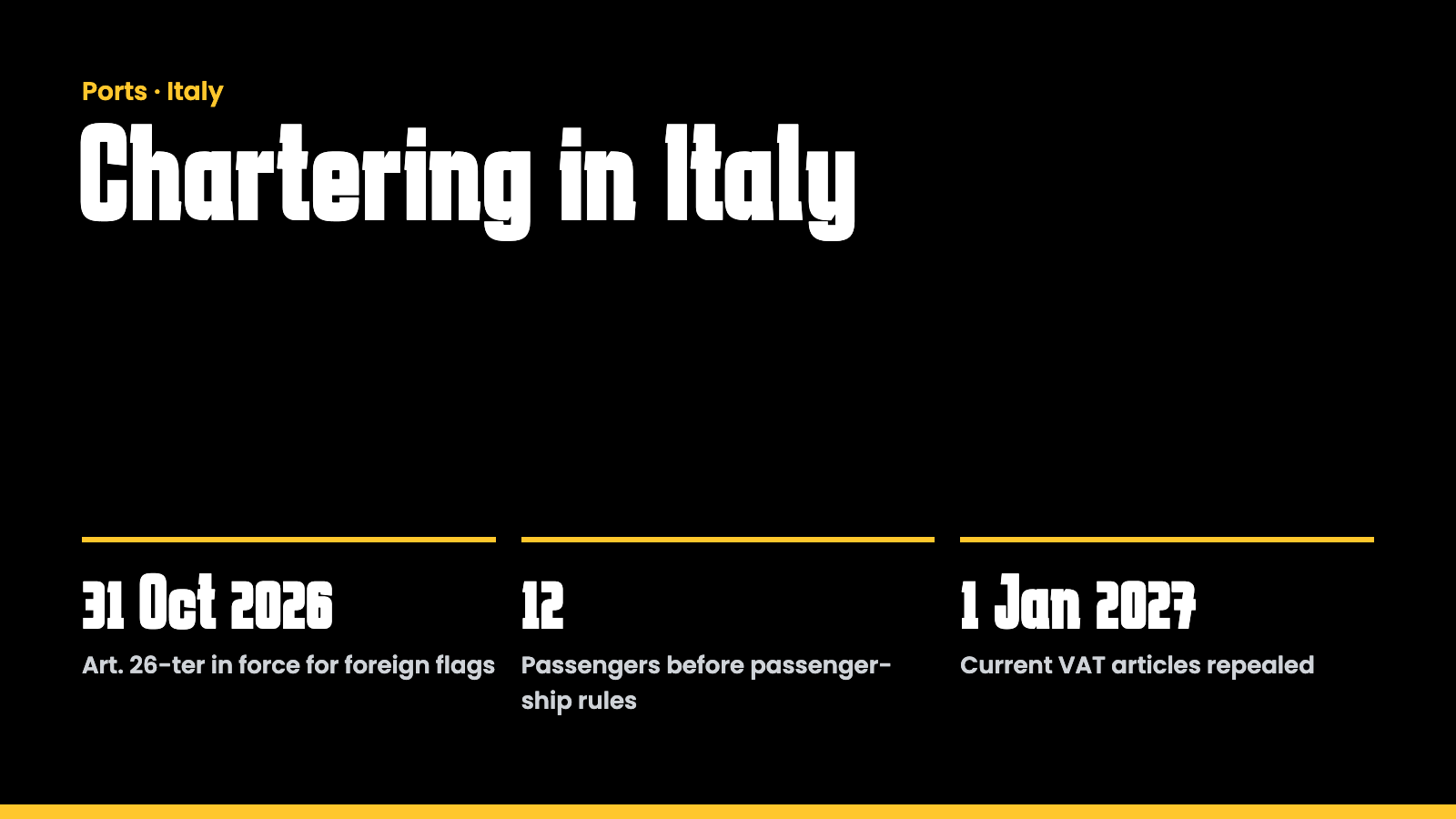
- Charter yachts carrying more than 12 passengers, crew excluded, fall under the passenger ship rules: Legislative Decree 45/2000 in national navigation, SOLAS in international navigation (D.M. 146/2008, Art. 78).
- The Italian Passenger Yacht Code sets design, construction and safety standards for charter yachts with more than 12 and up to 36 passengers on international voyages (D.M. 146/2008, Art. 89-ter).
- Yachts over 24 metres used in international navigation exclusively for charter can be entered in the Italian International Register, and may then carry at most 12 passengers (Law 172/2003, Art. 3).
Who can work on board?
On-board services on pleasure ships, the Italian category above 24 metres, are performed by personnel entered in the Italian seafarers' registers (matricole della gente di mare) (Codice della nautica, Art. 36(2)). Our sources do not say how this applies to foreign-flagged yachts. For crew contracts in general, see private or charter yacht crew.
How is VAT charged on a charter in Italy?
- Short-term hire or charter of a means of transport is taxable in Italy if it is made available to the client in Italy and used within the EU (D.P.R. 633/1972, Art. 7-quater(1)(e)).
- For pleasure craft, the place of supply counts as outside the EU if actual use outside the EU is shown by adequate evidence. This applies since 1 November 2020 (Normattiva note to Art. 7-quater, citing Law 160/2019).
- Long-term hire of pleasure craft to private clients is taxable in Italy if the yacht is made available in Italy, the supplier is established there and the yacht is used in the EU (Art. 7-sexies(1)(e-bis)).
- The VAT exemption for supplies of ships used on the high seas excludes pleasure craft under Law 50/1971. A ship counts as used on the high seas if more than 70 % of its voyages in the previous calendar year were on the high seas (Art. 8-bis).
Our sources do not show which evidence is accepted for use outside the EU, or whether flat-rate percentages apply; the tax agency's guidance could not be checked (see below). The former annual tax on pleasure craft no longer exists; it was repealed by Law 208/2015 (D.L. 201/2011, Art. 16(2)).
Is fuel duty-free for charter yachts?
Yes, for commercial use. Energy products for the uses listed in Table A of the excise code are exempt or taxed at a reduced rate (Testo unico accise, Art. 24). Item 3 exempts fuel for navigation in EU marine waters, excluding private pleasure craft, in the version of Legislative Decree 43/2025, effective from 1 January 2026 (Testo unico accise, Table A).
"Private pleasure craft" means use by the owner or a lessee for non-commercial purposes, in particular not for carrying passengers or providing services for payment (Table A, note 1). The procedure, such as the control booklet and bunkering under customs supervision, sits with the customs agency and could not be checked.
Which rules change in 2026 and 2027?
Three dates for the season ahead:
- 1 January 2026 (already in force): The duty-free fuel rule in its current wording (Table A).
- 31 October 2026: New Art. 26-ter of the Codice della nautica takes effect, as set by Decree-Law 144/2026. Foreign-flagged pleasure craft up to 24 metres owned by persons or companies resident in Italy must prove seaworthiness in Italian waters with flag-state certificates or, where the flag state has none, a survey by a notified body (Codice della nautica, Art. 26-ter).
- 1 January 2027: Articles 7-sexies and 8-bis of the VAT decree are repealed by the new consolidated VAT act, Legislative Decree 10/2026 (Normattiva, version from 1 January 2027). Art. 7-quater in its current version also applies only until 31 December 2026 (Normattiva).
Our sources do not show where the VAT rules sit from 2027. Ask a tax adviser before quoting 2027 charter prices.
What we could not confirm
- Whether charter under a non-EU flag between Italian ports is allowed: the texts do not say so expressly.
- Flat-rate VAT percentages for charter and the evidence required: the Agenzia delle Entrate website blocks automated access.
- Customs: clearing in, temporary admission (including any 18-month limit) and bunkering procedure. The customs agency (ADM) website is blocked as well.
- The new VAT provisions from 1 January 2027.
- Local harbour rules of the Capitanerie di Porto.
See also our Italy rules for yachts, chartering on the Côte d'Azur and chartering in the Balearics.
Sources
All sources were checked on 4 October 2026 and are linked at each point above. Main texts on Normattiva:
Sources and image rights
- Images
- Fran Zaina / Pexels (conditions)
- Checked
- 4 October 2026 by Andreas Lakeberg
Disclaimer. We research every article carefully and to the best of our knowledge. Salaries, prices, rules and port regulations change, and we cannot guarantee that all information is complete, current or correct. Please check anything important with the original source or the responsible authority before you rely on it. To the extent permitted by law, we accept no liability for errors or omissions.