Rules for yachts in the Caribbean: Bahamas, BVI, Antigua, St Martin and St Barths
Anchoring in protected areas, speed limits, AIS, waste, drones and fireworks in six Caribbean destinations, each rule linked to its official source.

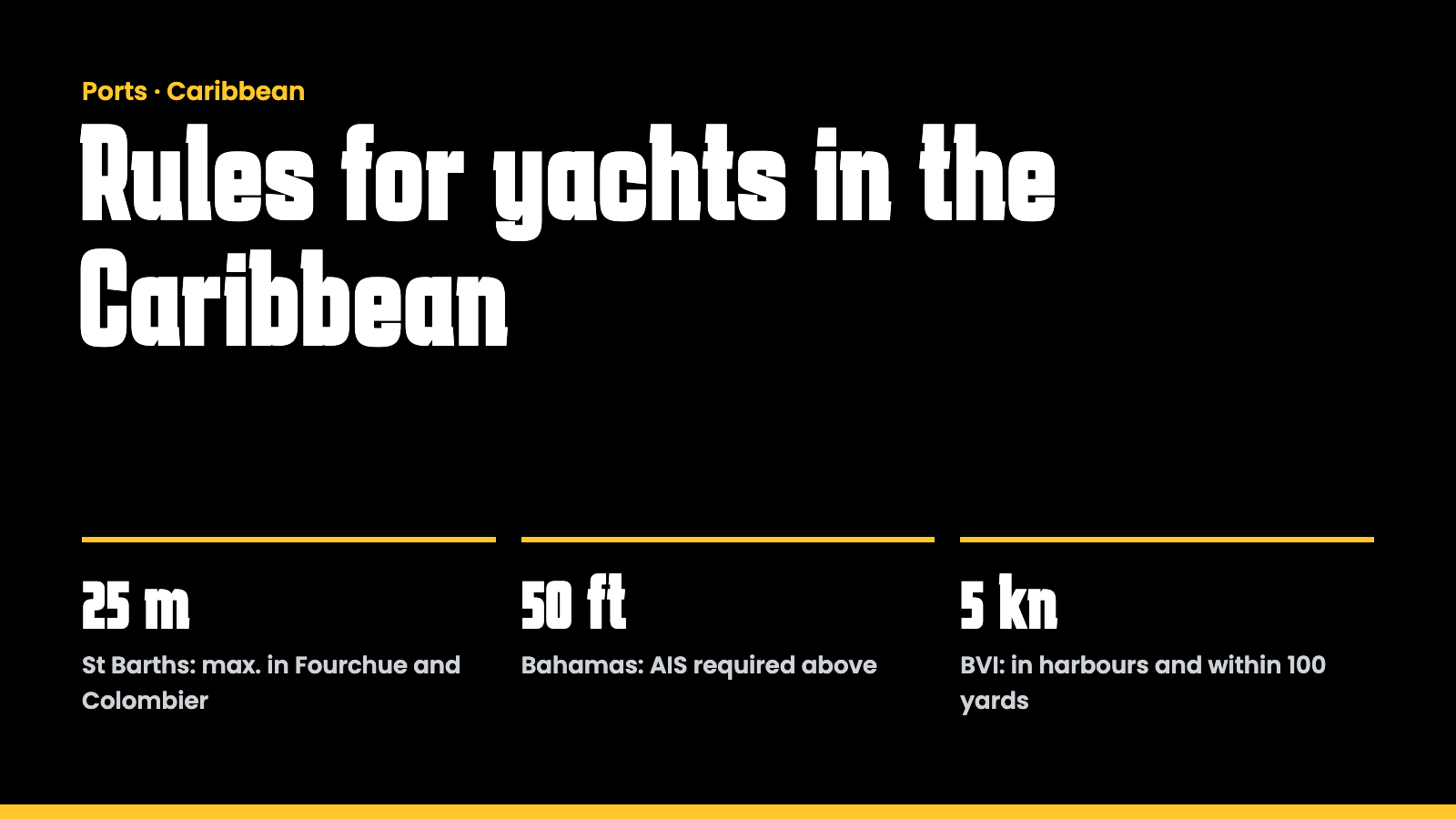
In the Caribbean, every island sets its own rules, and protected areas set the hardest limits. In St Barths, yachts over 25 metres may not stay in the bays of Fourchue and Colombier, and anchoring is banned in the rest of the nature reserve. The Bahamas require AIS on every foreign yacht over 50 feet, and the BVI allow 5 knots in harbours.
Each rule below links to the law, the authority or the managing body of the protected area. Six destinations are covered: the Bahamas, the British Virgin Islands (BVI), Antigua and Barbuda, the French side of St Martin (Saint-Martin), the Dutch side (Sint Maarten) and St Barths (Saint-Barthélemy). Amounts are given as the source gives them; where it writes only "$", so do we.
What is missing from this guide?
Sint Maarten is the weakest part. We found no official source for clearing in, fees, waste or VAT on the Dutch side. What is covered comes from the Nature Foundation, which manages the Man of War Shoal Marine Park, and from the website of the Simpson Bay Lagoon Authority, which names no legal basis.
Also not readable for this research: the fee notices of the Bahamas Port Department, the website of the Antigua Port Authority, the 2018 prefectoral order for Saint-Martin's coastal waters (Arrêté 2018-116, reportedly 5 knots within 300 metres) and the harbour police regulation of Gustavia. Before anchoring or launching toys, ask the harbour office or your agent.
Where can a large yacht anchor?
Protected areas decide most of it:
| Destination | Rule | Source |
|---|---|---|
| St Barths | Anchoring is banned in the whole nature reserve except parts of the bays of Fourchue and Colombier; also banned at the Petits Saints and Pointe Milou | Agence Territoriale de l'Environnement, "Sur l'eau" |
| St Barths | Yachts over 25 m are not allowed in Fourchue and Colombier; anyone anchoring there needs insurance with a "retirement et destruction" (wreck removal) clause | ATE, regulated zones |
| St Barths | Eco moorings only for boats up to 20 t and 25 m, for 96 hours at a time; then leave the reserve for at least 96 hours. No anchoring at all in the zone of reinforced protection | ATE, regulated zones |
| Saint-Martin | In the nature reserve: no anchoring on reefs or seagrass, no anchoring overnight without the manager's permission | Arrêté 2020-142, Title I, Ch. II |
| Saint-Martin | Marigot Bay: no anchoring within 50 m of the shore outside the mooring field (ZMEL). The ZMEL is only for pleasure craft up to 20 m and 20 t; dropping an anchor inside it is banned | ZMEL Marigot regulation, Art. 2, 5, 7 |
| Saint-Martin | Cul-de-Sac Bay: no anchoring of any kind in the zones around the sargassum barriers, whatever the size of the vessel (order published 7 September 2026) | Order 2026, Art. 4 |
| Sint Maarten | Man of War Shoal Marine Park: no anchoring within 50 m of the dive moorings; the moorings are for boats under 30 t and 14 m | Nature Foundation, Marine Park |
| Sint Maarten | Simpson Bay Lagoon: no anchoring in fairways and entrance channels, or near the bridge and the runway extension | Simpson Bay Lagoon Authority |
| BVI | In national parks and protected areas, anchoring, mooring or beaching needs the National Parks Trust's permission; anchoring in prohibited space can cost up to $10,000 | National Parks Act 2006, s. 49–50 |
| BVI | Park mooring buoys are for day use only and need a mooring permit, which foreign vessels buy at customs on entry. Boats of 55 to 80 ft may only use the larger yellow buoys; 90-minute limit on all buoys | National Parks Trust |
| Bahamas | Exuma Cays Land and Sea Park is a no-take zone. No anchoring in the mooring fields, on coral reefs and in other marked areas | Bahamas National Trust, park rules |
| Barbuda | Anchor or moor only in the designated zones (Low Bay, Coco Point, White Bay, River Hollow); do not drag dinghies across sand bars, reefs or seagrass | Barbuda Coastal Zoning Regulations 2014, reg. 10 |
| Antigua and Barbuda | No boat in the marine restricted areas (Diamond Reef and Salt Fish Tail Reef off Antigua, Palaster Reef off Barbuda) without written permission, except passing through. No anchoring in fairways without the Port Authority's consent | Cap. 259, reg. 5, Cap. 333, reg. 11 |
In the Bahamas, anchoring itself costs money: foreign yachts that do not lie in a marina pay an anchorage fee once per cruising permit. For yachts over 100 feet it is $200 for 30 days, $1,000 for six months and $1,500 for twelve months (Bahamas Customs, update 08/2026). In Exuma Park, all marine and park fees carry 10 % VAT (Bahamas National Trust).
In St Barths, approaching marine mammals closer than 300 metres is banned in the Agoa sanctuary, on, under and above the water (ATE, "Sur l'eau"). In the BVI, the 2026 closed season for turtles runs from 1 to 2 April and from 7 April to 30 November (S.I. 2026 No. 17).
Which speed limits and distances apply?
| Destination | Limit | Source |
|---|---|---|
| Bahamas | No motor boats or water skiing within 200 ft of the shoreline in the areas covered, except at up to 3 knots on the most direct line to and from the shore or a mooring; fine $1,000 to $5,000 | Water Skiing and Motor Boat Control Act, s. 3 |
| Bahamas | Exuma Park: idle speed in every mooring field and anchorage, including dinghies and jet skis | BNT park rules |
| BVI | Max. 5 knots in a harbour, when entering or leaving it, and within 100 yards of the low-water line; up to $1,000 or three months in prison | BVI Ports Authority Regulations 1995, reg. 15 |
| Antigua and Barbuda | Small power craft and jet skis: max. 5 knots within 75 m of the shore, 50 m clear of designated swimming areas, 15 m from other vessels unless at 5 knots or less | Small Craft (Control) Regulations 2017, reg. 7 and 24 |
| Antigua and Barbuda | Speed boats slow within 200 yards of the water's edge; all ships at moderate speed in harbours | Cap. 333, reg. 16 and 99 |
| St Barths | 5 knots in the channel, the port, anchorages, within 300 m of the coast, in the reserve's bays and within 100 m of islets | ATE, "Sur l'eau" |
| St Barths | The Port de Gustavia's website says 3 knots in the channel | Port de Gustavia |
| Saint-Martin | 3 knots in the Marigot mooring field and in the Marigot channel | ZMEL regulation, Art. 6, clearance portal |
| Sint Maarten | 5 mph in the bridge channel and the Simpson Bay Lagoon; no-wake zones near anchorages and marinas | Simpson Bay Lagoon Authority |
| Sint Maarten | Marine Park: pass extremely slowly within 90 m of a dive flag | Nature Foundation |
The two figures for the Gustavia channel contradict each other: the environment agency says 5 knots, the port's own banner 3 knots. We would keep to 3. In Gustavia, call the harbour office on VHF channel 12 before any manoeuvre (ATE); in Sint Maarten, call the Simpson Bay bridge on VHF 12 before approaching (SLAC).
Do you need AIS in the Bahamas?
Yes. Since 1 July 2025, every foreign vessel over 50 feet must keep a working AIS switched on in Bahamian waters, under way, at anchor and alongside. Failing to do so can cost $1,000 (Port Department, Notice to Boaters). We found no such rule in the other five destinations.
What are the rules on waste and sewage?
- Saint-Martin: no emptying of black-water tanks in the Marigot mooring field or within 3 nautical miles of the coast. Since 1 July 2023, boats with a toilet but no working holding tank may not stay in the mooring field (ZMEL regulation, Art. 15). The pump-out at Marina Fort Louis is free for boats on the Marigot Bay moorings (Port de Marigot).
- BVI: no discharge of pollutants, including sewage and garbage, into territorial waters; penalty $5,000 on top of any other punishment (Ports Authority Regulations, reg. 169). In parks, no sewage at all (National Parks Act, s. 49).
- Antigua and Barbuda: no rubbish or oil into a harbour (Cap. 333, reg. 53), and no garbage, sewage or petroleum waste in a marine restricted area or within one mile of it (Cap. 259, reg. 8).
- St Barths: visiting vessels pay a waste fee of €1 per person per day, crew and guests included (Code des contributions, Art. 139). Sorting waste is compulsory; the port has containers on the Quai Général de Gaulle and the Quai de la Collectivité (Port de Gustavia).
- Bahamas: Exuma Park has no rubbish disposal; take out everything you bring in (BNT). The Bahamas Maritime Authority's sewage notice applies only to Bahamian-flagged ships; for foreign yachts we found no official rule.
- Sint Maarten: no official source found.
What about drones, fireworks, noise and tenders?
- Drones: in the Bahamas, every drone must be registered with the Civil Aviation Authority, drones over 249 g need a certificate from the country of origin, and approval takes at least five business days (CAA-B). In the BVI, apply to Air Safety Support International (ASSI). In Antigua and Barbuda, a drone needs a certificate of registration, except Category 1 drones flown purely for recreation (RPAS Regulations 2019, reg. 4 and 38). St Barths bans drones below 300 metres in the nature reserve without permission (ATE), and Sint Maarten bans them in the Man of War Shoal Marine Park and at Mullet Pond (Nature Foundation).
- Fireworks: banned in Exuma Park (BNT) and in Antigua's national park without permission (National Parks Regulations 2012, reg. 13). In the BVI, each display needs a ministerial order; the March 2026 order for Necker Island kept every vessel 1,000 feet from the barge (S.I. 2026 No. 14).
- Noise and lights: the nature reserves of St Barths and Saint-Martin ban noise nuisance, and St Barths also bans underwater hull lighting (ATE, Arrêté 2020-142). In the Marigot mooring field, underwater lights may only be switched on when necessary (ZMEL regulation, Art. 12).
- Tenders: in the Bahamas, every tender over 25 feet costs $500 since 1 July 2025 (Port Department). In Antigua and Barbuda, tenders of foreign yachts share the mother ship's cruising permit limits (ADOMS FAQ), and dinghy operation inside the national park needs the Park Commissioner's permission (reg. 6(4)). In the BVI, a genuine tender of a yacht with a cruising permit needs no permit of its own (Act No. 14 of 2025, s. 4).
What are the penalties?
A few examples from the sources: in the Bahamas, $1,000 to $5,000 for breaking the 200-foot rule and $1,000 for a switched-off AIS. In the BVI, up to $1,000 or three months for speeding in a harbour, $5,000 for pollution and up to $10,000 for anchoring in prohibited space in a park. In Antigua and Barbuda, maritime activities in the territorial sea without a licence, cruising permit or written permission cost $4,000 to $100,000, and the vessel can be seized (Cap. 333, reg. 220 and 222).
Clearing in, charter and water toys
These have their own articles: Clearing in by yacht in the Caribbean, Chartering in the Caribbean and Jet skis and water toys in the Caribbean. In brief: Antigua wants an eSeaClear notice at least 24 hours before arrival, the Bahamas run clearance through Click2Clear, and the BVI changed their charter licences on 1 June 2025. St Barths bans jet skis, Seabobs and electric surfboards in its nature reserve. For comparison: rules for yachts in Italy and on the Côte d'Azur.
What else could we not verify?
- Saint-Martin: the general speed and jet ski limits along the coast (Arrêté 2018-116); the prefecture's website was unavailable. Drones and fuel: no official source.
- St Barths: the founding decree of the nature reserve, the harbour police regulation, and rules on sewage and fireworks.
- Antigua: the national park's anchoring fees and general rules on grey and black water.
- Bahamas: waste rules for foreign yachts.
- Saint-Martin, Cul-de-Sac order 2026: the order number is incomplete in the PDF, and the port page names "Monday 11 September 2026" as the start of enforcement, although 11 September 2026 is a Friday.
Sources
All sources were checked on 7 October 2026. Each rule above links to the legal text, the authority or the managing body of the protected area. Not accessible: Bahamas Port Department PDFs, the Antigua Port Authority, the prefecture of Saint-Barthélemy and Saint-Martin and Gustavia's harbour police regulation. Sint Maarten's lagoon rules come from the Simpson Bay Lagoon Authority's website, which names no legal basis.
Sources and image rights
- Images
- AI-generated (Magnific)
- Checked
- 21 October 2026 by Andreas Lakeberg
Know something we missed – a rule, a fee, a marina detail? Write to editor@toysandcrew.com. We check every tip against the source and note updates at the top of the story.
Disclaimer. We research every article carefully and to the best of our knowledge. Salaries, prices, rules and port regulations change, and we cannot guarantee that all information is complete, current or correct. Please check anything important with the original source or the responsible authority before you rely on it. To the extent permitted by law, we accept no liability for errors or omissions.