Clearing in by yacht in the Caribbean: eSeaClear, Click2Clear, ED Card and the French islands
How yachts clear in to the Bahamas, BVI, Antigua, St Barths and St Martin: online systems, notice periods, ports of entry, permits and fees.

Antigua wants an eSeaClear notice at least 24 hours before arrival, the Bahamas clear yachts through Click2Clear, and the BVI ask for an online ED card. St Barths takes online clearance at most 24 hours ahead, and the French side of St Martin uses the French Antilles form. For Sint Maarten we found no official procedure.
Every point below links to the customs, immigration or port authority. Amounts are given as the source gives them; where it writes only "$", so do we. Rules for charter yachts are in chartering in the Caribbean.
How do the systems compare?
| Destination | System | Notice before arrival | Ports of entry |
|---|---|---|---|
| Antigua and Barbuda | eSeaClear | at least 24 hours | Deep Water Harbour, Heritage Quay (both St John's), English Harbour, Jolly Harbour, Crabbs Peninsula (Barbuda) |
| Bahamas | Click2Clear (Cruising Permit Module) | "before arrival", no hours set | official list per island, including many marinas |
| British Virgin Islands | Online ED Card (immigration) | can be filled in from 72 hours before travel | Road Town Jetty, West End Ferry Terminal, Dog Hole Jetty (Jost Van Dyke), St Thomas Bay (Virgin Gorda), Gun Creek (Virgin Gorda, "reopening soon"), Port Purcell (cargo) |
| St Barths | Online clearance of the Port de Gustavia | at most 24 hours ahead | Gustavia (marina office, commercial port office) |
| Saint-Martin (French side) | French Antilles clearance form, plus the Port de Marigot portal | before arrival or departure | Anse Marcel Marina, Marina Fort Louis, Marigot ferry terminal (Galisbay) |
| Sint Maarten (Dutch side) | no official source found | – | – |
Sources: Antigua Customs, Customs Act 2013, s. 16, Bahamas Customs, Bahamas ports of entry, BVI Government, BVI Ports Authority, Port de Gustavia, French customs, approved clearance points.
How do you clear in to Antigua and Barbuda?
- eSeaClear: every vessel prepares an eSeaClear notification before arriving (Customs and Excise Division).
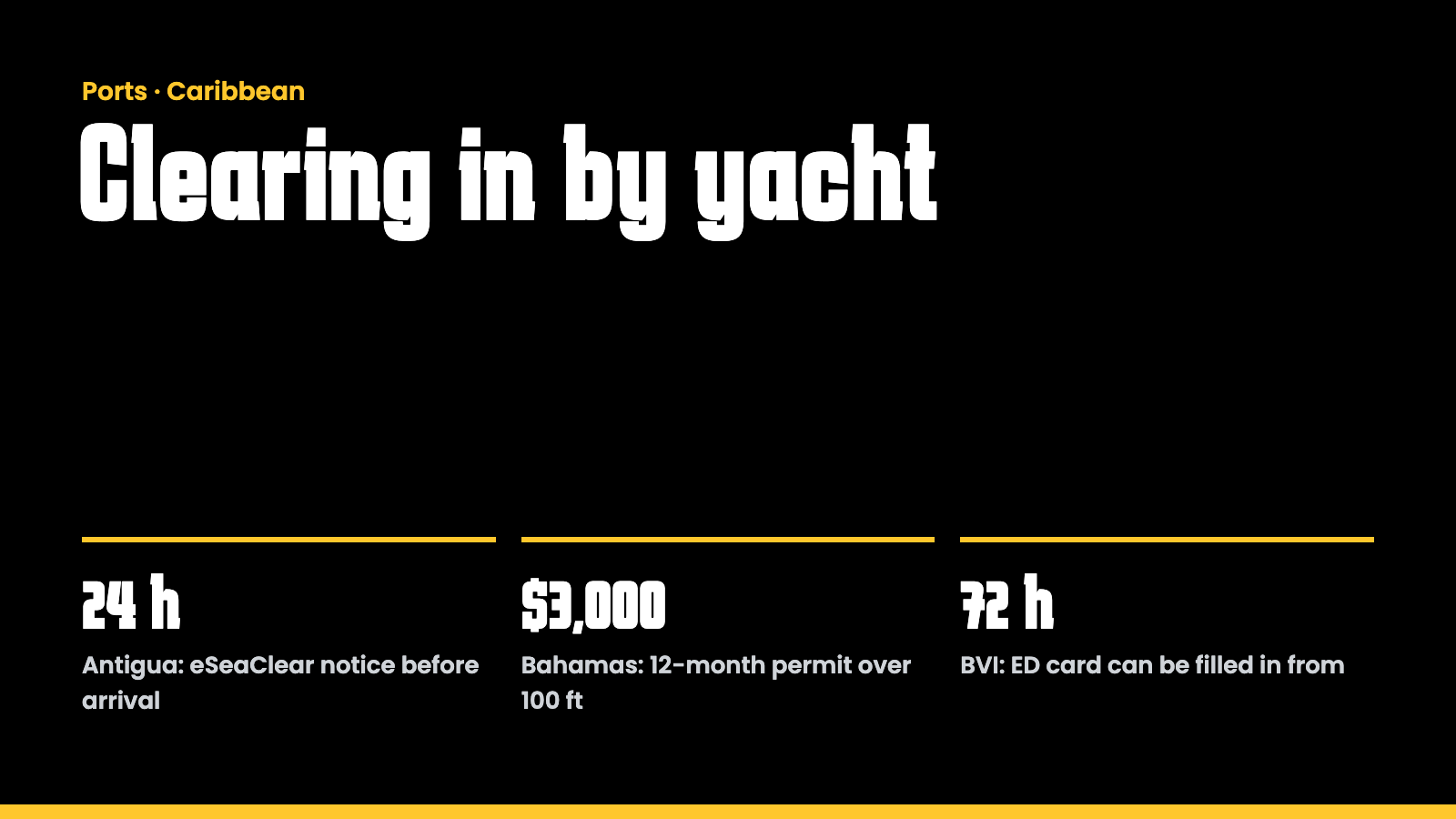
- 24 hours: the master or agent declares the ETA, the customs place and a list of all passengers and crew at least 24 hours before arrival, unless the Comptroller exempts a vessel because it comes from close by. On arrival, go directly to the notified customs place; breaches cost $10,000 (Customs Act 2013, s. 16).
- On arrival: only the captain goes ashore to clear, with one crew member if there is a language problem. Bring the clearance from the last port, the list of passengers and crew, and the vessel's registration. Clearance outside a port of entry needs a request to the Comptroller within 24 hours before arrival or departure (Customs).
- Cruising permit: any maritime activity in the territorial sea, pleasure cruising included, needs a licence, cruising permit or written permission (Port Authority Regulations, reg. 220). Permits from the Port Authority or National Parks run for up to six consecutive months (ADOMS Marine Notice 2017-02). We found no official price.
- Departure tax: every passenger who has been in the country more than 24 hours and leaves by pleasure craft pays an Embarkation Sea Port Tax of EC$75 or US$30 (Customs, Act No. 7 of 2013).
How do you clear in to the Bahamas?
- Click2Clear: all pleasure vessels are entered and paid for through the Cruising Permit Module of Click2Clear (Bahamas Customs). The declaration should be submitted before arrival; no deadline in hours is given (FAQ). Registering in Click2Clear is needed only for the two-year card (FDCC), not for permits of 12 months or less (update 08/2026).
- On arrival: at a port of entry, the captain reports directly to Customs, and only the captain may go ashore until Customs and Immigration have cleared the vessel. The permit is valid once paid and stamped and signed by a customs officer (Bahamas Customs).
- Leaving: outbound clearance is only needed if the next port abroad asks for clearance documents; it costs $75 (Bahamas Customs).
- Firearms: at most three, of calibre .308 or less, with 250 rounds each; all must be declared, and automatic weapons are banned (Bahamas Customs).
Cruising permit fees for private yachts (Bahamas Customs):
| Permit | 50 to 100 ft | Over 100 ft | Re-entries |
|---|---|---|---|
| 30 days | $350 | $600 | none |
| 6 months | $750 | $2,000 | one |
| 12 months | $1,000 | $3,000 | two |
| FDCC, 2 years | $2,500 | $8,000 | unlimited |
On top: an anchorage fee for yachts not in a marina (over 100 feet: $200, $1,000 or $1,500 for 30 days, six or twelve months), $500 per tender over 25 feet, and a passenger tax once a yacht carries more than three non-resident passengers aged six or older (Customs, other taxes, Port Department). The passenger tax is $30 on the Customs tax page but $20 on its clearance page; ask which applies. Since 1 July 2025, foreign yachts over 50 feet keep AIS switched on in Bahamian waters (Port Department).
Charter yachts and Bahamian-registered yachts get no cruising permit; they are entered as commercial vessels (FAQ).
How do you clear in to the BVI?
- Online ED Card: travellers fill in the immigration card at bviedcard.gov.vg, from 72 hours before travel up to arrival, but before facing an immigration officer (Government of the Virgin Islands). Our research also came across SailClear, but found no official page describing it.
- 12 hours: the master of a vessel arriving from abroad reports to Customs within twelve hours of arriving at a customs port (Customs Management and Duties Act 2010, s. 24).
- Nobody boards first: until pratique and inward clearance are complete, only the pilot, port health, customs and immigration officers may board (Ports Authority Regulations 1995, reg. 6).
- Leaving: outbound clearance becomes void if the vessel has not left territorial waters within 24 hours (Customs Act 2010, s. 35).
- Mooring permit: foreign vessels buy the National Parks mooring permit at Customs on entry (National Parks Trust).
- Temporary import: a vessel may be imported duty-free for a total of 180 days in twelve months (Customs Act 2010, s. 74); longer stays need a Temporary Importation Permit for $600 a year (Act No. 13 of 2025).
The cruising permit in the BVI applies to charter boats, not to private yachts (S.I. 2024 No. 83).
How do you clear in to St Barths?
- Gustavia: entry and exit formalities are compulsory for the marina. Do them at the port office or online, at most 24 hours in advance; online formalities only count once printed and signed at the port office. An agent is not required (Port de Gustavia). At the commercial port, formalities are done at its office on arrival (commercial port).
- French Antilles clearance: French customs require clearance on entering and leaving the French Antilles, which include St Barths (French customs). St Barths has been outside the EU customs territory since 1 January 2012 (French customs).
- Fees: at the public quay, per day, length overall × maximum beam × €1 (private) or €1.25 (charter) from 1 November to 30 April, and €0.40 or €0.65 from 1 May to 31 October. At anchor in transit, €0.30 or €0.35. A waste fee of €1 per person per day, crew included. Without full payment of the mooring fee, the port issues no exit clearance (Code des contributions, Art. 128-1 and 139).
How do you clear in to Saint-Martin and Sint Maarten?
French side: every captain of a pleasure vessel, private or commercial, completes clearance when arriving in or leaving the French Antilles (French customs). Since 1 September 2024 the form is online (démarche); for now, the confirmation is printed and stamped at an approved clearance point: Anse Marcel Marina, Marina Fort Louis or the Marigot ferry terminal (approved points). No declaration risks prosecution under the customs code (Boat Clearance Guide 2024).
The Port de Marigot runs its own portal to register the boat and declare arrivals and departures (portal). Clearance costs €7.50 for residents and €10.50 for visitors (Port de Marigot). Captains declare crew and passengers at the harbour master's office before they go ashore (Port de Marigot). Mooring in Marigot Bay costs €15 a day for yachts over 15 metres, plus 4 % tax; multihulls pay 50 % more (Port de Marigot).
Dutch side: we found no official source for clearing in, fees or VAT. Simpson Bay Marina says immigration is at the police station by the channel into the Simpson Bay Lagoon and asks for three copies of the crew list and a customs declaration, but describes this as "strictly for reference purposes only" (Simpson Bay Marina). Ask your agent or marina before arrival.
What we could not confirm
- Sint Maarten: the whole procedure, fees and ports of entry.
- BVI: SailClear (no official page), the legal basis of the ports of entry, and when Gun Creek reopens.
- Antigua: the price of a cruising permit and harbour fees; the Port Authority's website was not accessible.
- Bahamas: the Port Department's fee notices for foreign yachts (not accessible), and which passenger tax amount applies.
- St Barths: the harbour police regulation of Gustavia.
Sources
All sources were checked on 7 October 2026 and are linked at each point above: Antigua and Barbuda Customs and Excise Division and ADOMS, Bahamas Customs and Port Department, the Government and Ports Authority of the Virgin Islands, the Port de Gustavia and Collectivité de Saint-Barthélemy, French customs (douane.gouv.fr) and the Port de Marigot. For Sint Maarten, only marina information was available, marked as such.
Sources and image rights
- Images
- AI-generated (Magnific)
- Checked
- 21 October 2026 by Andreas Lakeberg
Know something we missed – a rule, a fee, a marina detail? Write to editor@toysandcrew.com. We check every tip against the source and note updates at the top of the story.
Disclaimer. We research every article carefully and to the best of our knowledge. Salaries, prices, rules and port regulations change, and we cannot guarantee that all information is complete, current or correct. Please check anything important with the original source or the responsible authority before you rely on it. To the extent permitted by law, we accept no liability for errors or omissions.