Rules for yachts in Croatia: distances, anchoring, national parks and clearance – what captains need to know
Croatia's new navigation rules of 2025 and 2026: distances from the coast, anchoring, pilot areas, national park fees, clearance and waste, each rule linked.

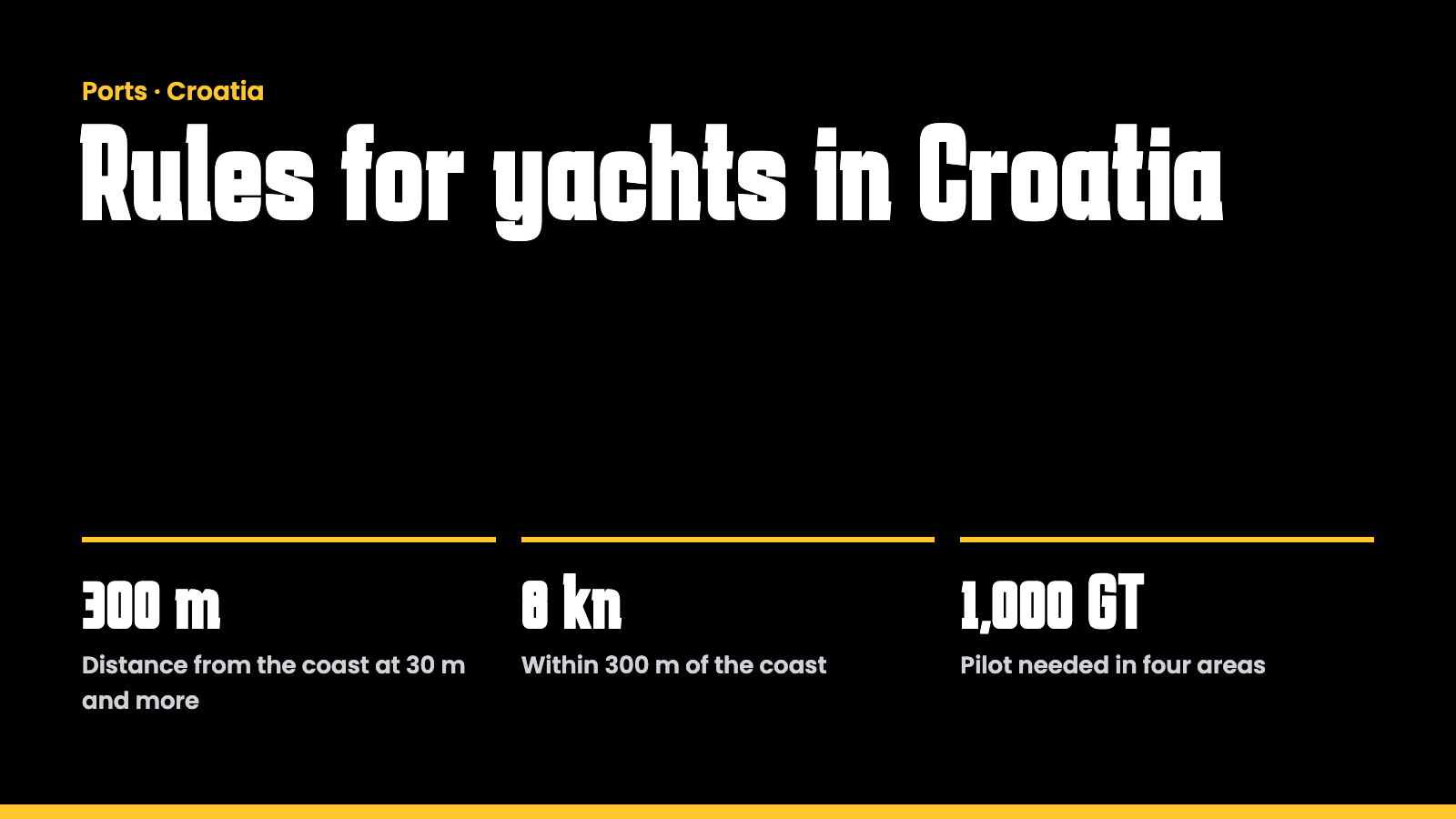
In Croatia, yachts of 30 metres and more must keep 300 metres from the coast, and every vessel is limited to 8 knots within 300 metres. You may not anchor within 150 metres of a natural beach. Yachts of 1,000 gross tonnage and more need a coastal pilot in four areas, three of them added in April 2026.
Each rule below links to the Croatian source, almost always the Official Gazette, Narodne novine (NN). Most of the rules for navigation now sit in one regulation, the Pravilnik o sigurnosti pomorske plovidbe, published as NN 52/2025 and amended by NN 40/2026.
What changed in 2025 and 2026?
The regulation of 2025 replaced the old one of 2013 (NN 79/2013 with its amendments) and took effect on 29 March 2025. Many websites and pilot books still quote the old version. The amendment of 17 April 2026 brought three changes that matter for large yachts:
- Stern-to and bow-to: mooring to the shore with lines is banned if any part of the vessel lies 70 metres or more from the shore, measured along the anchor chain. The limit was 50 metres before (NN 52/2025, Art. 53(7), as amended by NN 40/2026).
- Pilot areas: three more areas are closed to yachts of 1,000 gross tonnage and more unless they take a coastal pilot (see below).
- Distance from beaches: new distances from the boundary of a managed beach, by length of vessel (NN 40/2026, Art. 3).
A new fee for the use of aids to navigation applies from 1 January 2026 (see fees).
What is missing from this guide?
The Croatian tax authority's websites (Porezna uprava and gov.hr) blocked automated access, so its guidance on VAT is missing. We also found no list of the anchoring bans and speed limits set by the individual harbour masters (lučke kapetanije), although the regulation says they are published on the ministry's website. Fees set in kuna before Croatia adopted the euro in 2023 appear here in kuna, because we found no official euro version. Ask your agent or the local harbour master before you anchor.
How far from the coast and how fast?
| Rule | Vessels of 30 m and more | 15 to under 30 m | Under 15 m | Source |
|---|---|---|---|---|
| Minimum distance from the coast under way | 300 m | 150 m | 50 m | NN 52/2025, Art. 49(1) |
| Minimum distance from the boundary of a managed beach | 300 m | 100 m | 50 m | NN 40/2026, new Art. 49(3) |
- Exceptions: closer is allowed only to enter or leave a harbour, to anchor, to berth or where the channel requires it, and then at greatly reduced speed (NN 52/2025, Art. 49(2)).
- 8 knots: within 300 metres of the coast, in narrow channels and in the approaches to harbours and anchorages (Art. 50(1)). Harbour masters may set further limits for individual areas (Art. 50(3)–(4)).
- Managed beaches: berthing, anchoring, mooring and navigation are banned inside them (Pravilnik NN 72/2021, Art. 50(2)).
- Harbours: reduced speed so that the wash damages nothing (NN 72/2021, Art. 16(1)); in the port area of Rovinj, under 5 knots (Rovinj harbour rules, Art. 70(2)).
- Swimming: banned in harbours, harbour approaches and busy narrow channels (NN 72/2021, Art. 49). Swimming right next to the yacht is allowed when it is safely anchored and the propeller is stopped (Art. 53(5)).
Where do large yachts need a pilot?
Yachts of 1,000 gross tonnage and more (ships from 500) may pass these areas only with a coastal pilot (obalni peljar):
| Area | Rule | Source |
|---|---|---|
| Krka estuary to Skradin | Pilot required; 8 knots maximum; anchoring banned in the sv. Josip channel and the Skradin channel | NN 40/2026, new Art. 66.a |
| Pašmanski tjesnac (Pašman channel) | Pilot required; 8 knots in the traffic lanes | NN 40/2026, new Art. 64 |
| Murtersko more, Žirjanski and Vrgadski kanal | Pilot required | NN 40/2026, new Art. 63 |
| Fažanski kanal (approach to Brijuni) | Pilot required | NN 52/2025, Art. 58 |
Where can you anchor?
You may not anchor where official charts or publications show an anchoring ban, or where the harbour master has banned or restricted it (NN 52/2025, Art. 53(9)). The harbour master may do so for all vessels or only by length (Art. 53(3)). Also banned:
- Near beaches: anchoring so that the swinging circle comes within 50 metres of the boundary of a managed beach, or within 150 metres of the shore of a natural beach (Art. 53(9)).
- Over cables and pipes: anchoring so that the yacht can swing over them; mooring to the shore where they enter the sea or inside a beach area (Art. 53(9)–(10)). Lines may not damage vegetation on the shore (Art. 53(8)).
- Stari Grad bay (Hvar): anchoring banned east of the line Rt Babe – Uvala Maslinica until further notice; anchoring is possible in Uvala Tiha in 30 to 35 metres (Pilot book Peljar I, correction 2025).
- Korčula: the Korčula port authority's harbour rules ban anchoring for yachts and ships over 30 metres in Luka bay. We read this from a scanned page, so check it locally (Korčula harbour rules).
A natural anchorage is open to all, and anchoring there may not be charged for (Maritime Domain Act NN 83/2023, Art. 144). Buoy fields (nautička sidrišta) are run under concession, and the operator must take household waste from boats (Art. 145).
Posidonia: Neptune grass (Posidonia oceanica) and two other seagrasses are strictly protected species (NN 144/2013, Art. 4 and Annex I), and destroying strictly protected plants is banned (Nature Protection Act, Art. 153). The maritime ministry warns that anchors and chains of larger vessels dig up Posidonia meadows (MMPI). We found no national rule that expressly bans anchoring on Posidonia.
What applies in the national and nature parks?
In protected areas on the sea, you may moor only at places designated as berths, anchorages or harbours, and you may not wash boats (Nature Protection Act, Art. 139). Entering without a ticket where one is required is banned. Fees are per day; low season is January to May and October to December, high season June to September.
| Park | Main rules for yachts | Fee 2026, 25–34.99 m (low / high) | Fee 2026, over 100 m (low / high) |
|---|---|---|---|
| Kornati National Park | Anchoring and mooring only in 20 listed bays; four strict zones closed; 8 knots in the park (Pravilnik NN 141/2010) | €175 / €320 bought before entry, about double in the park (price list 2026) | €1,210 / €2,245 bought before entry |
| Mljet National Park | Anchoring only in Polače and Pomena harbours; banned in zone II.c and many bays; 5 knots within 150 m of the shore; no underwater lighting (park rules) | €175 / €320 in the park, €150 / €300 in the web shop (price list 2026) | €1,120 / €2,250 in the park, €1,050 / €2,080 online |
| Brijuni National Park | Navigation only with permission; harbour Veliki Brijun up to 55 m, larger yachts on a buoy or at anchor in the Fažana channel (park, Nautika) | Collected by the Pula port authority; 2026 tariff not found | – |
| Krka National Park | Navigation above the Skradin bridge only with permission; berthing only at marked landings (Pravilnik NN 123/2019, Art. 22 and 24) | – | – |
| Telašćica Nature Park | Anchoring banned in the whole park except in emergencies; mooring only at marked places; 10 knots, 5 knots in busy bays (Pravilnik NN 8/2022, Art. 47) | €145 / €290 bought outside the park (price list 2026) | €1,040 / €2,080 |
| Lastovo Nature Park | Anchoring and mooring only at marked places; buoys for boats up to 20 m, plus two up to 30 m in Skrivena luka and Vejo Lago; leave the buoys in gusts over 20 m/s (park, anchorages) | €96 / €192 online, buoy fee extra (price list) | €1,260 / €1,800 |
Two caveats: Telašćica's anchoring ban zones take effect only once they appear in official charts and nautical publications (Art. 70), and we could not check whether they have. Telašćica also sells a three-day ticket combined with Kornati (€400 / €720 for 25 to 34.99 metres).
How do you clear in and out?
A foreign pleasure yacht arriving by sea must go through border control and have its crew and passenger list certified at the harbour master's office. On arrival, the skipper also pays the navigation safety fee and the fee for aids to navigation, pays the tourist tax and registers foreigners on board (Decree NN 97/2013, Art. 4). Before leaving, the yacht clears out the same way and then leaves Croatian waters by the shortest route (Art. 9).
- Documents on board, in the original: proof of fees paid, seaworthiness, the skipper's qualification, liability insurance, and proof of ownership or authorisation (Art. 7).
- Private owners: only the owner, close family and persons authorised in writing may be on board; the owner's signature on the authorisation must be officially certified (Art. 6).
- Skipper: must be qualified under the rules of the flag state; if the flag state has none, Croatian rules apply (Art. 3).
- Border crossings: permanent sea crossings are Rijeka, Ploče, Zadar, Šibenik, Split, Dubrovnik and Raša-Bršica (Decree NN 79/2013, Art. 24–25), plus Umag, Pula, Mali Lošinj, Ubli, Vis and Cavtat for passengers (Schengen Handbook, Annex 4). The seasonal crossings were abolished in January 2023 (NN 1/2023).
- Schengen: since 1 January 2023, there are no checks on persons at internal sea borders; a border check depends on whether you cross the external border, arriving from or leaving for a non-Schengen country (Ministry of the Interior).
Our sources do not say expressly whether the decree of 2013 distinguishes between EU and non-EU flags for private yachts, and we did not find the ministry's list of ports open to international traffic. The harbours themselves are in our list of superyacht marinas in Croatia.
Which fees apply?
- Navigation safety fee: a foreign yacht must report its stay to the nearest harbour master before it sails, in order to pay this fee (Pravilnik NN 116/2016, Art. 3(3)). It is charged for a full year and cannot be split, however short the stay (Art. 4, as amended by NN 14/2020). For yachts over 12 metres, it depends on length and engine power; from 40 metres the formula is "7500 + 25*L", in kuna (Art. 8 and Annex 1).
- Aids to navigation: since 1 January 2026, a fee by gross tonnage for 30 days or 12 months from arrival (Pravilnik NN 132/2025). Yachts are not named separately in its tariff.
- Tourist tax: owners of private yachts over 7 metres with berths pay for everyone sleeping on board, per night or as a flat rate, before leaving (Tourist Tax Act NN 52/2019, Art. 14). For yachts over 20 metres, the flat rate runs from 300 kuna for three days to 6,000 kuna for a year (Pravilnik NN 73/2020, Annex 1).
The old vignette was abolished in 2013 (NN 97/2013, Art. 13). Customs and temporary admission are in our article on chartering in Croatia.
What about waste and sewage?
- National ban: solid and liquid waste, oily water and sewage may not be discharged into the sea or onto the coast (Maritime Code, Art. 49.b); tanks may be emptied only where reception facilities exist (Art. 49.c).
- Keep waste on board until it can be handed to a port reception facility (NN 72/2021, Art. 59(1)). Effluent from biological treatment plants meeting IMO resolution MEPC.227(64) does not count as waste (Art. 59(2)).
- Rovinj: emptying holding tanks and toilets into the sea, and discharging galley water with detergent, are banned; waste and sewage must be handed over before leaving (Rovinj harbour rules, Art. 116 and 119).
- Hvar: any discharge of oil, waste, sewage and waste water is banned (Hvar municipal order, Art. 117).
- Parks: Mljet and Brijuni order vessels that discharge waste water out of the park, besides a fine (Mljet, Art. 66; Brijuni, Art. 60).
We found no national rule on grey water; only Rovinj bans it.
Drones, noise and tenders
- Drones: Croatia applies EU Regulation 2019/947 (CCAA). Every flight must be reported via the AMC portal, whatever the weight, and insurance is required for aerial work such as photo or video (CCAA FAQ). Unauthorised drones are banned in national parks (Nature Protection Act, Art. 139); Mljet, Krka, Brijuni and Telašćica require the park's permission.
- Noise: Kornati has quiet hours from 23:00 to 06:00 (Art. 31). In Hvar harbour, loud music on board and barbecues that send smoke onto the quay are banned (Hvar, Art. 117). We found no national noise rule and no official source on fireworks.
- Tenders: a tender registered or marked as equipment of the yacht may go only within 500 metres of it, except when carrying people and goods to the nearest landing or between the anchorage and its harbour (NN 52/2025, Art. 49(9)). A craft carried on board but registered in its own right has no such limit (Art. 49(10)).
What are the penalties?
Mooring outside designated places in a protected area or flying a drone in a national park without permission costs a person 1,500 to 2,000 kuna and a company 5,000 to 10,000 kuna, according to the Nature Protection Act, which still states the amounts in kuna (Art. 231). We found no penalty provision for the anchoring rules of the 2025 regulation.
Charter, VAT and water toys
These have their own articles: Chartering in Croatia and Jet skis and water toys in Croatia. In brief, charter is open to yachts under the Croatian or an EEA flag, and to others only with a cabotage permit (Pravilnik NN 42/2017, Art. 3). Jet skis may plane only more than 300 metres from the coast (NN 52/2025, Art. 50(2)). For comparison: rules for yachts in Italy and on the Côte d'Azur.
What else could we not verify?
- The list of anchoring bans and speed limits set by each harbour master, and the protection zone around concession buoy fields.
- An express national ban on anchoring on Posidonia, and rules for Natura 2000 areas outside the parks.
- Euro amounts for the navigation safety fee, the tourist tax and the fines; the official texts we found give kuna.
- The Brijuni boat tariff for 2026 and whether Telašćica's no-anchoring zones are in the charts.
- A national rule on grey water, fireworks or noise.
Sources
All sources were checked on 7 October 2026. Each rule above links to the Official Gazette Narodne novine, a ministry, the harbour or park authority, or the EU Schengen Handbook. The tax authority's websites were not accessible. Fees in kuna are quoted as published; we did not convert them.
Sources and image rights
- Images
- AI-generated (Magnific)
- Checked
- 7 October 2026 by Andreas Lakeberg
Know something we missed – a rule, a fee, a marina detail? Write to editor@toysandcrew.com. We check every tip against the source and note updates at the top of the story.
Disclaimer. We research every article carefully and to the best of our knowledge. Salaries, prices, rules and port regulations change, and we cannot guarantee that all information is complete, current or correct. Please check anything important with the original source or the responsible authority before you rely on it. To the extent permitted by law, we accept no liability for errors or omissions.