Flying a drone from a superyacht: rules in the EU, UK, France, Spain, Italy and Monaco
Registration, minimum age, insurance and flying from a moving boat under EU and UK rules, plus what France, Spain, Italy and Monaco add.

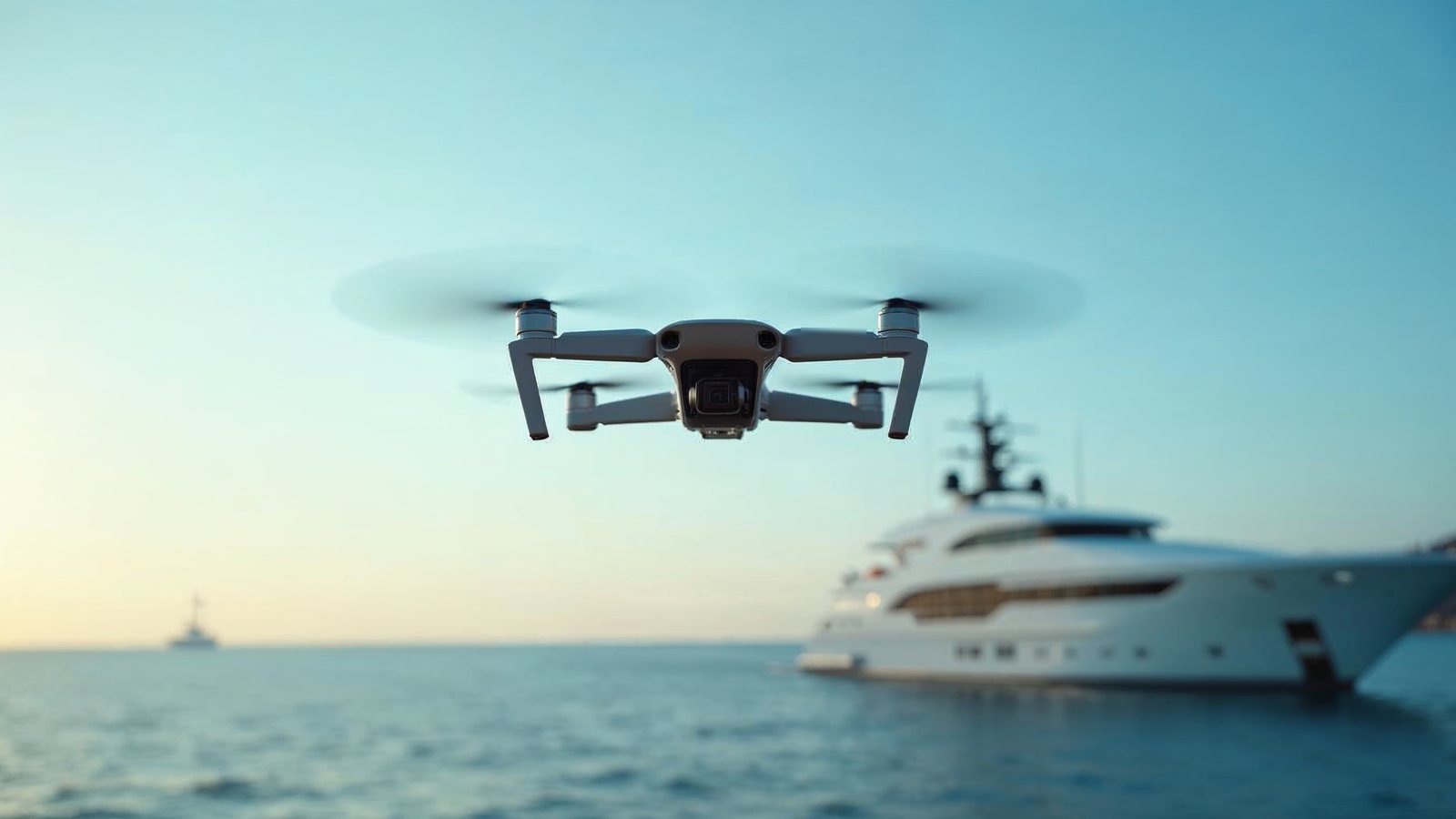
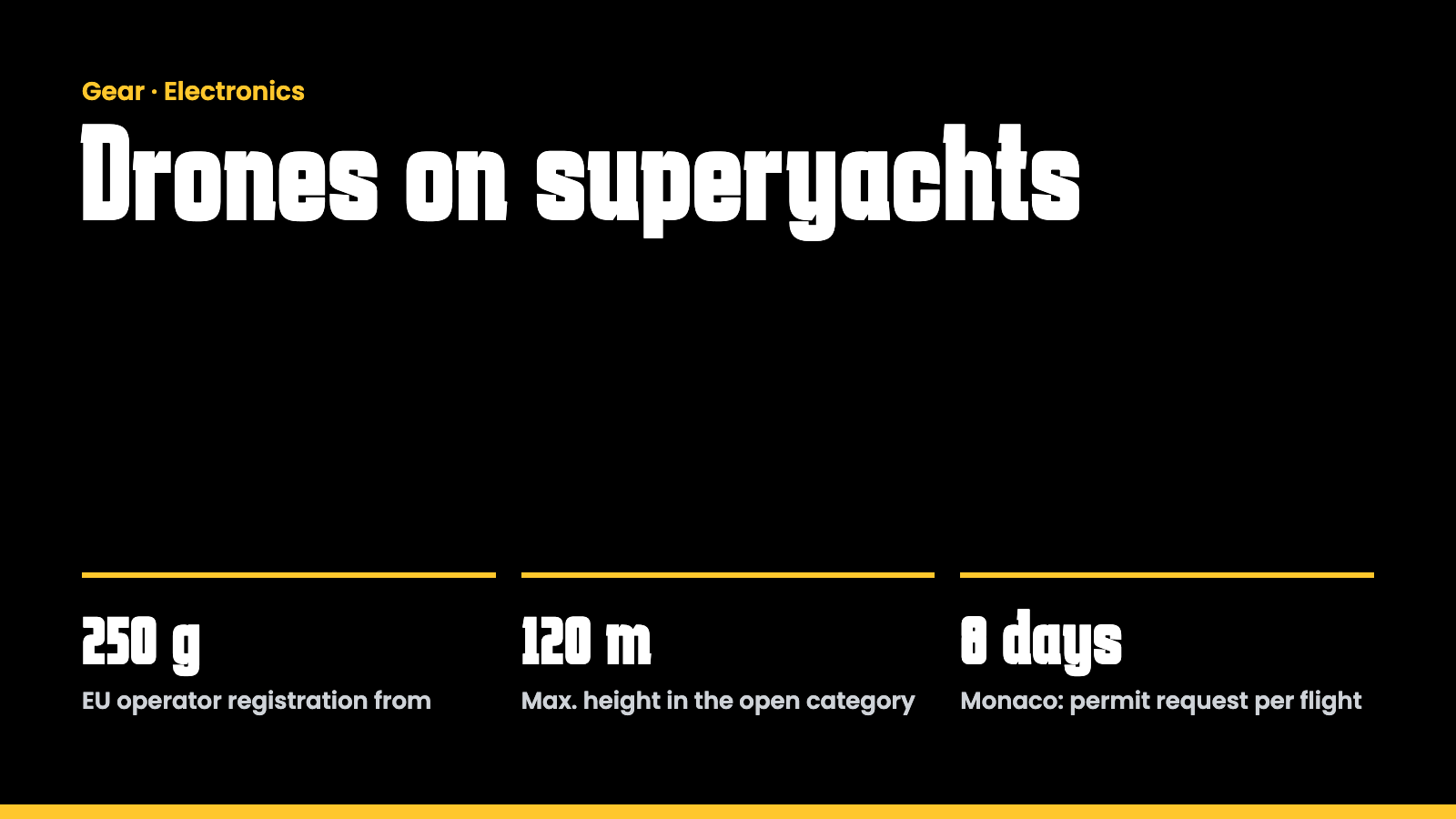
You may fly a drone from a moving yacht in the EU and the UK only if the yacht moves slowly enough for you to keep sight and control, and never while you are steering a vessel. In the EU, operators register for drones of 250 g or more or with a camera. Monaco requires a permit for each flight.
Every rule below links to the official source. For the EU, we used EASA's Easy Access Rules, an unofficial consolidation of Regulation (EU) 2019/947, in the June 2026 revision (EASA).
Can you fly a drone from a moving yacht?
Yes, but under conditions. EASA's guidance says the remote pilot may fly from a moving boat or vehicle if it is slow enough to keep visual contact, control and orientation at all times. Whoever is driving a moving vehicle, such as a tender, may not fly a drone at the same time (AMC1 UAS.OPEN.060(2)(d)). The UK has kept the same wording (CAA, UK Regulation 2019/947, p. 134).
For beyond-visual-line-of-sight flights under the predefined risk assessment PDRA-G01, the pilot should not fly from a moving vehicle at all (AMC2 Article 11). We found no separate rule in France, Spain or Italy on launching drones from vessels or in ports.
What are the basic EU rules?
All from Regulation (EU) 2019/947 and EASA's guidance (EASA Easy Access Rules; EASA, open category):
- Minimum age: 16 in the "open" and "specific" categories. A member state may lower it, in the open category by up to four years, but the lower age then applies only in that state (Art. 9).
- Registration: required for drones of 250 g or more, or able to transfer more than 80 J on impact, or with a camera or sensor that can capture personal data (toys excepted); in the specific category always (Art. 14(5)). The registration number must be shown on the drone (Art. 14(8)).
- Where to register: in the member state of residence for a private person, or of the main place of business for a company, and only in one state (Art. 14(6)). Owners or crew who live outside the EU register with the aviation authority of the first EU country where they plan to fly (EASA FAQ). The number is valid in all EASA member states.
- Height: below 120 m above ground in the open category.
- Distance: class C2 drones (under 4 kg, subcategory A2) keep 30 m horizontally from uninvolved people, or 5 m with low-speed mode. In subcategory A3, 150 m from uninvolved people and from residential, commercial, industrial and recreational areas.
- Older drones without a C class label may fly in the open category only if placed on the market before 31 December 2023, or if privately built.
- Remote ID is required in the open category, with few exceptions; at night a green flashing light must be on (UAS.OPEN.060(2)(g)).
- Insurance: required EU-wide for drones over 20 kg; most member states also require liability insurance for lighter drones (EASA FAQ).
- Drone zones: before every flight, the pilot must check the current geographical UAS zones of the state; states can ban flights in them, set conditions or require prior permission (UAS.OPEN.060(1)(b), Art. 15).
What do the UK, France, Spain, Italy and Monaco add?
| Country | Registration and age | Insurance | Notable rules | Source |
|---|---|---|---|---|
| UK | Flyer ID (CAA theory test) from 100 g; Operator ID from 250 g, or from 100 g with a camera; Operator ID only from 18 | Regulation 785/2004 does not apply under 20 kg; no other rule found | below 120 m (400 ft); at least 50 m from people, including people in vehicles and on boats; flight restriction zones around most airports | CAA Drone Code, March 2026, legislation.gov.uk |
| France | registration online in the DGAC portal AlphaTango; minimum age in the open category lowered to 14 | not checked | no night flights (prefect can grant exceptions, apply at least 30 days ahead); no flights over public space in towns; no aerial photography in ZICAD zones | Ministère de la Transition écologique |
| Spain | minimum age 12 for A1 with class C0, 14 for C1, C2, C3/C4 and privately built drones under 25 kg | mandatory from 20 kg; under 20 kg in subcategory A2 and in specific and certified categories | public beaches with leisure facilities count as urban environments; flights in towns or over crowds notified to the Interior Ministry at least 5 calendar days ahead | RD 517/2024 |
| Italy | registration on D-Flight, QR code on the drone | every flight needs valid liability insurance | flights beyond visual line of sight planned on D-Flight; minimum age and zones not confirmed | ENAC Regolamento UAS-IT |
| Monaco | approval (agrément) and a flight permit from the Direction de l'Aviation Civile; pilot over 18 | copy of liability insurance with the application | see below | Arrêté ministériel 2021-532 |
France at sea: over the territorial sea, the Préfet maritime is responsible for drone flights; on inland waters, the département's prefect (Préfecture maritime de la Méditerranée, Mémento, Fiche 1.13). The map of restricted areas for mainland France is on Géoportail, but temporary bans over nature areas during the breeding season are not shown on it.
Spain near airports: around public aerodromes, a UAS zone up to 45 m high extends 6 km from the runway end and 5 km on each side of the runway axis. ENAIRE publishes Spain's UAS zones in digital form.
What are the drone rules in Monaco?
Monaco is the strictest of the places covered here. Under Arrêté ministériel 2021-532 (Légimonaco):
- Every flight in Monegasque airspace needs an approval and a flight permit from the Direction de l'Aviation Civile (Art. 2). Only "aéromodèles" are exempt: leisure devices under 100 g without geolocation (Art. 3).
- Over the Principality itself, only professional flights are allowed, unless the Minister of State grants an exception (Art. 5).
- Each flight permit must be requested at least 8 working days ahead; later requests are not accepted (Art. 15). The approval is valid for one year.
- No flights over the Prince's Palace and Place du Palais, or within 150 m of the heliport boundary (Art. 4–5).
- Visual line of sight only, no video goggles, no night flights except with DAC approval; drones with combustion engines are banned (Art. 7–9).
- Drones over 0.7 kg need a protection system that limits impact energy to 69 J, plus a flashing light, electronic identification and a plate with operator details (Art. 14).
- Police and the DAC may neutralise drones flying without a permit; the owner bears any damage (Art. 17).
Whether Monaco's airspace rules also cover its territorial waters is not stated in the sources we read.
What we could not find
Regulation 785/2004 was not read directly; the 20 kg insurance threshold is confirmed through EASA, Spain's RD 517/2024 and legislation.gov.uk. The pages of AESA, ENAIRE and D-Flight were not read, nor Monaco's Loi 1.458. For the UK, an insurance duty for drones under 20 kg was not confirmed; for Italy, the minimum age and zones were not confirmed. France, Spain and Italy have no rule of their own on flying from vessels or in ports that we could find.
Sources
EASA Easy Access Rules for UAS (June 2026) and EASA pages and FAQ; CAA Drone Code CAP2320 (March 2026) and UK Regulation 2019/947 (September 2026); legislation.gov.uk; French Ministry of Ecological Transition (September 2026) and Préfecture maritime de la Méditerranée; Spain's RD 517/2024 (BOE, consolidated July 2025); ENAC Regolamento UAS-IT (2021); Monaco Arrêté ministériel 2021-532. All checked on 7 October 2026 and linked above.
Sources and image rights
- Images
- AI-generated (Magnific)
- Checked
- 7 October 2026 by Andreas Lakeberg
Disclaimer. We research every article carefully and to the best of our knowledge. Salaries, prices, rules and port regulations change, and we cannot guarantee that all information is complete, current or correct. Please check anything important with the original source or the responsible authority before you rely on it. To the extent permitted by law, we accept no liability for errors or omissions.