Jet skis on a superyacht: garage, petrol, cranes and licences under the yacht codes
What the REG Yacht Code, LOLER and MGN 618 require for jet ski garages, petrol, davits and cranes, and which licence crew need.

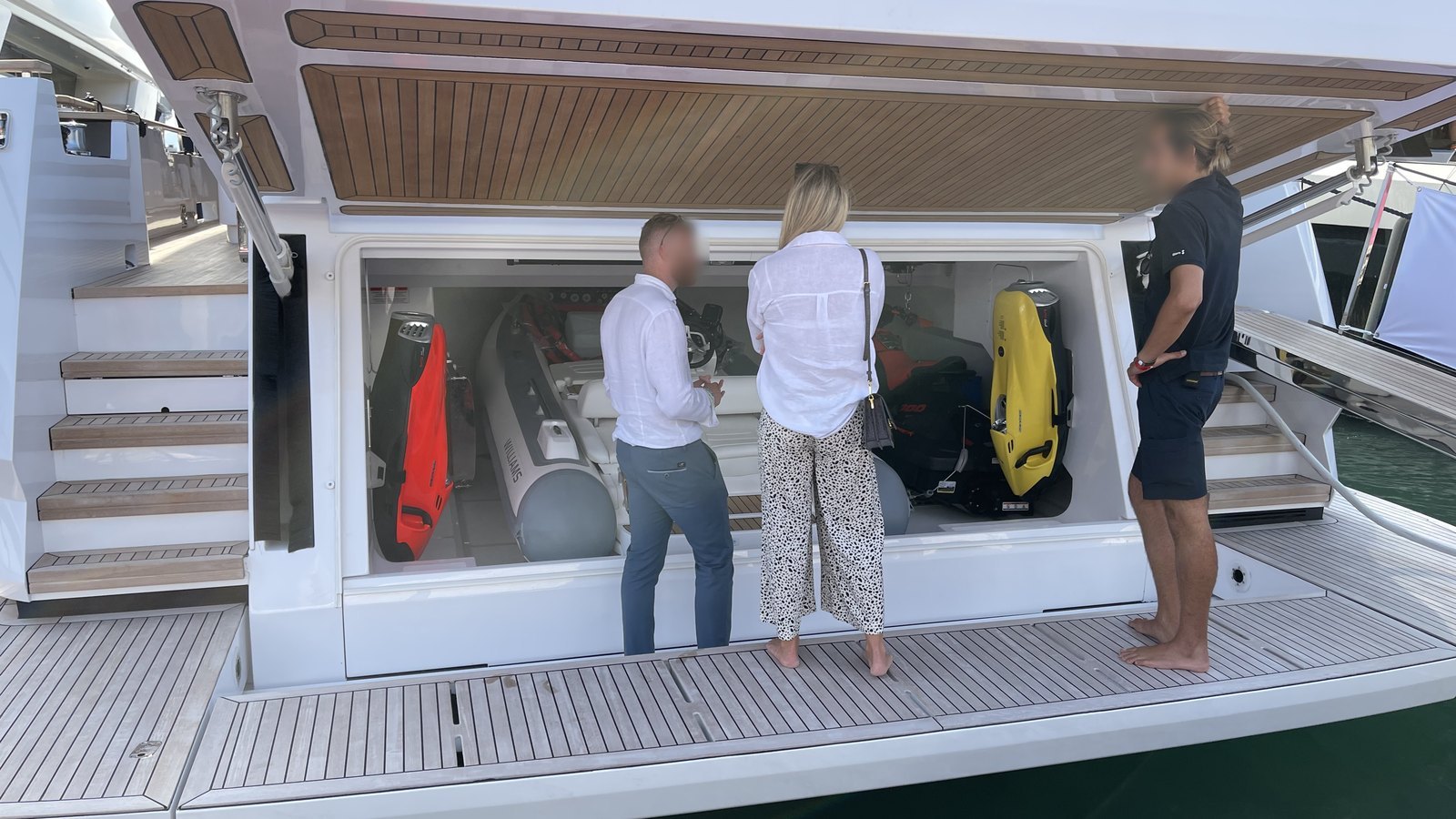
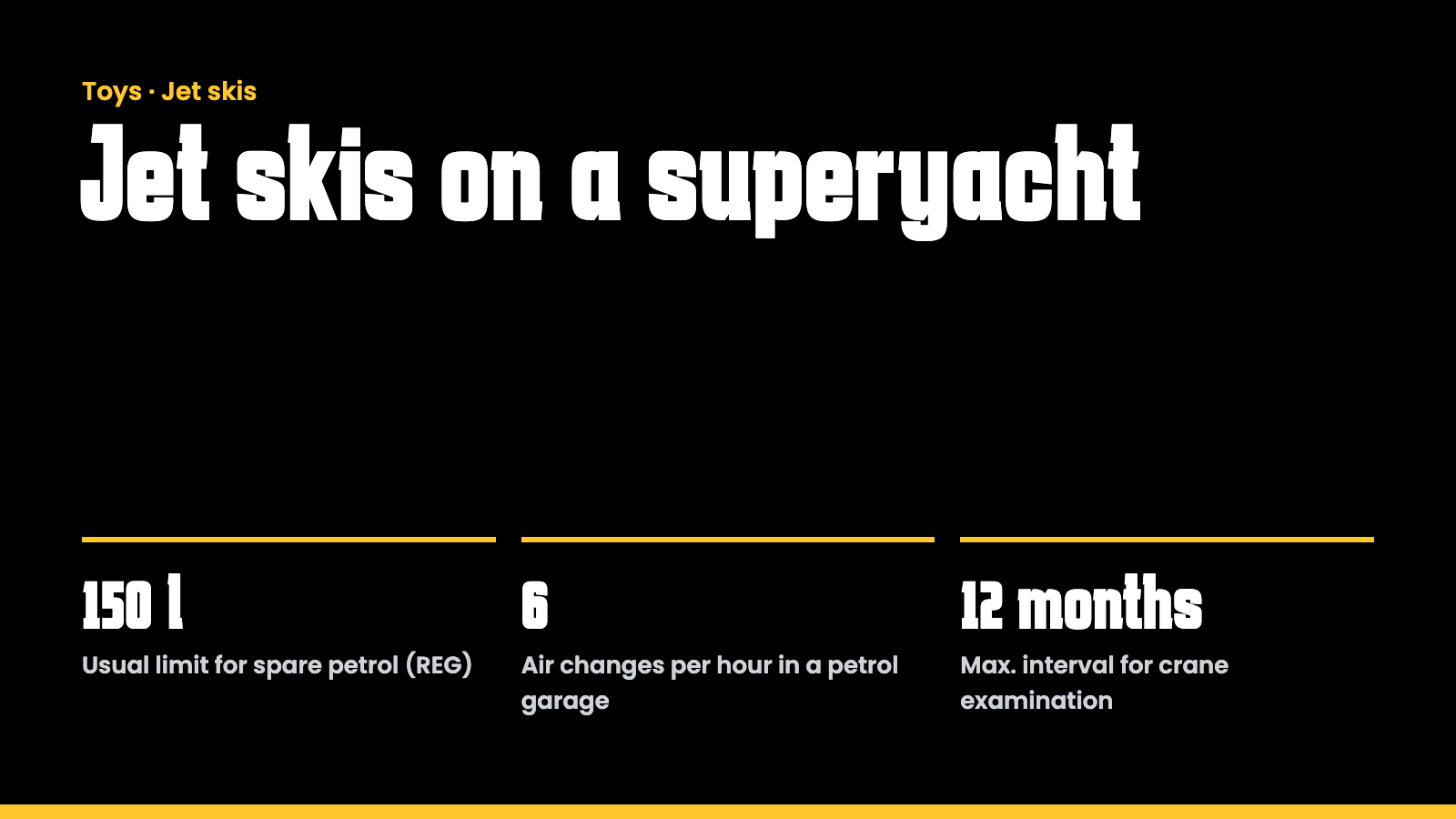
On a commercial yacht under the REG Yacht Code, an enclosed garage for jet skis with petrol in their tanks needs a manual water spray system of 3.5 litres per square metre per minute, mechanical extraction with at least six air changes an hour and a gas alarm. Spare petrol is normally limited to 150 litres. The code requires no licence but refers to the coastal state.
This guide covers the Red Ensign Group (REG) Yacht Code, the UK lifting-gear rules and the Marshall Islands Yacht Code, all checked on 7 October 2026. The rules for riding jet skis in the Balearics, on the Côte d'Azur and in Italy have their own articles, linked at the end.
Disclosure: Toys & Crew is published by Lakeberg GmbH, which trades as E-SURFER and sells ROXEN electric jet skis. This article covers the rules only and names no jet ski brands except where a manufacturer's instruction is quoted.
Which yacht code applies?
The REG Yacht Code replaced the Large Commercial Yacht Code (LY3); its Part A applies to commercial yachts over 24 metres built from 1 January 2019 (MSN 1895). Older yachts may still be certified under LY3, which also caps petrol at 150 litres (LY3, 14.1.2). Yachts under the Marshall Islands flag follow the RMI Yacht Code MI-103. We used the REG Yacht Code's July 2024 edition; it is reviewed every year.
What does a jet ski garage need?
The REG Yacht Code defines garage spaces as including spaces for jet skis and other motorised craft (Part A, Ch. 2). For enclosed spaces with petrol-fuelled craft, section 14.1(5) requires:
- Water spray: a manually released system delivering 3.5 l/m² per minute over the whole deck area.
- Drainage: if the garage drains directly overboard, the drains must be closable, and an oil spill kit must be ready; it may be part of the SOPEP kit.
- Ventilation: independent mechanical extraction of at least six air changes per hour, drawing from the lower bilge area.
- Gas detection: an alarm with sound and light in the wheelhouse.
- Electrics: equipment up to 450 mm above deck must be certified for petrol vapour; above that, IP55, or automatic all-pole isolation when the gas alarm sounds.
- Fire boundaries (yachts under 500 GT): "A-30", or "B-15" on short-range yachts (Part A, 14A.2(3)(b)).
The Marshall Islands code also requires fire and gas detection and a 3.5 l/m²/min spray system, but says the drainage must not lead directly overboard (MI-103, 10.1.3.1). This differs from the REG code, so check which code the yacht is certified to.
How much petrol can a yacht carry for its toys?
Under the REG Yacht Code, spare petrol and other highly flammable liquids are to be kept to a minimum, normally no more than 150 litres; more only after the flag has assessed the case (Part A, 14.1(2)). The rules apply to petrol in cans and in the tanks of craft such as jet skis, not to diesel (14.1(1)).
- Cans must be built to a recognised standard and labelled with their contents (14.1(3)).
- Deck lockers for cans must be away from high-risk areas, without electrics, naturally ventilated at top and bottom, drain overboard and hold the cans secure (14.1(4)). Lockers under 4 m² with no access to accommodation need only a portable CO2 extinguisher delivering at least 40 % of the gross volume as free gas, through an opening from outside.
- Fixed petrol tanks for refuelling tenders and jet skis must not be in category A machinery spaces, under sleeping quarters, forward of the collision bulkhead, closer than B/5 to the side, closer than 760 mm to the bottom or at the stern. The tank space must be gastight and insulated to "A-60", with remote level monitoring and a high-level alarm; sight glasses are banned. At least two portable foam extinguishers of 9 litres or more are required at both the dispensing point and the bunker station (Annex F).
The Marshall Islands code also caps petrol cans at 150 litres in total and bans them from weather-exposed places (MI-103, 10.1.1.2).
What rules apply to the crane or davit?
There is no davit rule written for jet skis; the general lifting-gear rules apply. On UK-registered yachts, that means LOLER 2006 (MGN 618, 2.1):
- Thorough examination: at least every 12 months, or every six months for gear that lifts people (MGN 332 Amd 4, reg. 12). Ship's lifting gear may only be used if tested by a competent person within the last five years (reg. 11).
- Responsible person: the master should appoint one person on board for lifting gear: rules, training, test records and the register (MGN 618, 4.1).
- Marking and register: every lifting appliance and loose gear is marked with its safe working load (SWL) and an identifier linked to its certificate (8.1), and the yacht keeps a register on the ILO model (10.2).
- Falls: renewed every five years at the latest; fibre ropes such as Dyneema within 18 months unless the maker says less (12.1.13–12.1.14).
- Heavier toy, same crane: if a tender is replaced with one heavier than the previous maximum working load, the owner must show the crane's working load limit is not exceeded (12.1.8).
- Manned launching: tenders and leisure craft launched with people aboard must meet the strength and load-test standards for life-saving launching appliances, with examination at least every 12 months (11.4).
The REG Yacht Code adds that stability calculations for garages and transom doors must include launching a tender, jet ski or submersible at the crane's SWL at maximum outreach (Part A, 11.5). Since 1 January 2026, cranes used to lift people must be designed, built, tested and certified to the rules of a recognised organisation, and operating instructions and limits must be posted at the controls (Annex O, O4).
On yachts under 500 GT whose rescue boat is not LSA-approved, a jet ski or other craft must not be used to launch or recover the rescue boat (Part A, 13.4(3)(d)). One manufacturer example: Taiga says its electric jet ski may only be lifted with suitable gear and PWC-rated slings spread evenly around the hull (owner's manual, 4.8).
Is a jet ski a tender?
Not under the Marshall Islands code, which says jet skis and other personal watercraft are not tenders (MI-103, 24.1.2). The REG Yacht Code lists jet skis separately from tenders in its garage and stability rules.
Which licence do crew need to ride a jet ski?
The REG Yacht Code does not set one: jet ski operation follows the law of the state in whose waters you ride (Annex G, G7). On yachts under 500 GT, the safety management procedures must cover the safe use of jet skis and the qualification of riders (Part A, 23A.12(1)(i)). We found no official licence requirement for jet ski crew from the MCA or flag states. What exists:
- RYA Personal Watercraft Proficiency: one day, mostly practical, from age 12 (12 to 16 under supervision) (rya.org.uk). The certificate can be used as evidence for an ICC (rya.org.uk). It is not on the list of certificates the RYA issues on behalf of the MCA (rya.org.uk).
- ICC: based on UNECE Resolution No. 40 and issued in the UK by the RYA; which craft it covers depends on the flag and coastal state, and a renewed ICC is valid for five years (rya.org.uk).
- On board: the RYA runs an "Introduction to Personal Watercraft Safety" course directly on superyachts worldwide (rya.org.uk).
- Tender driving is a separate qualification: the RYA Tender Operator course, developed with the PYA, takes two days and requires Powerboat Level 2 with coastal endorsement and a minimum age of 17 (rya.org.uk).
In UK waters, the Merchant Shipping Act's offences for dangerous use have applied to jet skis since 31 March 2023, including inland. Owners can be liable for an insufficient safety briefing or rider training, and the collision regulations apply (MGN 684).
What are the local rules for riding?
Each country sets its own. A few examples from official texts:
- France (Mediterranean): without a beach marking plan, jet skis may only cross the 300-metre zone at right angles to the coast at 5 knots (Préfecture maritime, Mémento).
- Croatia: jet skis may only plane more than 300 metres from the coast (NN 52/2025, Art. 50).
- Greece: at least 200 metres from the buoys of a bathing area, or 300 metres from swimmers where there are none, and a speedboat licence (ΓΚΛ 20/2022, Art. 9).
Full details for three regions: jet skis and water toys in the Balearics, on the Côte d'Azur and in Italy. For licences in six countries, see do you need a licence for a jetboard?.
What did we not check?
REG Yacht Code Part B, its transitional rule 1.6(2) and chapter 14B for yachts of 500 GT and more were not reviewed. We did not research davit and crane manufacturers.
Sources
REG Yacht Code Part A and Common Annexes (July 2024 edition), MSN 1895, LY3, RMI Yacht Code MI-103 (Rev. May 2026), MGN 618, MGN 332 Amendment 4, MGN 684, RYA course and ICC pages, Taiga Orca owner's manual, and official texts from France, Croatia and Greece. All checked on 7 October 2026 and linked above.
Sources and image rights
- Images
- Toys & Crew
- Checked
- 7 October 2026 by Andreas Lakeberg
Disclaimer. We research every article carefully and to the best of our knowledge. Salaries, prices, rules and port regulations change, and we cannot guarantee that all information is complete, current or correct. Please check anything important with the original source or the responsible authority before you rely on it. To the extent permitted by law, we accept no liability for errors or omissions.
Toys & Crew is published by Lakeberg GmbH, Berlin, the company behind E-SURFER, which began in 2017 as the first blog and YouTube channel about electric surfboards and today also sells eFoils and jetboards. We sell some of the brands we write about. That never decides what we cover or how we rate it.