From merchant navy to superyacht: what officers and engineers need to know
How merchant navy officers and engineers move to superyachts under UK rules: which licences count, conversions and the new Yachts Unlimited route.

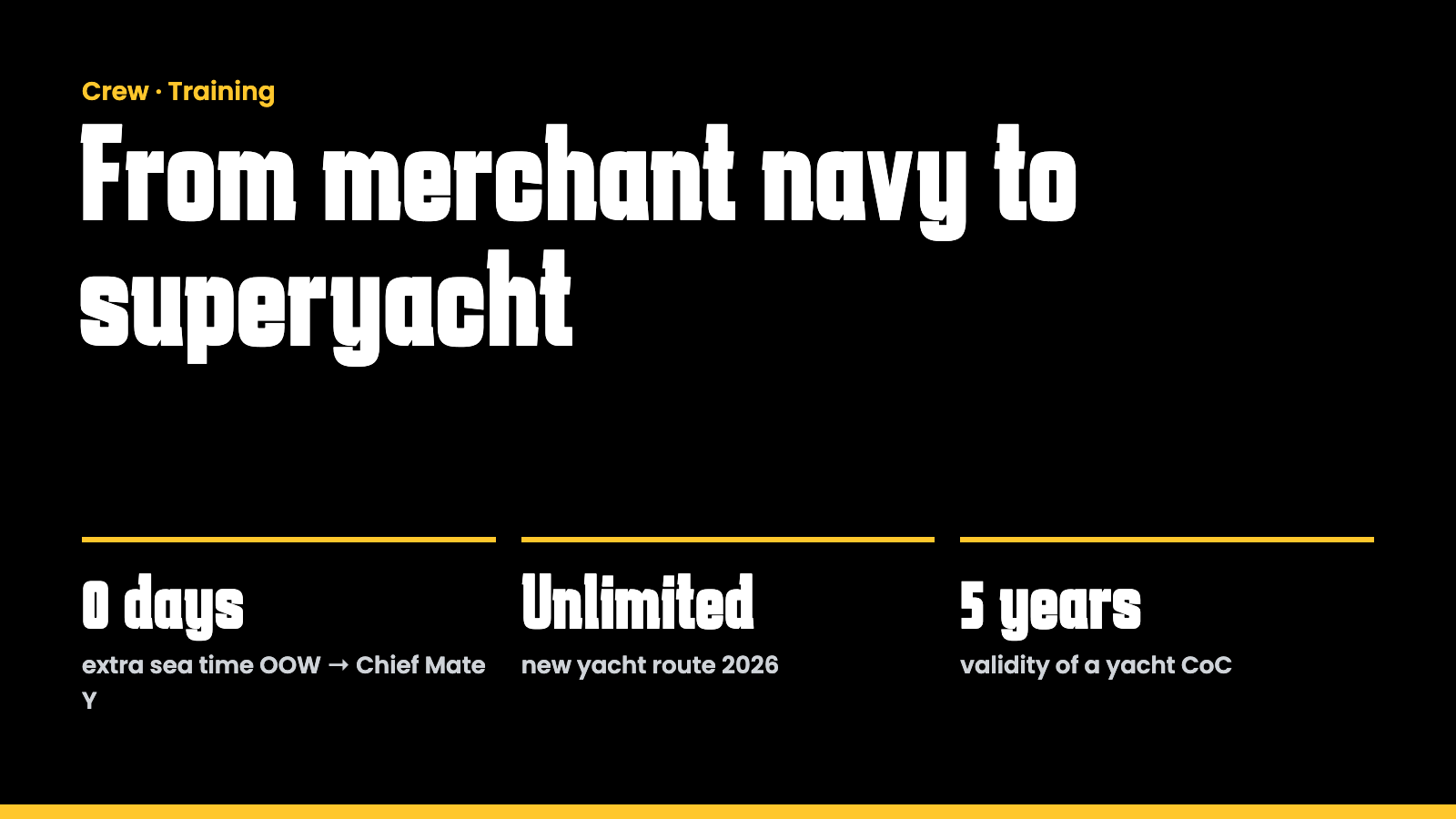
A merchant navy deck officer can work on a UK yacht of 24 metres and more under 3000 GT with their existing merchant certificate; a yacht licence is not required. Those who want a yacht certificate can convert: a UK Officer of the Watch (Unlimited) gets the Chief Mate (Yachts under 3000 GT) endorsement with additional certificates and an ENG1 only, without further sea time or exams.
We use the UK Maritime and Coastguard Agency (MCA) as reference. Other flags differ; the Cayman Islands are covered at the end.
Can you work on a yacht with a merchant navy licence?
Yes. Masters and deck officers on UK yachts of 24 metres and more under 3000 GT may be qualified either under MSN 1858 (yacht certificates) or under MSN 1856 (merchant navy certificates) (MCA, MSN 1858, section 1.2). Yacht certificates are STCW certificates limited to service on yachts and sail training vessels.
The REG Yacht Code expects STCW certificates for masters and officers in general and lets the flag accept yacht certificates only on yachts under 3000 GT (REG Yacht Code, Common Annexes). Officers without a UK certificate need a UK Certificate of Equivalent Competency (CEC); with confirmation of their application they may serve for up to three months (MCA, Master's Guide to the UK Flag).
How do you convert to a yacht certificate as a deck officer?
From the MCA guidance on deck officer certification (GOV.UK):
| You hold | You get | What you need |
|---|---|---|
| UK OOW Unlimited (II/1) | Chief Mate (Yachts < 3000 GT) | additional certificates (table A) and a valid ENG1; no further sea time or exams |
| UK OOW Unlimited (II/1) | Master (Yachts < 3000 GT) | 24 months' sea time as OOW, modules "Business and Law" and "Navigation, Radar and ARPA Simulator", celestial navigation and an oral exam |
| Master Unlimited (II/2) | Master (Yachts < 3000 GT) | the same two modules, celestial navigation and an oral exam; no additional sea time |
These conversions apply to UK certificates. Holders of foreign OOW certificates go through the routes for foreign certificates, which require more modules. The MCA recommends having yacht sea time verified by Nautilus International or the PYA before applying, otherwise delays of around 160 days can occur.
What is the new Yachts Unlimited route?
Since 18 May 2026, MSN 1858 Amendment 2 adds Chief Mate Yachts Unlimited and Master Yachts Unlimited, without a tonnage limit (MSN 1858, section 4):
- Chief Mate Yachts Unlimited for OOW Unlimited holders: 12 months of yacht service as OOW, at least 6 months of it at sea, all on yachts of 500 GT and more; NAEST (Management); nine academic modules at an approved nautical college, including "Management of Yacht Operations" and "Shipmaster's Law and Business"; MCA exams in navigation and stability and an oral exam.
- Master Yachts Unlimited for OOW Unlimited holders: 36 months of yacht service as OOW, at least 15 months of it at sea on vessels of 500 GT and more.
- Holders of a merchant Chief Mate Unlimited are exempt from the Chief Mate Yacht Unlimited oral exam but must pass the Master Unlimited GT Yacht oral.
- Additional certificates for the Unlimited route include ECDIS, GMDSS (GOC), HELM (Management) and NAEST (Management).
How is sea time counted?
- Sea time on vessels of any flag counts.
- A day counts if you worked at least 4 hours in 24.
- At least 6 months must fall within the 5 years before the MCA receives your application.
- Combined deck and engine duties count at 50 %.
- Standby time after a voyage counts for at most 14 consecutive days, and never more than actual sea time.
All from MSN 1858, section 5. A yacht certificate is valid for 5 years.
What about engineers?
- The old yacht engineer route (MSN 1859) closed on 31 December 2022 and was formally withdrawn in January 2023. Since then, the Small Vessel route under MSN 1904 applies; existing yacht engineer certificates can still be revalidated (MCA, MSN 1904).
- MSN 1904 has three levels: EOOW (under 9000 kW / under 3000 GT), Chief Engineer (under 3000 kW / under 500 GT) and Chief Engineer (under 9000 kW / under 3000 GT), each with unlimited area. Certificates limited to yachts are possible. For yacht engineers, sea time only counts while the vessel is under way with the main engine running (MSN 1904).
- An engineer with a higher yacht or a merchant navy certificate may serve in the corresponding role on a yacht (MCA, certification for engineers on yachts).
The conversion routes from merchant navy to Small Vessel engineer certificates are set out in MIN 642. In its last version, a Second Engineer Unlimited (III/2) could get Chief Engineer SV (under 3000 kW / under 500 GT) with additional certificates and an ENG1 only (MCA, MIN 642). MIN 642 expired on 1 December 2025 according to its own text, and we found no successor; check the current rules with the MCA before applying.
Other flags: the Cayman Islands
The Cayman flag accepts yacht certificates only from France, Italy, the Netherlands, New Zealand and the UK, and merchant certificates from a longer list of countries. Officers on Cayman-flagged vessels, including yachts, also need a Cayman endorsement under STCW regulation I/10 (CISR Shipping Notice 05/2011).
Sources
UK Maritime and Coastguard Agency (MSN 1858 Amendment 2, MSN 1904, MIN 642, guidance on deck and engineer certification for yachts, Master's Guide to the UK Flag), REG Yacht Code (July 2024) and Cayman Islands Shipping Registry. All checked on 4 October 2026 and linked above.
Sources and image rights
- Images
- Simon R. Minshall / Pexels (conditions)
- Checked
- 4 October 2026 by Andreas Lakeberg
Disclaimer. We research every article carefully and to the best of our knowledge. Salaries, prices, rules and port regulations change, and we cannot guarantee that all information is complete, current or correct. Please check anything important with the original source or the responsible authority before you rely on it. To the extent permitted by law, we accept no liability for errors or omissions.