STCW basic safety training: what yacht crew need to know in 2026
The four STCW basic training modules, who needs them, refreshers every five years, course prices and the new harassment module due by March 2027.

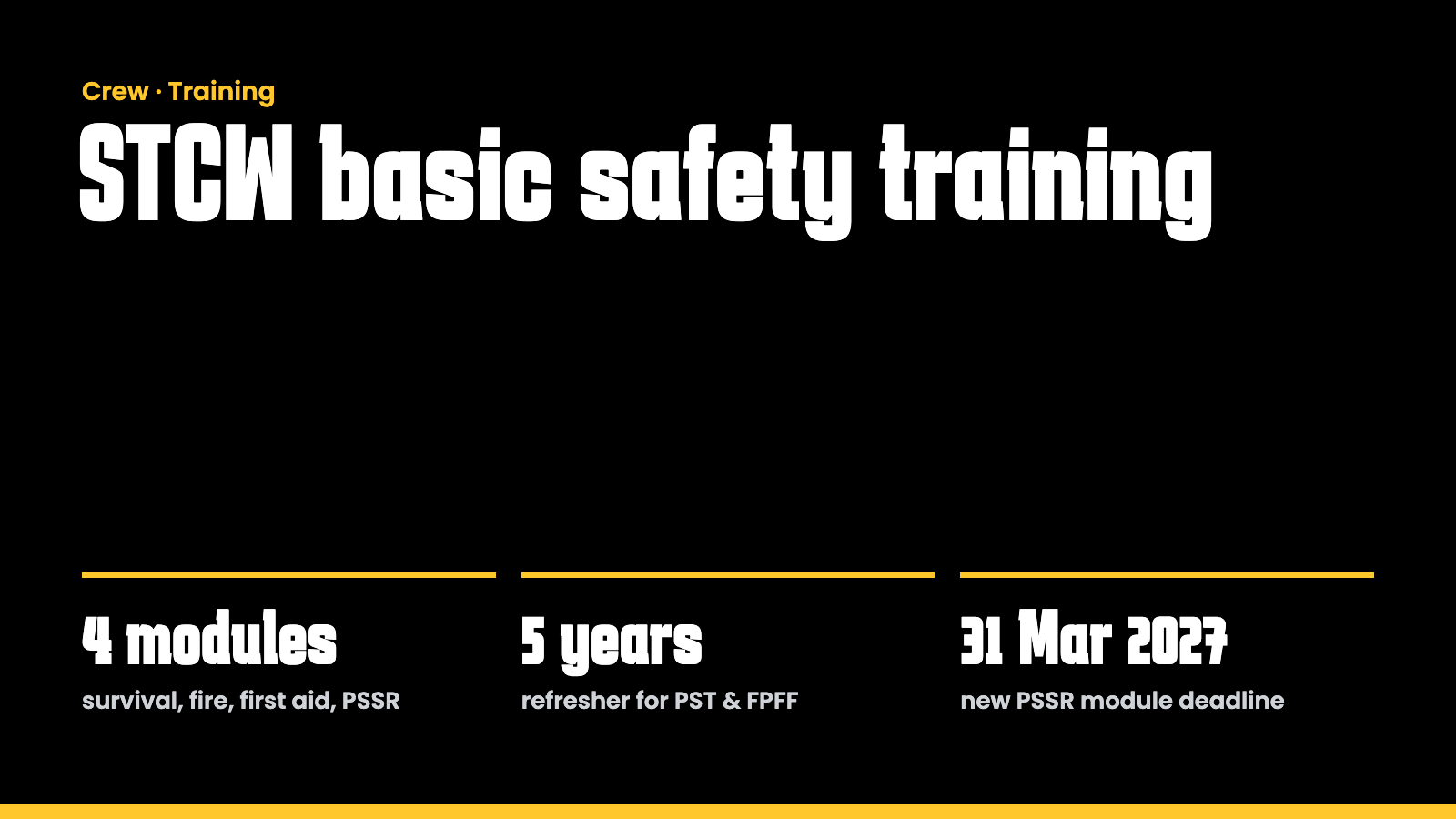
STCW basic safety training is the course every yacht crew member with safety duties must complete before starting work on board. It has four modules: personal survival, fire fighting, first aid and personal safety. Survival and fire fighting must be refreshed every five years, and anyone holding a UK personal safety certificate from before 2026 must add a short online module by 31 March 2027.
We use the UK Maritime and Coastguard Agency (MCA) as our reference, because it publishes its rules and approved course lists in full. Other flag states apply the same international STCW Code but can differ in detail.
What is STCW?
STCW is the International Convention on Standards of Training, Certification and Watchkeeping for Seafarers. It was adopted on 7 July 1978 and came into force on 28 April 1984 (IMO).
Basic training consists of four elements (MCA, MSN 1865, section 3.1):
- Personal Survival Techniques (PST)
- Fire Prevention and Fire Fighting (FPFF)
- Elementary First Aid (EFA)
- Personal Safety and Social Responsibilities (PSSR)
Who needs STCW basic training?
Every crew member who is assigned safety or pollution-prevention duties needs it, and needs it before taking up any duties on board (MCA, MSN 1865, section 3.1; STCW Regulations 2022, reg. 27).
- The minimum age for each certificate is 16. For the survival course, the MCA can allow younger participants in exceptional cases if they are physically fit (MSN 1865, sections 3.2–3.5).
- For a UK certificate, the course must be taken with an MCA approved training provider (MSN 1865, section 3.2). The MCA publishes a list of approved providers per module and updates it monthly (MCA approved training providers).
- Purely online courses are not recognised where the STCW Code requires practical training, such as fire fighting or survival at sea (MCA, MIN 643, section 4.2).
Is security training part of it?
On ships that must comply with the ISPS Code, every crew member also needs Proficiency in Security Awareness before starting work (MSN 1865, section 7.3; STCW Regulations 2022, reg. 30). Many schools add it to the basic training week at no extra cost.
How long does the course take, and what does it cost?
There is no official course length. The schools we checked run basic safety training as a week:
| School | Location | Length | Price | As of |
|---|---|---|---|---|
| UKSA | Cowes, UK | 5 days, incl. Security Awareness | £850 | courses Oct–Dec 2026 |
| UKSA | Cowes, UK | 5 days | £875 | courses from Feb 2027 |
| Flying Fish | Cowes, UK | 5.5 course days, without accommodation | £850 | page undated |
| Warsash Maritime School | Southampton, UK | 5 days, incl. Security Awareness | £999 | booking portal, undated |
| Bluewater | Antibes, France | 5 days | €1,295 | courses Oct–Nov 2026 |
| Bluewater | Palma, Spain | 5 days | €1,295 | courses Oct–Nov 2026 |
Flying Fish breaks the week down as follows: fire fighting 2.5 days, survival techniques 1 day (theory in the morning, life raft drill in the pool in the afternoon), first aid 1 day, personal safety half a day and security awareness half a day (Flying Fish). Bluewater in Antibes and Palma is on the MCA list of approved providers abroad (MCA list, 10 September 2026).
Do STCW certificates expire?
Survival techniques and fire fighting must be refreshed at least every five years (STCW Regulations 2022, reg. 43; MSN 1865, section 4.4). Strictly speaking, the certificates do not expire, but to work on a ship that falls under STCW, you must have gained or refreshed them within the last five years (MIN 643, section 5.4).
- First aid and personal safety (PSSR) need no refresher (MIN 643, section 5.1).
- The fire fighting refresher is only available as a 7-hour course ashore. For the survival refresher, a 4-hour course is enough if you sign a self-declaration for the parts done on board; otherwise you repeat the full course (MSN 1865, section 4.5).
- UKSA runs the combined survival and fire fighting refresher as a 3-day course for £550 (courses Oct–Dec 2026, UKSA).
What changed in 2026?
Since 1 January 2026, the personal safety module (PSSR) includes a new competence on preventing and responding to violence and harassment (MCA, MGN 718).
- If you hold a UK PSSR certificate issued before 1 January 2026, you must complete the free online module "Prevention and Response to Violence & Harassment" (OneOcean, reference 0900) by 31 March 2027.
- The module takes about one hour, works on a phone and has no final exam.
- MCA approved PSSR courses from 1 January 2026 already include the new competence.
Are certificates from other countries accepted?
For the four basic modules, the MCA accepts certificates from any administration on the IMO list of countries that fully implement STCW, the so-called White List (MIN 643, section 4.4). Security Awareness certificates from these countries are accepted too (MIN 643, section 4.9).
Sources
UK Maritime and Coastguard Agency (MSN 1865 Amendment 1, MIN 643, MGN 718, approved provider lists), UK STCW Regulations 2022, IMO, and the course pages of the schools listed. All checked on 4 October 2026 and linked above. MIN 643 is due to expire on 30 November 2026.
Sources and image rights
- Images
- Mathias Reding / Pexels (conditions)
- Checked
- 4 October 2026 by Andreas Lakeberg
Disclaimer. We research every article carefully and to the best of our knowledge. Salaries, prices, rules and port regulations change, and we cannot guarantee that all information is complete, current or correct. Please check anything important with the original source or the responsible authority before you rely on it. To the extent permitted by law, we accept no liability for errors or omissions.