Towing tubes and banana boats behind the tender: rules, ropes, speeds and prices
What France, Greece, Spain, Croatia, Monaco and the UK require when the tender tows guests on tubes or bananas, plus maker limits, ropes and prices.

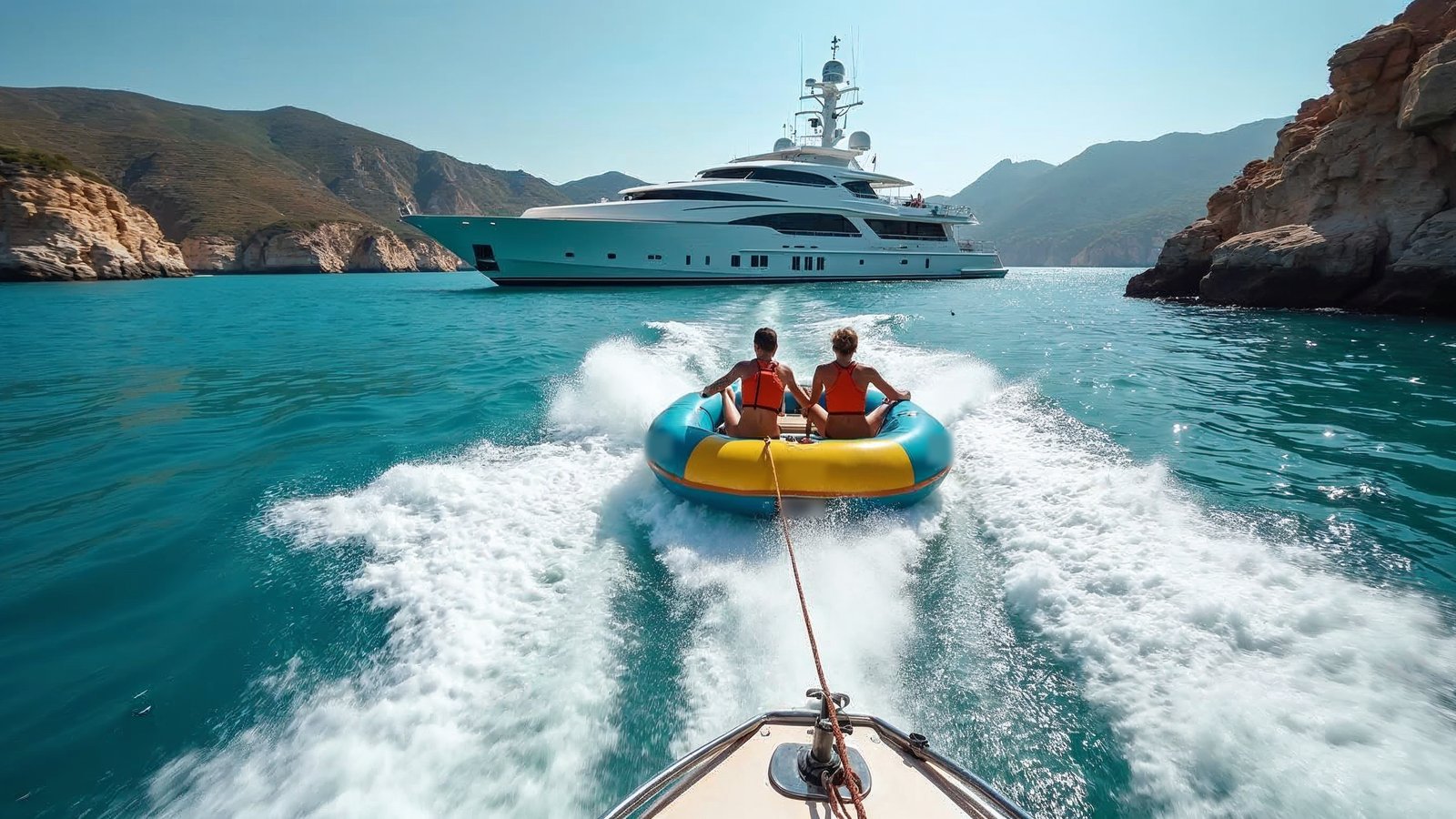
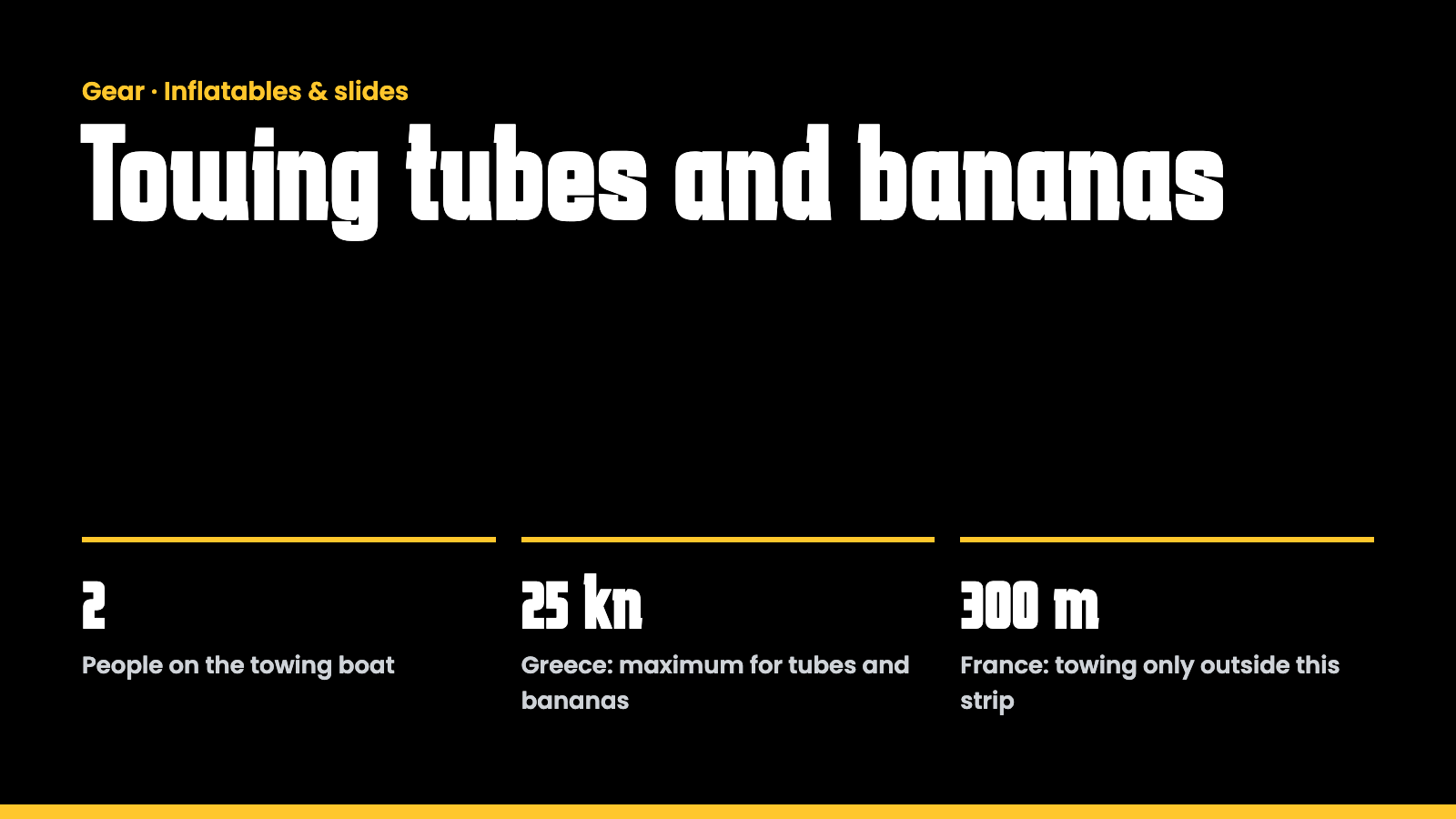
Behind the tender, the rules agree on three things: a second person on board who only watches the riders, daylight, and distance from bathing areas. France requires that observer to be at least 16 and keeps towing outside the 300-metre coastal strip; Greece caps tubes and bananas at 25 knots. Manufacturers set lower speed limits.
Every rule below links to the official text, every product figure to the manufacturer. We found no country that names the yacht tender itself in its towing rules; they apply to whichever boat is towing.
What are the towing rules in each country?
| Country | Observer | Where and when | Other rules | Source |
|---|---|---|---|---|
| France (Mediterranean) | two people on the towing boat: one drives, one watches and releases the line; the observer must be at least 16 for private use | daylight only, outside the 300 m coastal strip, which is crossed through a channel for fast water sports; 5 knots within the strip | life jackets for riders; the boat must be able to take all riders on board; 2 m fluorescent orange pennant; tow in a conspicuous colour, floating line and quick release | Prémar Méditerranée arrêté 109/2024 |
| Greece | two people; the second at least 18 and able to swim; a mirror in front of the helm keeping the riders in view | tubes and bananas at most 25 knots, never before sunrise or after sunset, not in winds above force 5 or poor visibility | riders at least 16 (on bananas, younger riders with parental consent), life jackets in red, green, yellow or orange; one banana per boat; no more than four 1-person, two 2-person or one 3-to-6-person tube; equal rope lengths | ΓΚΛ 20, codified 6 October 2026 |
| Spain | not specified nationally | always outside bathing zones | towing with a jet ski: riders plus towed persons within the jet ski's seats, life jackets for all; a towed object never carries more people than the maker allows | Real Decreto 259/2002, Art. 6 |
| Croatia | no towing rule of its own | 8 knots within 300 m of the coast; planing only beyond 300 m, so towing starts outside that line | a tender registered as the mother ship's equipment stays within 500 m of her; boats under 15 m keep 50 m from the coast | NN 52/2025 |
| Monaco | not regulated in the Code de la mer | 5 knots within 300 m of the shore and harbour entrances, 3 knots in harbours | seasonal no-go area between the Digue Rainier III solarium and Pointe de la Poudrière, 1 May to 31 October | Code de la mer |
| UK | two people for commercial towing from beaches and harbours: one drives, one watches | – | ropes about 25 to 30 m with quick release; children under 8 accompanied by an adult; tow should float with 110 % of its rated load even with one chamber failed; kill cord always used | MGN 498 Amendment 1 |
In Greece, private fast boats leave or reach a beach only through a marked channel at no more than 3 knots, with no swimmers within 100 m on either side, and a boat towing a water-skier may not tow a banana or tube at the same time (ΓΚΛ 20). The UK guidance is not binding but was written after a fatal accident in which a child fell from a banana and was struck by the towing boat; local authorities can make it mandatory (MGN 498 Amd 1). On the French Channel and North Sea coasts, a separate order sets the same two-person, daylight and 300-metre rules (Prémar Manche 41/2018); whether it is still in force was not checked.
Does the tender driver need a licence?
Usually yes. In France, a boating licence is required for motorboats above 4.5 kW (French Ministry of the Sea). In Italy, boats up to 24 m need a licence with engines over 30 kW, among other cases (Codice della nautica, Art. 39). Greece requires a licence for fast boats and the ability to swim from anyone towing people (ΓΚΛ 20). Which licences crew hold for the tender is in our guide from deckhand to captain.
Which standard applies to towables?
ISO 25649 classes towed inflatables such as tubes, rafts and bananas as Class C, with extra requirements and tests in Part 5; typical use is away from bathing areas and busy water, in little swell and no strong current (SIS, ISO 25649-5). Class C has three subclasses, C1 to C3, from static to extreme use; water skis and wakeboards are outside the standard (ISO/FDIS 25649-1). We read only the catalogue page and the draft; none of the manufacturers below states an ISO class or CE marking on its product pages.
What do manufacturers say about speed, ropes and riders?
| Topic | Maker's figure | Source |
|---|---|---|
| Speed, tubes | at most 32 km/h with adults, 24 km/h with children | O'Brien manual |
| Speed, banana | at most 24 km/h; faster towing voids the warranty | Jobe manual |
| Rope length | 15 to 20 m | Jobe manual, O'Brien manual |
| Rope strength | 1–2 riders up to 155 kg: 1,077 kg; 3–4 riders up to 308 kg: 1,860 kg; 5–10 riders up to 770 kg: 2,767 kg | Jobe manual |
| Distance | boat and towable at least 55 m from shore, rocks, boats, jetties, buoys and shallows | Jobe manual |
| Children | no banana riders under 6, children only with an adult supervising | Jobe manual |
| Inflation | about 2 PSI (around 0.14 bar) for a tube; Jobe inflates to 95 % so the air can expand in the sun | O'Brien manual, Jobe manual |
Both Jobe and O'Brien require a spotter besides the driver (Jobe; O'Brien). Jobe allows one towable at a time, no jumps and starts only from the water, and warns never to let anyone hold on closer than 6 m behind a moving boat because of carbon monoxide (Jobe manual). O'Brien warns that a tube can swing out and become much faster than the boat in tight turns (O'Brien manual). Never use a water-ski rope or a rope with elastic or bungee material for tubes (Jobe; O'Brien). For an outboard tender or towing eyes on both sides of the transom, Mesle calls for a bridle (Mesle).
What do tubes, bananas and ropes cost?
| Product | Riders | Price | Tax basis | Source |
|---|---|---|---|---|
| Spinera Rocket 3 (banana) | 3 | €239.95 | incl. 19 % VAT | Spinera |
| Mesle Tube Gravity 3P | 3 | €279.99 | incl. VAT | Mesle |
| Jobe Chaser Towable 4P | 4 | €349.99 | unclear | Jobe |
| Airhead Quadra Cruiser | 1–4 | US$370.99 | unclear | Airhead |
| Connelly Fun 4 | 4 | US$449.99 | unclear | Connelly |
| O'Brien Pillar 4 | 4 | US$499.99 | unclear | O'Brien |
| HO Sports 4G Tube | 4 | US$665.00 | unclear | HO Sports |
| Jobe Banana Watersled 6P | 6 | €1,099.99 | unclear | Jobe |
| Spinera Professional Multirider 10 | 10 | €1,589.95 | incl. 19 % VAT | Spinera |
| Jobe Rental Multi Rider 8P | 8 | €1,844.99 | unclear | Jobe |
| Mesle Skibob Banana Boat Pro HD 10P | 10 | €2,299.99 | incl. VAT | Mesle |
| Tow ropes for 4 to 10 riders | – | €19.95 to €59.99; US$29.99 to US$54.99 | incl. VAT at Spinera and Mesle, unclear at Jobe, Airhead, O'Brien and Connelly | Spinera, Mesle, Jobe, Airhead, O'Brien, Connelly |
Prices were taken from the makers' shops on 7 October 2026 and are not converted. Airhead ships only to the continental US from its own shop (Airhead FAQ). Commercial bananas are heavy to stow: Mesle's 10-seater weighs 58.8 kg and packs to 115 × 75 × 30 cm (Mesle), Spinera's about 52 kg (Spinera).
How should crew look after towables?
- Rinse with fresh water after salt water and store dry, deflated and cool; very cold storage can crack the vinyl (O'Brien manual).
- In breaks, let some air out or move the tube into shade; sun expands the air and bleaches the material (Airhead; Jobe manual).
- Inflate with a hand or foot pump, not a compressor (Mesle).
- Before a crossing, wash every toy including valves and seams, stow it so it cannot chafe or overheat, and before the first guest use inflate everything fully and check valves, fittings and pumps (FunAir).
For slides and floating platforms, see our guides to inflatable yacht slides and inflatable docks and swim platforms.
What could we not verify?
- Italy: the coastguard ordinances (ordinanze of the Capitanerie) were not accessible, so observer, age, distance, zone and daylight rules are missing.
- Spain: national detail rules for towing from boats were not found; the 2026 rules of individual harbour masters were not used.
- The published version of ISO 25649, and the EU decision on floating leisure articles.
Sources
Préfecture maritime de la Méditerranée arrêté 109/2024 and Préfecture maritime Manche 41/2018; French Ministry of the Sea; Spain's Real Decreto 259/2002 (BOE); Greek ΓΚΛ 20 (Hellenic Coast Guard, codified 6 October 2026); Croatian NN 52/2025; Italy's Codice della nautica; UK MGN 498 Amendment 1 (June 2025); Monaco Code de la mer; ISO 25649 via SIS and the ISO/FDIS draft; manufacturer pages and manuals of Jobe, O'Brien, Connelly, HO Sports, Airhead, Mesle, Spinera and FunAir. All checked on 7 October 2026.
Sources and image rights
- Images
- AI-generated (Magnific)
- Checked
- 7 October 2026 by Andreas Lakeberg
Disclaimer. We research every article carefully and to the best of our knowledge. Salaries, prices, rules and port regulations change, and we cannot guarantee that all information is complete, current or correct. Please check anything important with the original source or the responsible authority before you rely on it. To the extent permitted by law, we accept no liability for errors or omissions.