Electric yacht tenders in 2026: models, battery sizes, range and charging on board
Nine electric tenders from 1.8 to 8.8 metres with battery, range, charging time and published prices, plus the standards that apply to electric propulsion.

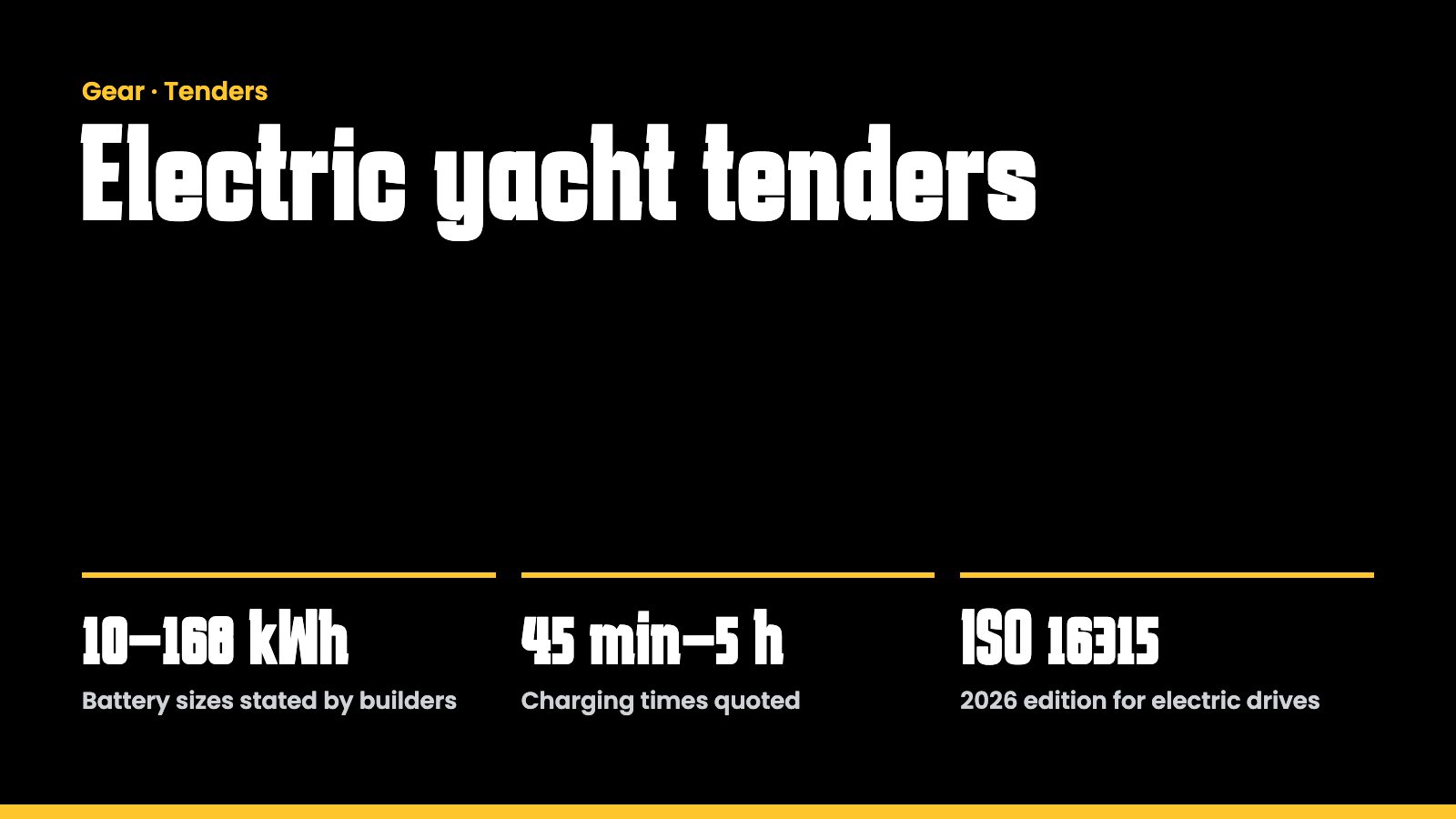
Electric yacht tenders in 2026 range from a 1.8-metre inflatable with a swappable battery to an 8.8-metre RIB with 168 kWh. Builders quote 10 to 168 kWh, ranges from 15 km to 100 nautical miles depending on model and speed, and charging times from 45 minutes to five hours. Few publish prices, and some large models are still prototypes.
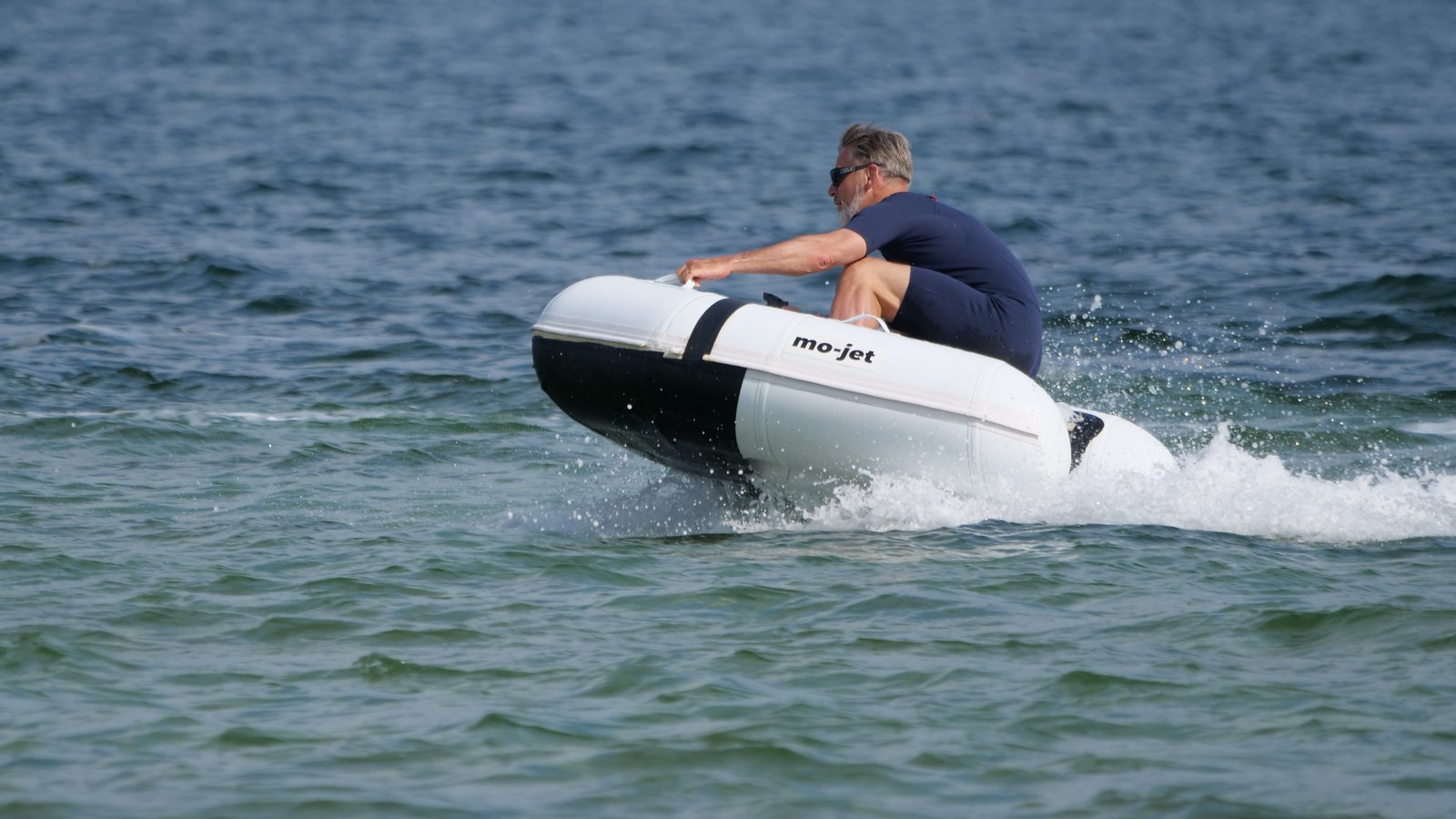
Disclosure: Toys & Crew is published by Lakeberg GmbH, which trades as E-SURFER and sells the mo-jet tender. It is listed below with the same data as every other builder.
All figures are the builders' own, checked on 7 October 2026. For tender types in general, see Yacht tenders explained.
Which electric tenders are available?
| Model | Further published figures | Source |
|---|---|---|
| Voltari 260T/T (carbon deep-V RIB) | Length: 8.8 m incl. 3-ft swim platform; Battery: 168 kWh; Speed: over 55 mph; Range / run time: over 90 miles at low wake, over 30 miles cruising | Voltari |
| Falcon Tenders E8 (open, Vita Power drive) | Length: 8 m; Battery: 63 or 126 kWh; Speed: 20 kn / 37 km/h cruise, 30 kn / 55.6 km/h top (expected); Range / run time: estimated 30 nm with a two-battery system (63 or 126 kWh) | Falcon, press release 2023 |
| RS Electric Boats Pulse 63 | Speed: 23 kn / 42.6 km/h; Range / run time: 100 nm at 5 kn / 9.3 km/h, 70 at 10 kn / 18.5 km/h, 45 at 15 kn / 27.8 km/h, 25 at 20 kn / 37 km/h | RS Electric FAQ |
| MC-ZERO 450 (McConaghy / ZeroJet, carbon jet) | Length: 4.5 m; Battery: 32 kWh (LiFePO4); Speed: 24 kn / 44.4 km/h; Range / run time: driver only: 18 nm at 18 kn / 33.3 km/h, 42 nm at 4 kn / 7.4 km/h; 8 people: 13 nm at 17 kn / 31.5 km/h, 18 nm at 4 kn / 7.4 km/h | ZeroJet |
| Zodiac eJET 450 (previous model) | Length: 4.5 m; Battery: 40 kWh; Speed: 25 kn / 46.3 km/h; Range / run time: 90 min at 24 kn / 44.4 km/h, 8 h at 5 kn / 9.3 km/h | Zodiac |
| Highfield EJET330 (ZeroJet drive) | Length: 3.36 m; Battery: 10.8 kWh (LiFePO4) | Highfield |
| MC-ZERO 325 | Length: 3.25 m; Battery: 16 kWh; Speed: 24 kn / 44.4 km/h; Range / run time: not stated | ZeroJet |
| Agilis 280E (Germany, ZeroJet drive) | Length: 2.80 m; Battery: 10 kWh; Speed: 21 kn / 38.9 km/h | ZeroJet |
| mo-jet tender 180 / 238 (Hypalon inflatable, modular electric jet) | Length: 1.8 / 2.38 m; Battery: swappable battery; Speed: up to approx. 50 km/h / 27 kn with 1 person, 35 km/h / 18.9 kn with 2; Range / run time: 15 min to approx. 1 h, up to 15 km | mo-jet |
Notes from the builders:
- Williams calls the EvoJet 70e a fully electric technology demonstrator, not a series model. It seats 13, weighs 2,200 kg dry and is meant for yachts of 40 metres and more; with the T-top folded, the height drops from 1.83 to 1.35 metres, which matters for the garage (Williams).
- Pascoe offers fully electric drive for several tender models; its current page says the first eLimousine is still under construction (Pascoe). In 2022 it gave target figures of 40 knots (74.1 km/h) and up to 60 miles, and announced the first delivery for 2023 (Pascoe, press release 2022).
- Falcon E8: two drive packages, 90 kW continuous / 126 kW peak or 150 kW / 220 kW.
- Voltari 260T/T: 550 kW peak, 11 seats (or 5 with an open bow for cargo), about 2,950 kg; bow tow plate standard, three-point lifting kit optional.
- RS Pulse 63: battery enlarged from 46 to 63 kWh in August 2023, 40 kW drive, 815 kg including batteries, four-point lifting harness optional (RS Electric). It can be coded for leisure use or commercially under MGN 280.
- MC-ZERO 450: 780 kg, 8–9 seats, two 30 kW jets, 650 kg payload, 1.13 m high with the console folded. The 325 weighs 446 kg, seats 5–6 and has one 30 kW jet. ZeroJet gives three years' warranty on the system and five on the batteries.
- Highfield EJET330: up to 5 people, 425 kg payload, CE design category C.
- Agilis 280E: 215 kg dry, 3 people, 22 kW.
- Zodiac now lists the eJET 450 under "Previous Models" (Zodiac). It had a 50 kW Torqeedo Deep Blue drive, a BMW battery, 870 kg and room for 7.
- mo-jet tender 180: tender module 180 × 138 × 70 cm, about 66 kg; drive unit 39.3 kg with about 100 kg static thrust.
How are electric tenders charged on board?
From the yacht's own power, according to the builders. Pascoe says its eLimousine charges from the mother ship's generators instead of bunkering diesel for the tender (Pascoe). Voltari's 260T/T needs no fuel on board and charges from the generator or shore power (Voltari). RS Electric describes the routine as: rinse after use, lift into the garage or onto the platform, charge overnight (RS Electric). The mo-jet tender uses a plug-and-play battery that is charged outside the boat (mo-jet).
| Model | Charging time (builder) |
|---|---|
| Voltari 260T/T | empty to full in 45 min with its Level III fast charger |
| Falcon E8 | 20 to 80 % in just under one hour (DC fast charging), slow charging 4–5 h |
| RS Pulse 63 | full in 2 h via CCS, or from mains or shore power |
| Highfield EJET330 | 2–5 h, 1–2.5 h with fast charger |
| Zodiac eJET 450 | 3 kW charger and shore power cable as standard |
For battery storage, charging spaces and firefighting on yachts, see lithium batteries for water toys on yachts.
What do electric tenders cost?
Few builders publish a price. Prices are not converted; the tax basis is as stated on the page.
| Model | Price | Basis | Source |
|---|---|---|---|
| mo-jet tender 180 | €18,400 | EUR, Germany, excl. VAT, delivery 3 weeks | mo-jet |
| mo-jet tender 238 | €18,900 | EUR, Germany, excl. VAT | mo-jet |
| Highfield EJET330 | from $35,000 | USD, listed by ZeroJet | ZeroJet |
| Agilis 280E | from $34,000 | USD, listed by ZeroJet | ZeroJet |
| RS Pulse 63 | on request | no list price | RS Electric FAQ |
Which standards apply to electric propulsion in a tender?
For small craft up to 24 metres, the standard for electric drives is EN ISO 16315:2026, "Small craft — Electrical systems used for electrical propulsion", second edition. It covers electric and hybrid propulsion systems below 1,500 V DC or 1,000 V AC (SIS). The 2016 edition is withdrawn (SIS).
Under the EU Recreational Craft Directive, as explained in the European Boating Industry's application guide, batteries must be secured and protected against water ingress and ventilated against gas build-up, and electric propulsion circuits must not affect other circuits in a way that makes either fail. Relevant harmonised standards include EN ISO 10133:2017 for DC and EN ISO 13297:2018 for AC systems (EBI RCD Application Guide, 5.3).
Sources
Builders' pages of Williams, Pascoe, Falcon Tenders, Voltari, RS Electric Boats, ZeroJet / McConaghy, Highfield, Agilis, Zodiac and mo-jet; SIS pages on EN ISO 16315; European Boating Industry RCD Application Guide (2nd edition, January 2022). All checked on 7 October 2026 and linked above. Prices change often; check with the builder before buying.
Sources and image rights
- Images
- Toys & Crew
- Checked
- 7 October 2026 by Andreas Lakeberg
Know something we missed – a rule, a fee, a marina detail? Write to editor@toysandcrew.com. We check every tip against the source and note updates at the top of the story.
Disclaimer. We research every article carefully and to the best of our knowledge. Salaries, prices, rules and port regulations change, and we cannot guarantee that all information is complete, current or correct. Please check anything important with the original source or the responsible authority before you rely on it. To the extent permitted by law, we accept no liability for errors or omissions.
Toys & Crew is published by Lakeberg GmbH, Berlin, the company behind E-SURFER, which began in 2017 as the first blog and YouTube channel about electric surfboards and today also sells eFoils and jetboards. We sell some of the brands we write about. That never decides what we cover or how we rate it.