Lithium batteries for water toys on yachts: storage, charging and fire safety rules
What MGN 681 and the REG Yacht Code require for eFoil, jet ski and tender batteries on board, the 2027 type approval for battery boxes, and storage tips.

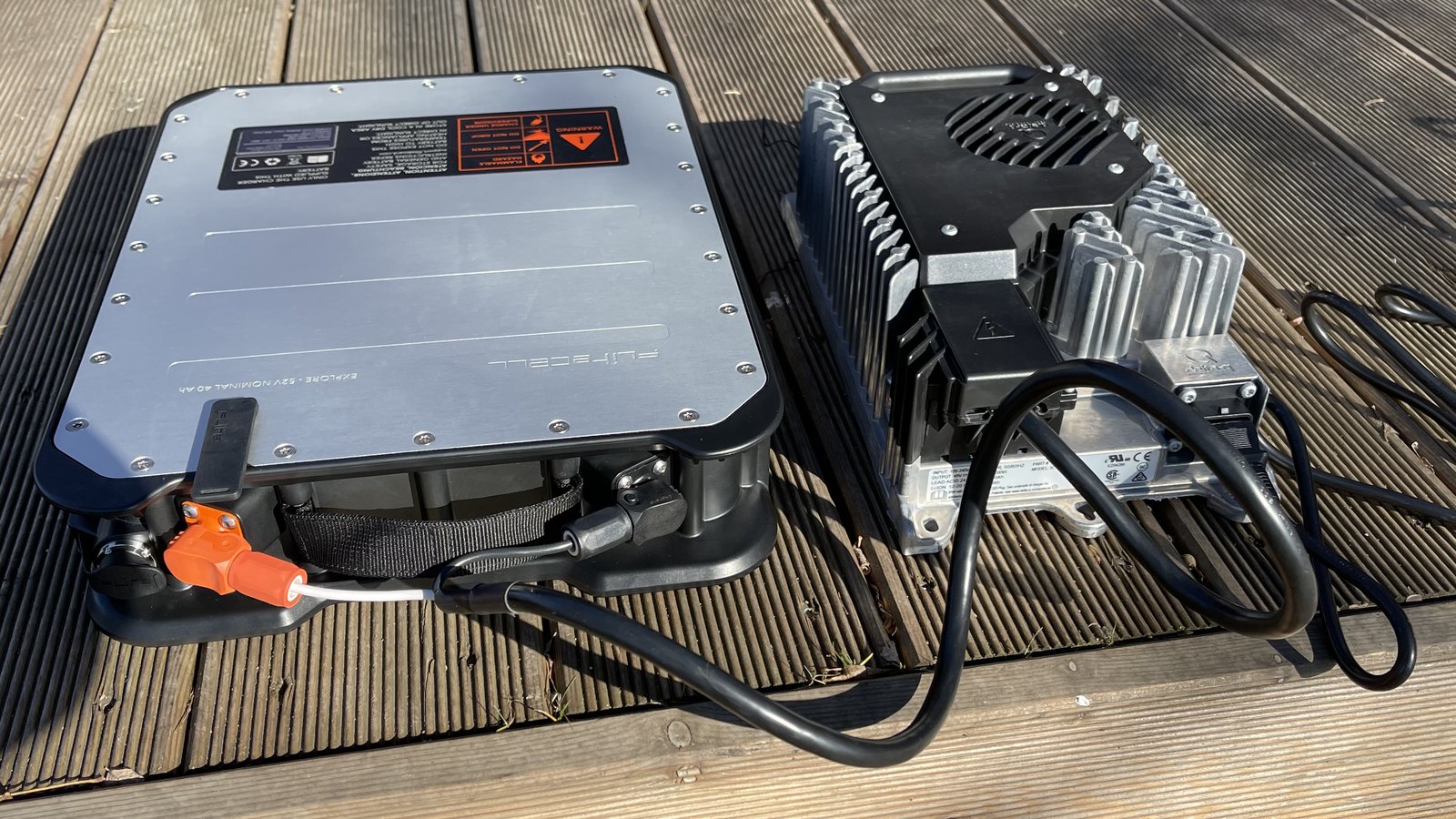
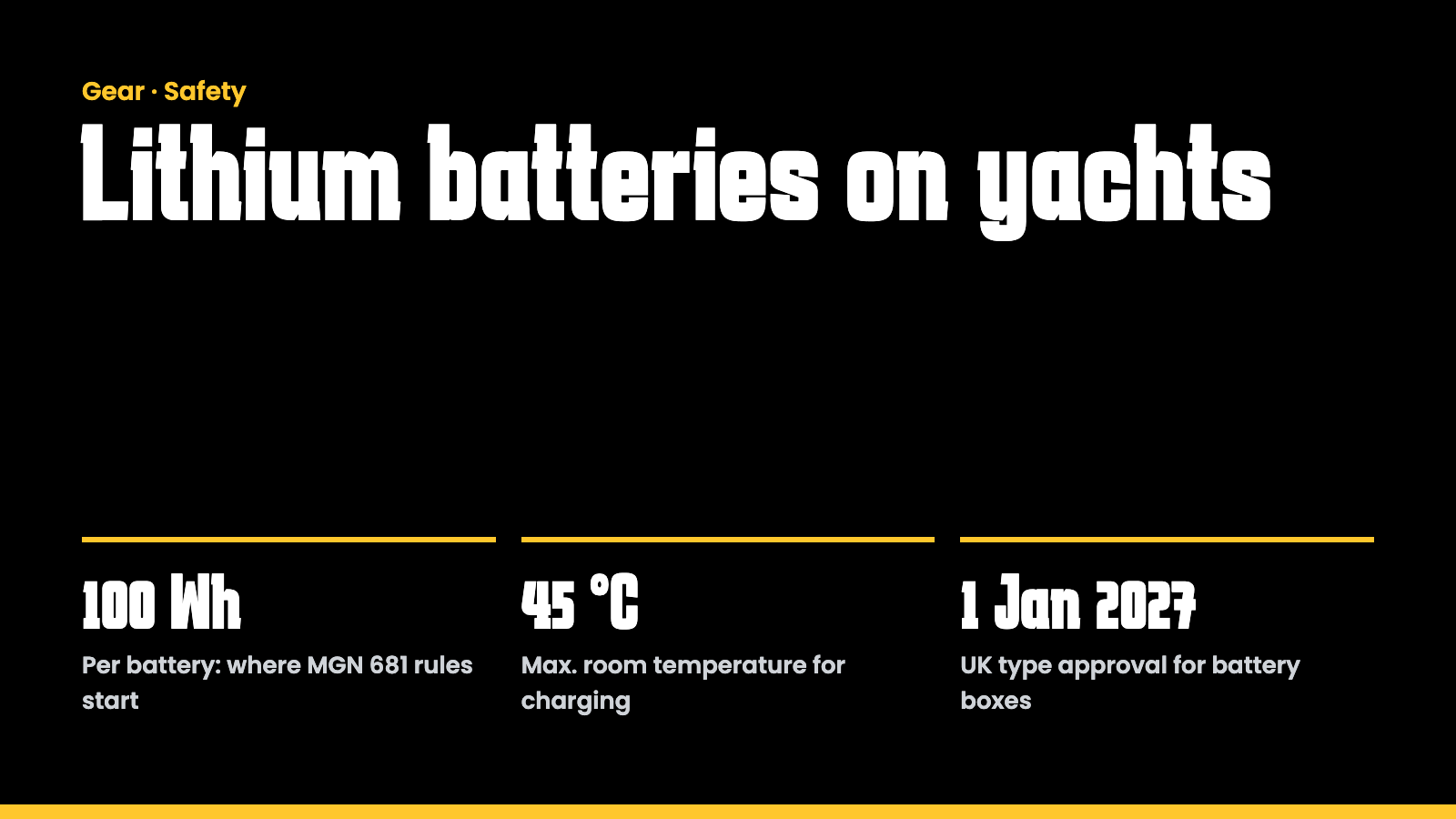
On UK-flagged yachts, MGN 681 sets the rules for lithium-ion batteries in eFoils, jet skis, tenders and underwater scooters. Spare batteries over 100 Wh go in a dedicated cabinet, charging happens only in rated spaces, and those spaces should stay below 45 °C. From 1 January 2027, charging and storage boxes must be UK type-approved.
Disclosure: Toys & Crew is published by Lakeberg GmbH, which trades as E-SURFER and sells eFoils, jetboards and fire-resistant battery boxes. No battery box maker is named or recommended below; the rules are quoted from the official texts.
Which rules apply to lithium batteries on a yacht?
The main text is MGN 681 (M) Amendment 1 of the UK Maritime and Coastguard Agency. It covers electric tenders, electric jet skis, eFoils and other personal watercraft with lithium-ion batteries on board (MGN 681, 1.1). The first edition of 2 June 2023 was replaced by Amendment 1 on 19 December 2025 (gov.uk).
Other flags point to it or have their own rules:
- REG Yacht Code (Red Ensign flags): MGN 681, as amended, applies to fire safety and storage of small electric craft (Common Annexes, A6(1)).
- Cayman Islands: strongly recommends MGN 681 on all yachts with small electric craft until the revised REG Yacht Code is in force (CISR Guidance Note 06/2023, 1.4). The note still refers to the withdrawn first edition.
- Marshall Islands: own rules in the Yacht Code MI-103 and Marine Guideline 2-11-22, which names water toys, surfboards, jet skis, tenders and submersibles with lithium-ion batteries and their spares (MG 2-11-22, A.2).
How big are the batteries in water toys?
MGN 681 gives typical sizes for most craft; the eFoil and jetboard rows come from the manufacturers, because MGN 681's range of 1–5 kWh for eFoils is far above today's packs (MGN 681, 3.1.1):
| Craft | Typical battery |
|---|---|
| Electric tender | 40–100 kWh |
| Electric jet ski | 20–50 kWh |
| Underwater scooter | 1–3 kWh |
| eFoil | 0.5–2.55 kWh: Lift Foils 0.5, 1.0 and 2.2 kWh, Waydoo 1.8 and 2.3 kWh, Awake 2.55 kWh (Lift LIFTX, Lift LIFT5, Waydoo, Awake; more in what an eFoil costs) |
| Electric jetboard | 2.55–3.1 kWh: Awake 2.55 kWh, JETSURF 3 kWh, LIND 3.1 kWh (Awake, JETSURF, LIND; more in electric jetboards on a yacht) |
The rules apply from 100 Wh per battery. Phones and laptops are below that, but crews should watch for collections of more than 500 Wh in total (2.4). A removed or spare battery counts as dangerous goods UN 3480, the craft itself as UN 3171, whatever the battery size (1.5.1–1.5.2).
Where may batteries be stored on board?
MGN 681 separates spare batteries from the craft:
- Spare and swap batteries over 100 Wh belong in a dedicated cabinet built to a recognised standard, for example EN 14470, EN 16121 or EN 16122, or in an approved charging and storage cabinet (4.2).
- Outside rated spaces only on open deck, in a dedicated cabinet, at least 1 metre from combustible material and away from escape routes, muster stations and life-saving appliances (4.3).
- Garages that do not meet at least REG Yacht Code Part A 14.1 may not hold electric water toys (1.8).
- Next to petrol craft: batteries as far as possible from petrol tanks and petrol-powered craft (4.17.5).
- Fire insulation of charging and storage spaces: A-60 for yachts of 500 GT and more (some boundaries A-0), A-30 under 500 GT, B-15 for short-range yachts (4.15).
The REG Yacht Code adds for yachts under 500 GT that the number and capacity of lithium-ion batteries in enclosed spaces should be kept as low as practicable (Part A, 14A.2). The Marshall Islands code treats spaces for storing or charging lithium toys as Category A machinery spaces for fire protection and bans charging in petrol spaces unless the chargers are rated for flammable vapours (MI-103, 10.1.4.2 and 11.1.10).
Where and how may batteries be charged?
Only in dedicated spaces meeting REG 14.1: not forward of the collision bulkhead, not in or next to Category A machinery spaces or the main switchboard, and with batteries at least 1 metre from those boundaries (MGN 681, 4.8). Further points from MGN 681:
- Room temperature in charging and storage spaces should not exceed 45 °C, because manufacturers say thermal runaway can start at a battery temperature of 60–70 °C (4.10). The REG Yacht Code says that, depending on the cell, runaway can start from 120 °C and the cell can reach its maximum temperature in under two minutes (Common Annexes, A3(3)).
- The battery management system keeps the battery in its best charging range of 15–35 °C and should be linked to the yacht's alarm system (6.1, 6.3).
- Electrical equipment in these spaces must be explosion-protected (Ex T2 IIC or similar) or switchable from outside (4.11).
- Charging cabinets outside the garage must be supervised at all times, report a temperature rise, allow extinguishing without opening and vent gases (4.12).
- All charging must stop automatically in a fire or at high temperature; chargers over 100 Wh need their own circuit with residual current protection (4.21–4.22).
- Keep as few different battery and charger systems on board as possible; incompatible chargers are a serious risk (4.7).
- Damaged batteries must not be charged and go ashore for disposal or repair at the first opportunity (4.6).
What changes for battery boxes in 2027?
From 1 January 2027, charging and storage boxes for lithium-ion batteries on UK ships must be UK type-approved. Boxes already on board may stay but should be replaced soon (MGN 681, 5.1). Until then, the MCA warns that there is no internationally agreed standard for battery storage boxes, so manufacturers' certification claims should be treated with caution (MCA Safety Bulletin 35).
What fire detection and firefighting gear is needed?
MGN 681 asks for the following (MGN 681, 7–8):
- Detection: fixed smoke, heat and gas detectors plus CCTV monitored from a continuously manned station; a thermal imaging camera is recommended (7.1.1).
- Fixed system: automatic and water-based; water mist has proved most effective against battery fires (8.1–8.2).
- Portable extinguishers: at least two suitable for battery fires, outside or at the entrance of the battery space; large electric craft get their own as well (8.5).
- Fire blankets or containment bags matching the batteries on board. Watch for heat going down and gas building up under the blanket (8.6).
- Procedure: isolate the power to a charging battery before extinguishing. Re-ignition is likely, so keep a fire watch until the battery is off the yacht (8.10–8.11).
- Protective gear: level 2 firefighting suits to BS EN 469:2020 and breathing apparatus are recommended, because the smoke can contain hydrogen fluoride (8.12–8.14).
Taiga's manual for its Orca electric jet ski says: in a fire, pull the lanyard key, keep your distance and call the emergency services (Taiga Orca manual, 3.20).
Who is responsible on board?
MGN 681 recommends naming one responsible person for lithium-ion batteries, for example the safety officer, captain or chief engineer (9.7). The REG Yacht Code recommends at least two people on board at all times who are trained in all battery systems and procedures (Common Annexes, A7(8)). Under the Marshall Islands guideline, guests and passengers must also be told about safe handling, storage, fault signs and firefighting (MG 2-11-22, 2.1). Shadow vessels may carry toys, but the flag can limit the amount of lithium-ion batteries (REG Part A, 1.2(7)).
How do manufacturers say to store batteries over winter?
The advice differs by brand, so follow the manual for each toy:
| Brand / product | Storage charge | Temperature | Check | Source |
|---|---|---|---|---|
| Lift Foils (eFoil) | 40–60 % | 10–25 °C, cool and dry | monthly; below 20 % recharge to 40–60 %; charging at least every 3 months is a warranty condition | Lift Foils |
| Awake (eFoil, jetboard) | 80 % (4 LEDs) | about room temperature, apart from board and charger | after 60 days; deeply discharged batteries shut down and are not covered by warranty | Awake |
| Taiga Orca (electric jet ski) | 60–80 % | not in direct sun, not in the water | monthly | Taiga manual, 9.14 |
| Lampuga AIR (jetboard, 3.6 kWh) | 40–50 % | store 5–35 °C (20 °C recommended), charge 5–45 °C | not stated | Lampuga manual, p. 12 |
| Sublue Vapor (underwater scooter, 384.8 Wh) | not stated | store 0–45 °C, max. 65 % humidity; charge 5–40 °C, never below 0 °C | not stated | Sublue manual |
Lift Foils also warns against storing batteries fully charged, which speeds up ageing, or at 20 % or less.
Can water toy batteries be flown to the yacht?
Only with strict limits. Under IATA rules, lithium-ion batteries shipped on their own (UN 3480) may have at most 30 % state of charge and may not travel on passenger aircraft, except with approval. Since 1 January 2026, the 30 % limit also applies to batteries packed with equipment (IATA Lithium Battery Guidance 2026). Battery-powered vehicles with batteries over 100 Wh ship at no more than 30 % charge, or 25 % on the display.
Lift Foils approves only its Zarges battery case for air freight (Lift Foils); Lampuga gives 30 % as the maximum charge for transport. Lefeet's underwater scooter batteries (100 Wh and 160 Wh) come with UN 38.3 test and safety data sheet (Lefeet).
What we could not find
There is no MIN (Marine Information Note) on lithium batteries, and IMO circulars and the UN Model Regulations were not read directly. None of the sources names a fire class for portable extinguishers (EN 2 / EN 3). Guidance from fire services and insurers was not read, nor were Malta and the Isle of Man. Fliteboard and Awake support pages blocked access; SEABOB has no manual on its own website; Takuma, Manta5, Waydoo, Aerofoils, SiFly and Audi were not checked.
Sources
MGN 681 (M) Amendment 1 (updated 13 January 2026), MCA Safety Bulletin 35, REG Yacht Code (July 2024), CISR Guidance Note 06/2023, Marshall Islands MI-103 (May 2026) and MG 2-11-22, IATA Lithium Battery Guidance Document 2026, and the manuals and support pages of Lift Foils, Awake, Taiga, Lampuga, Sublue and Lefeet. All checked on 7 October 2026 and linked above.
Sources and image rights
- Images
- Toys & Crew
- Checked
- 7 October 2026 by Andreas Lakeberg
Disclaimer. We research every article carefully and to the best of our knowledge. Salaries, prices, rules and port regulations change, and we cannot guarantee that all information is complete, current or correct. Please check anything important with the original source or the responsible authority before you rely on it. To the extent permitted by law, we accept no liability for errors or omissions.
Toys & Crew is published by Lakeberg GmbH, Berlin, the company behind E-SURFER, which began in 2017 as the first blog and YouTube channel about electric surfboards and today also sells eFoils and jetboards. We sell some of the brands we write about. That never decides what we cover or how we rate it.