Hours of rest for yacht crew: what MLC and STCW require and how it is recorded
The 10 and 77 hour rule, which exceptions flag states allow, how rest records must be kept and what port state control finds when it checks them.

Yacht crew on commercial yachts must get at least 10 hours of rest in any 24 hours and 77 hours in any 7 days, captain included. Rest must be recorded every day in a standard format, countersigned and kept on board for inspection. Exceptions exist but are narrow, and guest service is not one of them. Purely private yachts are often outside these rules.
What are the minimum rest hours?
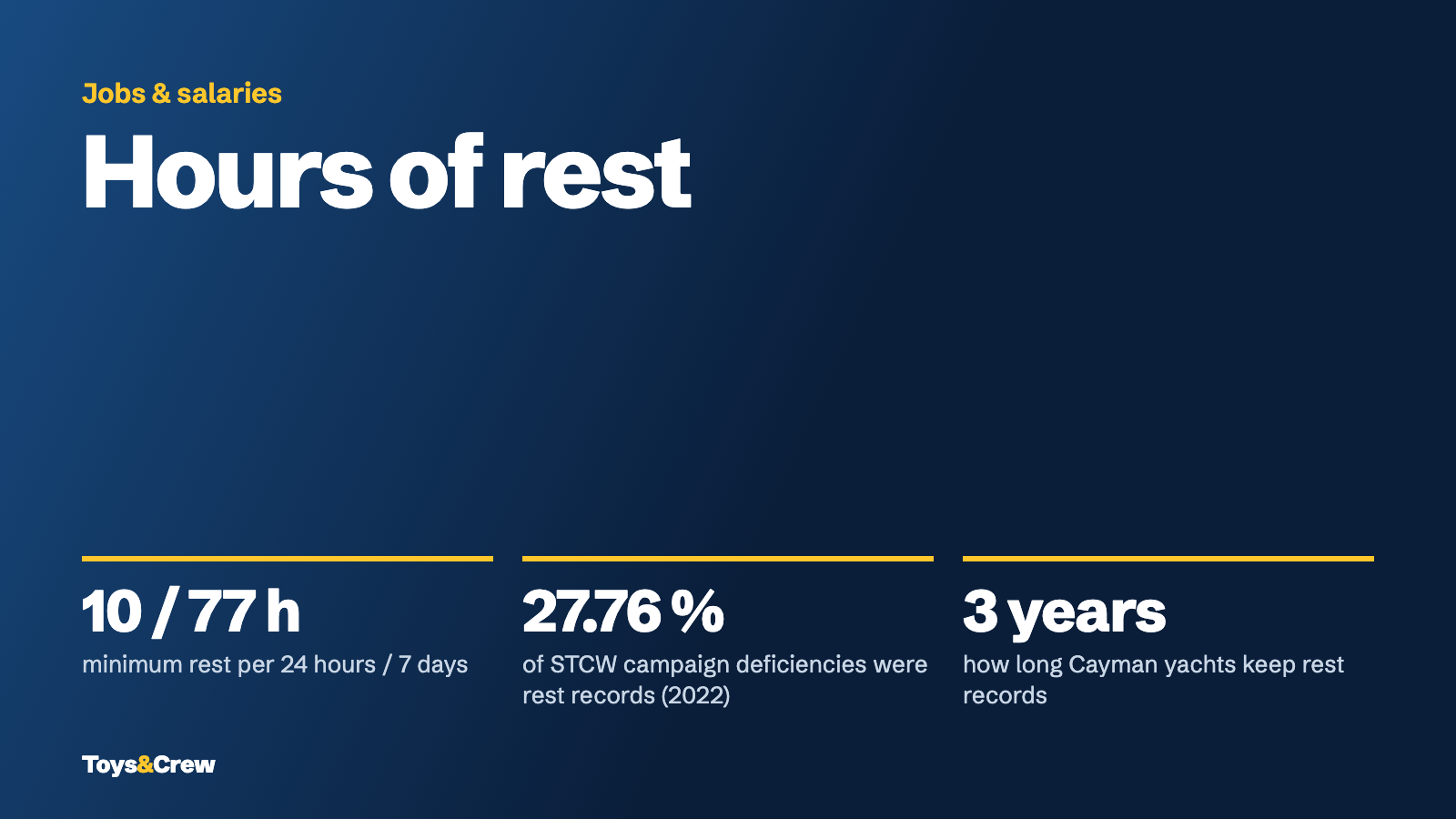
Under the Maritime Labour Convention (MLC), the flag state sets either maximum hours of work (14 hours in 24, 72 hours in 7 days) or minimum hours of rest (10 hours in 24, 77 hours in 7 days). Rest may be split into no more than two periods, one of at least 6 hours, and no more than 14 hours may pass between two rest periods. The EU directive on seafarers' working time sets the same limits (Directive 1999/63/EC, Annex, clause 5, German version). The REG Yacht Code, used by the British and other Red Ensign flags, applies 10 and 77 hours to the whole crew (REG Yacht Code 2024, Annex G).
The choice of model matters: 72 hours of work a week leave 96 hours of rest, while the rest model only requires 77 (ILO FAQ, 6th edition 2026, C2.3.d). Germany requires both at the same time (SeeArbG § 48).
Some details that come up on board:
- Short breaks are not rest. The MLC does not define a short break; according to the ILO, any break that does not allow real recovery, such as a meal break, can count as a short break and then is not rest (ILO FAQ, C2.3.i; MLC, Standard A2.3).
- The captain is included. Captains are seafarers too (ILO FAQ, C2.3.g).
- Drills must disturb rest as little as possible and not cause fatigue (MLC, A2.3, paragraph 7).
- On call: being on call, for example with an unmanned engine room, is not work until you are actually called out; if your rest is interrupted, you are entitled to compensatory rest (MLC, A2.3, paragraph 8; MCA, MSN 1877 Amendment 2, 4.1.2).
- Crew under 18: the MLC recommends no more than 8 hours a day and 40 a week, a one-hour break for the main meal and 15 minutes after every two hours of continuous work (Guideline B2.3.1).
- Your own duty: in the UK, every seafarer is responsible for reporting for duty rested and using time off to rest (MSN 1877, 3.2).
Which exceptions are allowed?
Flag states may allow exceptions, which should follow the standard as closely as possible, for example with longer leave or compensatory leave for watchkeepers (MLC, A2.3, paragraph 13). MLC and STCW are almost identical on minimum rest and differ mainly in the exceptions; according to the ILO, the MLC only allows them through a registered collective agreement (ILO FAQ, C2.3.f). The STCW exception as implemented in UK law (SI 2018/58, regulation 7):
- at least 70 hours of rest in 7 days, for no more than two consecutive weeks;
- between two exception periods, a break at least twice as long as the longer exception period;
- the 10 daily hours may be split into up to three periods, one of at least 6 hours and none under 1 hour, on no more than two 24-hour periods in 7 days.
In the UK, an exception via a workforce agreement must be in writing, is valid for at most five years and needs a written application to an MCA Marine Office (MSN 1877, 5.4 to 5.5). The Marshall Islands allow the STCW exception only under overriding operational conditions that are not emergencies, and only if a collective agreement covers it (Marine Notice 7-051-2). The Isle of Man does not recognise these exceptions at all: 10 and 77 hours always apply (MLN 2.3).
The rules are under review: in 2025 an MLC committee adopted a resolution on a joint ILO-IMO working group meeting to look at the hours of work and rest in both conventions (ILO FAQ, C2.3.d).
Do guests justify less rest?
No. The Cayman Islands flag, in guidance written for yachts, says guest operations do not justify a deviation; interruptions are only acceptable in exceptional cases such as emergencies, with compensatory rest and a reason recorded. The registry found inadequate rest a notable factor in incidents on its yachts, calls the yacht sector an outlier compared with merchant shipping, and warns against a "hero culture" in which rest records become a "hero chart". Regular deviations should be logged as an ISM non-conformity with a corrective plan, and 24/7 guest service is often not feasible with a small crew (Cayman Islands, Guidance Note 03/2022).
Under the Cayman regulations of 2025 the captain must make sure watchkeepers are rested before their watch and that the yacht does not sail before the first watch after departure has had enough rest. Breaches make the offender liable on summary conviction to a fine of $10,000, or on conviction on indictment to a fine of $25,000, to imprisonment for a term of two years, or to both (Cayman Islands, SL 1 of 2025, regulation 18%20Regulations,%202025.pdf)). Under the REG Yacht Code a yacht's Safe Manning Document can be withdrawn if it persistently fails to meet rest requirements (REG Yacht Code, Annex G, G3).
How must rest hours be recorded?
Every day, in a standard format, countersigned, with a copy for you:
- On display: a table of shipboard working arrangements for every position, with the schedule at sea and in port and the applicable limits, in the working language and in English (MLC, A2.3, paragraphs 10 and 11; UK: SI 2018/58, regulation 9). Under the REG Yacht Code the captain draws up a schedule for every crew member, and everyone gets a copy (Annex G, G5).
- Daily records in a standard format set by the authority based on ILO guidelines, or the ILO's own format (MLC, A2.3, paragraph 12). Each person gets a copy of their own records, endorsed by the captain and the seafarer (EU Directive 1999/63/EC, clause 8); in the Cayman Islands this copy is given monthly (SL 1 of 2025, regulation 15%20Regulations,%202025.pdf)).
- What goes in: date, name and position, and the start, end and length of every rest period, in English (Cayman, regulation 15). Deviations and breaches must appear in the record, as must compensatory rest (Cayman Shipping Notice 05/2014, 5.2).
- Electronic records are allowed if the format follows the ILO guidelines, the data are protected against later changes, countersigning is possible and every seafarer gets a copy (Cayman Shipping Notice 05/2014, 6.1).
How long to keep them:
| Flag / code | Keep records for | Source |
|---|---|---|
| UK | at least 1 year after countersigning; filled in at least monthly | MSN 1877, 8.2 |
| REG Yacht Code | at least 12 months, available for flag inspections at any time | REG Yacht Code, Annex G, G6(11) |
| Cayman Islands | 3 years | SL 1 of 2025, regulation 15 |
| Isle of Man | 3 years on board, to cover the time between two MLC inspections | MLN 2.3, section 4 |
In the UK, an MCA inspector checks and signs the records at intervals; the regulations, MSN 1877 and any approved exception agreements must be on board (SI 2018/58, regulation 12).
What does port state control find?
Mostly problems with the records. Port state control (PSC) inspectors check rest hours, and two joint campaigns of the Tokyo and Paris memoranda looked at them closely. Both covered merchant ships in general, not yachts:
- 2014 campaign on STCW hours of rest (1 September to 30 November): 62.7 % of the campaign deficiencies in the Tokyo region concerned the recording of rest hours, and the worst results were on whether records were countersigned and correctly kept. In the Paris region, 16 detentions out of 4,041 campaign inspections were due to deficiencies on the campaign topic (Tokyo MOU, final report).
- 2022 campaign on STCW: records of rest hours were the most frequent deficiency, 289 cases or 27.76 % of all campaign deficiencies. Rest hour breaches led to no detentions, because inspectors were to make sure crew got compensatory rest before departure (Tokyo MOU, CIC STCW 2022 report).
For yachts: in 2025 the Paris MoU carried out 260 inspections on commercial yachts, 96 of them with deficiencies of any kind, and detained 6 yachts, a detention rate of 2.31 % after 2.82 % in 2024 and 5.52 % in 2023 (Paris MoU Annual Report 2025).
Do the rules apply on private yachts?
Often not. The UK regulations do not apply to pleasure vessels; a company-owned yacht only counts as one if it is used purely for pleasure and the owner receives no money for its operation (SI 2018/58, regulations 2 and 3). The Cayman rest hour regulations of 2025 do not apply to pleasure vessels either (SL 1 of 2025, regulation 3). The EU directive covers seagoing ships under an EU flag that are ordinarily engaged in commercial maritime operations, so EU-flagged charter yachts are covered and purely private yachts are not (Directive 1999/63/EC, clause 1). The REG Yacht Code Part A covers commercially used yachts of 24 m load line length and over carrying up to 12 passengers, Part B those with 13 to 36 (REG Yacht Code, Part A). How to tell what your yacht is: private or charter yacht. Your contract rights are in our MLC guide.
Sources
Maritime Labour Convention 2006 as amended and ILO MLC FAQ 6th edition 2026; EU Directive 1999/63/EC (German version); UK SI 2018/58 and MCA MSN 1877 Amendment 2; REG Yacht Code (July 2024); Cayman Islands Regulations 2025, Guidance Note 03/2022 and Shipping Notice 05/2014; Marshall Islands Marine Notice 7-051-2; Isle of Man MLN 2.3; German Seearbeitsgesetz; Tokyo MOU campaign reports 2014 and 2022; Paris MoU Annual Report 2025. All checked on 22 October 2026 and linked above.
Sources and image rights
- Images
- Sergii / Pexels (conditions)
- Checked
- 22 October 2026 by Andreas Lakeberg
Know something we missed – a rule, a fee, a marina detail? Write to editor@toysandcrew.com. We check every tip against the source and note updates at the top of the story.
Disclaimer. We research every article carefully and to the best of our knowledge. Salaries, prices, rules and port regulations change, and we cannot guarantee that all information is complete, current or correct. Please check anything important with the original source or the responsible authority before you rely on it. To the extent permitted by law, we accept no liability for errors or omissions.