MLC 2006 for yacht crew: your contract, hours, leave and repatriation
What the Maritime Labour Convention guarantees yacht crew: what your contract must contain, maximum working hours, paid leave, repatriation and how to complain.


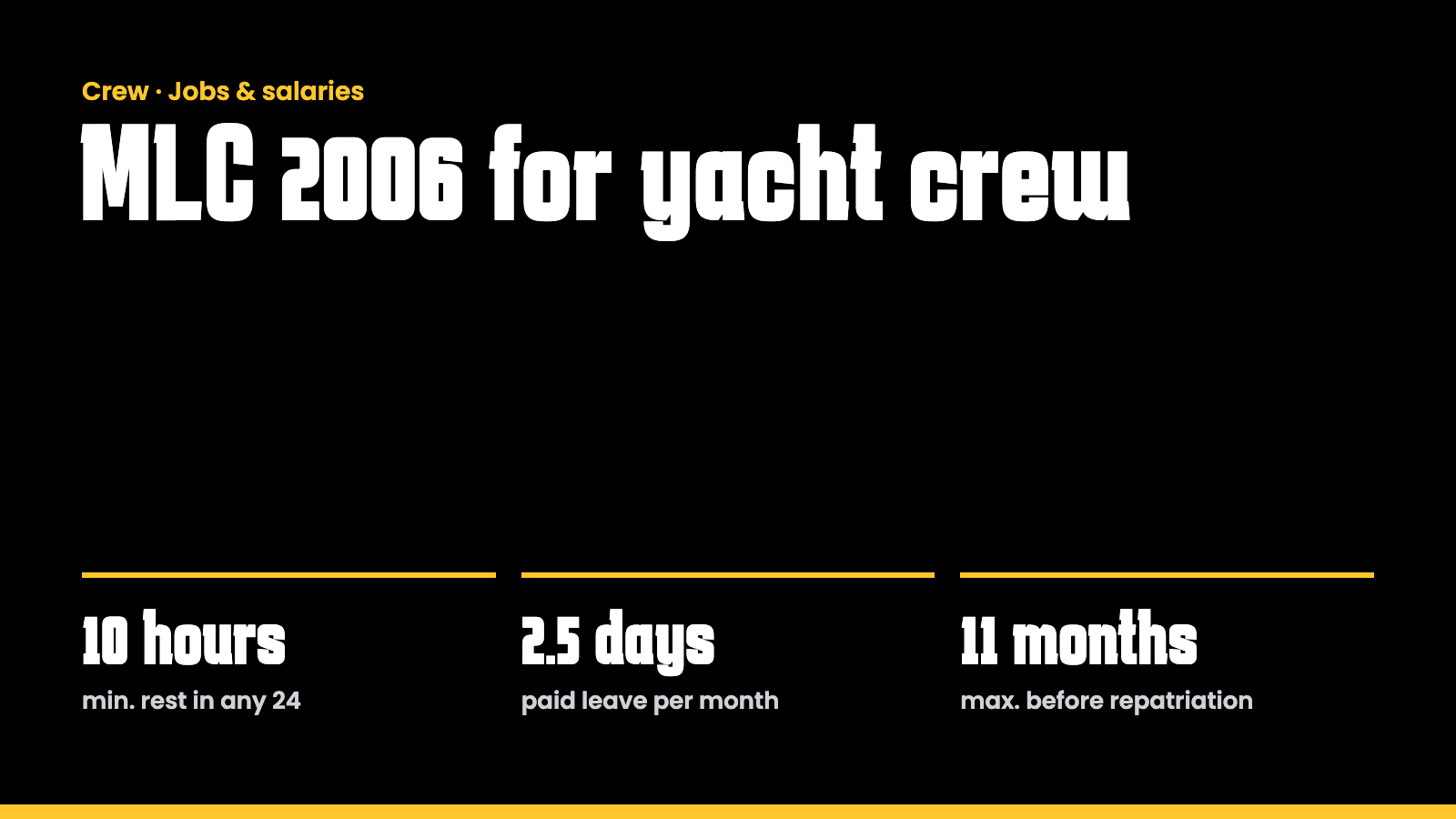
The Maritime Labour Convention 2006 (MLC) gives yacht crew on commercially used yachts a written employment contract, at least 10 hours of rest in any 24 hours, at least 2.5 days of paid leave per month of service and free repatriation after at most 12 months on board. It applies to ships ordinarily engaged in commercial activities, whatever their size, under the flag of one of the more than 110 countries that have ratified it.
Below is what the convention and the UK Maritime and Coastguard Agency (MCA) say, with the source for each point. National rules can add to these minimums.
Does the MLC apply to your yacht?
- The MLC applies to all ships, publicly or privately owned, that are ordinarily engaged in commercial activities, except fishing vessels, traditionally built ships and warships (MLC, Article II(4)).
- There is no general size limit (ILO FAQ 2026, B8). Flag states may only adjust details for ships under 200 GT that do not go on international voyages (MLC, Article II(6)).
- A Maritime Labour Certificate is required on ships of 500 GT and more on international voyages (MLC, Regulation 5.1.3).
- The common yacht flags have ratified it: the UK, Malta, the Marshall Islands and the Bahamas; the Cayman Islands (since 2014), the Isle of Man (since 2013) and the British Virgin Islands (since 2020) through the UK (ILO compendium 2026).
Whether a privately used yacht falls under the MLC is covered in our article private or charter yacht.
What must your employment contract contain?
Your terms must be set out in a clear, written, legally enforceable seafarer employment agreement (SEA). You must be able to review it and take advice before signing, and both you and the employer keep a signed original (MLC, Regulation 2.1 and Standard A2.1).
The SEA must include at least:
- your full name, date or age and place of birth, and the employer's name and address
- place and date of signing, your position on board and your wage (or how it is calculated)
- your paid annual leave (or how it is calculated)
- how the contract ends and the notice period; for open-ended contracts, the employer's notice period may not be shorter than yours
- health and social security benefits, your right to repatriation and any collective agreement that applies
The minimum notice period is seven days (MLC, Standard A2.1(5)). In the UK it must be the same for both sides (MCA, MGN 477).
How must you be paid?
At least monthly, with a monthly statement of what was due and paid, including allowances and the exchange rate used. Your employer must offer a way to send part of your wage to your family, at a reasonable fee (MLC, Standard A2.2).
How many hours can you be made to work?
The flag state sets either maximum hours of work or minimum hours of rest; the owner or captain cannot pick the model (ILO FAQ, C2.3.a).
| Model | Limit per 24 hours | Limit per 7 days |
|---|---|---|
| Maximum work | 14 hours of work | 72 hours of work |
| Minimum rest | 10 hours of rest | 77 hours of rest |
- Rest may be split into at most two periods, one of them at least 6 hours, with no more than 14 hours between them (MLC, Standard A2.3).
- "Any 24 hours" is rolling: every 24-hour window must contain at least 10 hours of rest (ILO FAQ, C2.3.c).
- Hours are recorded daily; you receive a copy signed by the captain and by you.
- In an emergency, the captain can suspend rest hours, but must give compensatory rest afterwards.
How much leave do you get?
- At least 2.5 calendar days of paid leave per month of employment. Paying out leave instead of granting it is generally not allowed (MLC, Standard A2.4); in the EU only at the end of employment (Directive 2009/13/EC).
- After 11 months of continuous service on board, at least 30 days of paid leave are due (ILO FAQ, C2.4.a).
- In the UK, eight paid public holidays a year come on top (MCA, MSN 1877).
- Shore leave must be granted where operations allow.
When do you have the right to go home?
- You are entitled to repatriation when your contract ends abroad, when the employer ends it, or when you end it for a justified reason. The maximum period on board before repatriation must be less than 12 months; the ILO reads this as 11 months of continuous service (MLC, Standard A2.5.1; ILO FAQ, C2.4.c).
- Repatriation is free of charge for you, and flag states must require financial security to cover it.
- If wages are unpaid for at least two months, you count as abandoned; the security then covers up to four months of outstanding wages (MLC, Standard A2.5.2).
How can you complain?
- On board, you may always complain directly to the captain and, if needed, to outside authorities. You may be accompanied or represented and must be protected from victimisation. With your SEA you receive a copy of the complaint procedure, including the flag state's contact details (MLC, Standard A5.1.5).
- Ashore, you can go to an authorised port state control officer in any port of call. Complaints are treated confidentially (MLC, Standard A5.2.2).
What if the flag has not ratified the MLC?
Then the MLC does not apply directly (ILO FAQ, A30), although conditions on board can still be checked during port state control in ratifying countries. The MCA warns that crew on such ships may not have the same level of protection (MCA, MGN 476).
What changes next?
Amendments adopted in 2025, on shore leave, violence and harassment and a binding list of repatriation costs, are expected to enter into force on 23 December 2027 (ILO FAQ).
Sources
Maritime Labour Convention 2006 as amended (ILO), ILO MLC FAQ 6th edition 2026, ILO MLC compendium 2026, UK MCA (MGN 476, MGN 477, MSN 1877) and EU Directive 2009/13/EC. All checked on 4 October 2026 and linked above.
Sources and image rights
- Images
- Tima Miroshnichenko / Pexels (conditions)
- Checked
- 4 October 2026 by Andreas Lakeberg
Disclaimer. We research every article carefully and to the best of our knowledge. Salaries, prices, rules and port regulations change, and we cannot guarantee that all information is complete, current or correct. Please check anything important with the original source or the responsible authority before you rely on it. To the extent permitted by law, we accept no liability for errors or omissions.