Man overboard on a yacht: required equipment, drills and recovery
How many lifebuoys a commercial yacht needs, what SOLAS and the REG Yacht Code say about man-overboard drills, and how to recover a person safely.

A commercial yacht of 24 metres or more under the Red Ensign carries at least four lifebuoys, from 500 GT at least eight, and needs a vessel-specific plan for recovering people from the water. A separate monthly man-overboard drill is not written into SOLAS, but official guidance assumes crews run routine man-overboard drills anyway.
Below are the rules for equipment, drills and recovery, each with its source. Where we could not find an official answer, we say so. For the other main life-saving equipment, see our guides to life rafts on yachts and the EPIRB on a yacht.
How many lifebuoys does a yacht need?
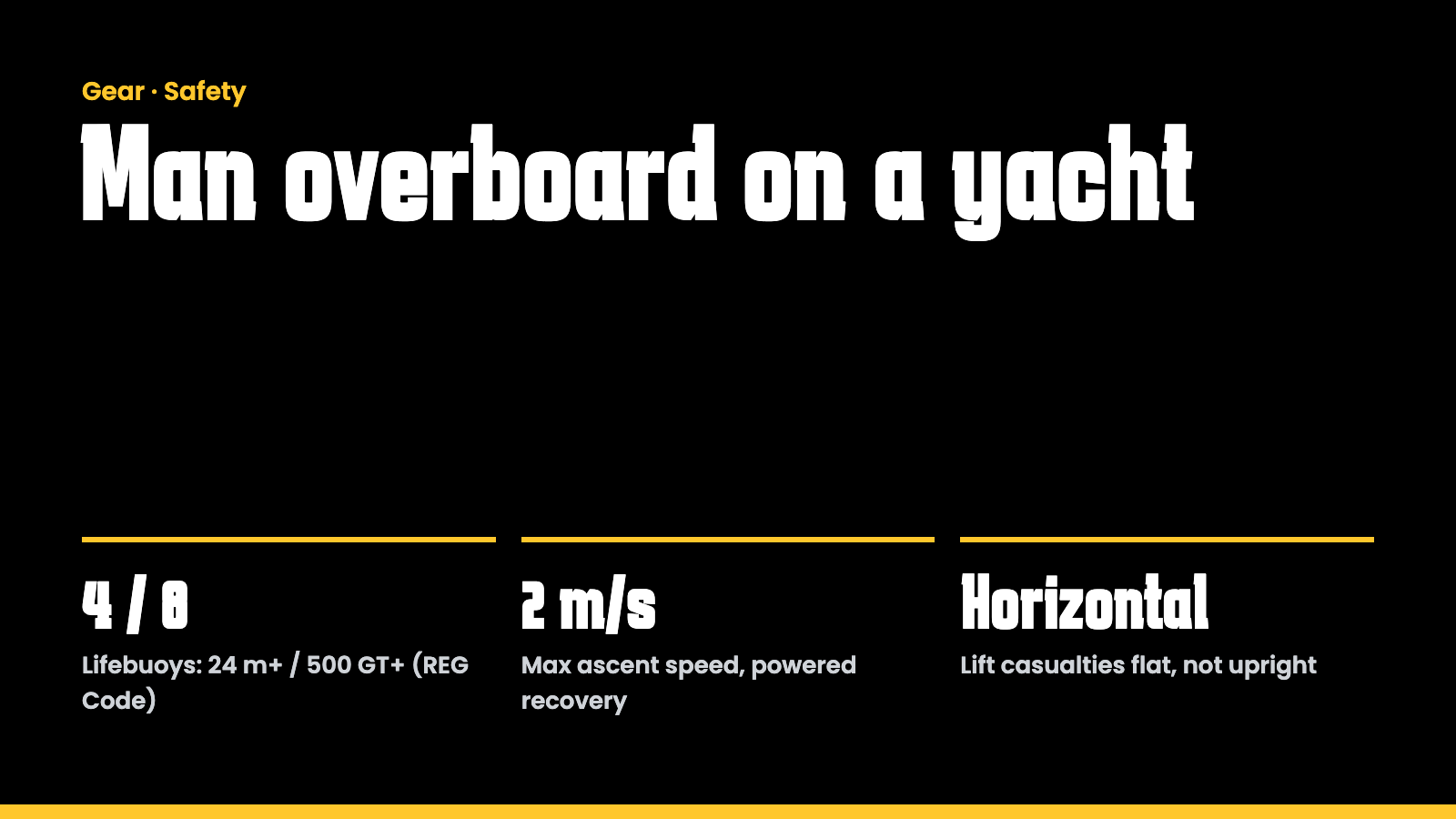
Under the REG Yacht Code Part A, a commercial yacht of 24 metres and over and a short range yacht carry at least four lifebuoys; yachts of 500 GT and over and of 85 metres and over carry at least eight (REG Yacht Code Part A, Table 13.1). Part A covers commercial yachts of 24 metres load line length and over with up to 12 passengers (Preamble).
| Yacht | Lifebuoys (minimum) |
|---|---|
| Short range yacht | 4 |
| 24 m and over | 4 |
| 500 GT and over | 8 |
| 85 m and over | 8 |
| 100 m and over | as SOLAS III/32.1 |
In each case two lifebuoys carry a self-igniting light and smoke signal and two a buoyant lifeline (REG Yacht Code, Table 13.1 and note 2).
A short range yacht is one under 500 GT that operates up to Force 4 (motor) or Force 6 (sail) and no more than 60 nautical miles from a safe haven (REG Yacht Code, chapter 1). The two lifelines must be at least 30 metres long, and the lifebuoys with light and smoke must be quick-release from the bridge (REG Yacht Code, 13.7).
For yachts of 100 metres and over, the numbers in SOLAS regulation III/32 apply. The only SOLAS text in our sources is the consolidated edition of 2004, which lists 10 lifebuoys for ships of 100 to 150 metres, 12 for 150 to 200 metres and 14 from 200 metres. Later amendments are not included there, so check the current SOLAS text before relying on these figures.
What must a lifebuoy and its light, smoke and line meet?
The current UK figures come from MSN 1676 Amendment 2 (June 2025), which implements the IMO Life-Saving Appliances Code:
- Lifebuoy: outer diameter no more than 800 mm, inner diameter at least 400 mm; mass at least 2.5 kg, or at least 4 kg if it triggers the quick release of light and smoke signal (Schedule 8, Part 2).
- It must survive a drop into the water from its stowage height, or 30 metres if that is greater, and support at least 14.5 kg of iron in fresh water for 24 hours (Schedule 8, Part 2).
- Grabline: at least 9.5 mm thick, four times the outer diameter long; ring marked with ship's name and port of registry.
- Self-igniting light: at least 2 hours, either steady at 2 candela or more, or flashing at 50 to 70 flashes per minute (Schedule 8, Part 4).
- Smoke signal: highly visible smoke for at least 15 minutes (Schedule 8, Part 5).
- Buoyant lifeline: at least 8 mm thick, 5 kN breaking strength, twice the stowage height and at least 30 metres long; on ships under 12 metres at least 18 metres (Schedule 8, Part 6).
Is a man-overboard drill mandatory?
Not as a separate drill under SOLAS. Regulation III/19 requires every crew member to take part in at least one abandon ship drill and one fire drill each month, and to repeat them within 24 hours of leaving port if more than 25 % of the crew missed the previous month's drills (SOLAS 2004 consolidated edition, III/19.3.2). The REG Yacht Code applies the same monthly rule to yachts (REG Yacht Code Common Annexes, Annex C). Rescue boats should be launched and manoeuvred monthly if possible, at least every three months.
Man overboard is still expected to be practised:
- The IMO guidelines reproduced in MGN 544 Amendment 1, Annex 1 say recovery drills "may be conducted in conjunction with routine man-overboard drills", so they take such drills for granted.
- The REG Yacht Code lists man overboard among the emergencies that need clear procedures (REG Yacht Code, 23A.8).
- The Cayman Islands Shipping Registry names man overboard in its example list of drills to be held on yachts and noted in the log (Yachtmaster's Handbook 2018).
How should a person be recovered from the water?
Since 1 July 2014, SOLAS regulation III/17-1 requires ship-specific plans and procedures for recovering people from the water (MGN 544 Amendment 1, April 2026). It does not require new equipment, but the plan must name the equipment and protect the crew who help. The REG Yacht Code requires such plans on all yachts it covers (13.14), and the MCA recommends them for non-SOLAS vessels too, including class XII pleasure vessels.
- Horizontal, not vertical: lift people horizontally or in a "deck chair" position where possible; vertical recovery risks cardiac arrest in hypothermic casualties (MGN 544 Annex 1, 2.3).
- Away from the propellers, and with dedicated equipment marked with its maximum number of persons, based on 82.5 kg each.
- Short range yachts need a man-overboard recovery system; larger yachts carry a rescue boat instead (REG Yacht Code, Table 13.1). Without a rescue boat, the crew must be able to recover a person without anyone else entering the water, and not over the stern or next to the propellers (13.4).
- Powered recovery devices should limit the speed of ascent to 2 metres per second; when accepting new equipment, the MCA may ask for a drill lifting a 100 kg weight or manikin on board (MGN 544, 3.3.2 and 4.8).
- Overside work: before using rail-and-trolley systems, a risk assessment with a plan to recover anyone who falls in is required, and the systems must not be used under way (MGN 578 Amendment 3).
LY3, the former MCA Large Commercial Yacht Code, assumed the person in the water is unconscious. It was withdrawn on 25 April 2025 and replaced by the REG Yacht Code (MSN 1895), so it is no longer the reference.
How often does man overboard happen on yachts?
We found no combined official statistic for yachts. The UK MAIB removed the statistics chapter from its annual report and now publishes figures in a data portal from 2020 (MAIB Annual Report 2025), which we have not analysed. US and Canadian investigators were not searched.
Individual reports show recurring patterns, though almost all involve sailing yachts:
- CV30, 2017: a tether hook failed; the crew member was recovered after 32 minutes with no signs of life. The MAIB called for tethered recovery procedures that are effective and regularly drilled (MAIB 7/2019).
- Keelboat off Cowes, 2022: a person died despite a correctly worn lifejacket; the risk assessment had not considered recovery from the water (MAIB 7/2025).
- Huw Jars, 2006: no lifejacket; the skipper had drowned although recovered within 10 minutes (MAIB).
- PARADISE, 2019: on a 19.90 m charter sailing yacht, the captain and a guest went overboard without lifejackets or tethers and were never found. Recovery had never been practised on board (BEAmer).
Sources
REG Yacht Code Part A and Common Annexes (July 2024), UK MCA (MSN 1676 Amendment 2, MGN 544 Amendment 1 with Annex 1, MGN 578 Amendment 3, withdrawal notice for MSN 1851/LY3), SOLAS 1974 consolidated edition 2004, Cayman Islands Shipping Registry, UK MAIB reports and annual report 2025, and French BEAmer. All checked on 4 October 2026 and linked above.
Sources and image rights
- Images
- Esra Nur Kalay / Pexels (conditions)
- Checked
- 4 October 2026 by Andreas Lakeberg
Disclaimer. We research every article carefully and to the best of our knowledge. Salaries, prices, rules and port regulations change, and we cannot guarantee that all information is complete, current or correct. Please check anything important with the original source or the responsible authority before you rely on it. To the extent permitted by law, we accept no liability for errors or omissions.