Am I too old for yachting? Age limits and what the rules say
There is no upper age limit for yacht crew. What the MLC, the ENG1 and flag states say about age, and what agencies tell career changers in their 30s and 40s.


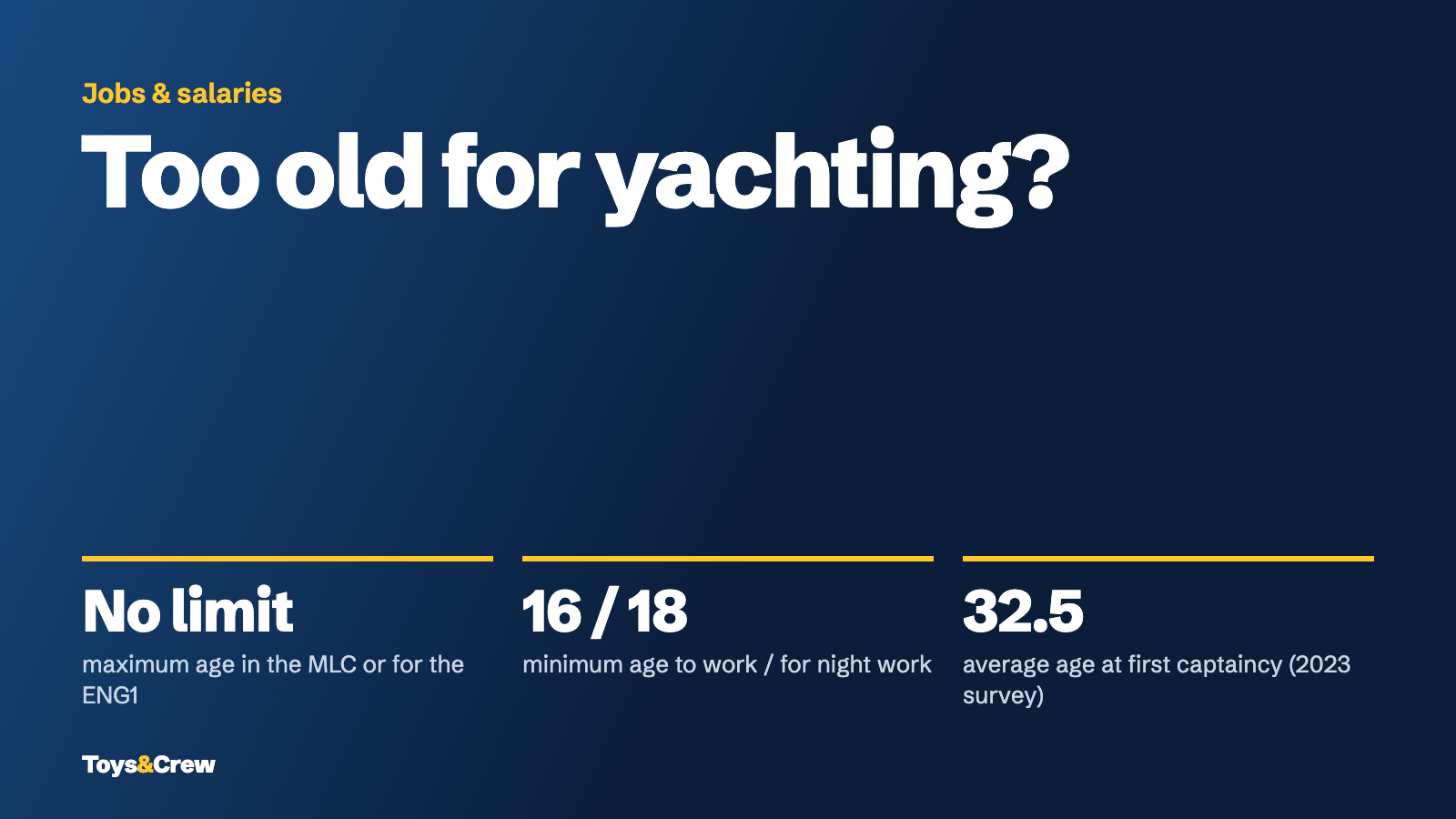
No. There is no maximum age for working on a yacht: the Maritime Labour Convention (MLC), the UK Maritime and Coastguard Agency (MCA) and the Marshall Islands only set minimum ages, and the MCA says there is no maximum age for the ENG1 medical. What limits older crew in practice is medical fitness and how employers and agencies hire, not the law.
Is there a maximum age for yacht crew?
Not in the rules we checked. The MLC sets a minimum age for working on a ship, but no upper limit (MLC, Regulation 1.1). The UK yacht licences up to Master Yachts 3000 GT require sea time as an officer, but no maximum age (MCA, MSN 1858 Amendment 2). The Marshall Islands ask for proof of age, but their age rules only set minimums (MI-118, 2.11.1).
The clearest statement comes from the MCA's manual for ENG1 doctors: there is neither a minimum nor a maximum age for the ENG1; it is issued to anyone who meets the medical standards (MCA, Approved Doctor's Manual, July 2020, FAQ). Details of the exam are in our ENG1 guide.
Health is where age can matter. The same manual notes that cataract, glaucoma and macular degeneration are most common in older seafarers and can mean the eyesight standards are no longer met. Of 55,446 ENG1 exams in 2025, 78 % ended with an unrestricted certificate for the full two years; the most common reasons for restrictions or unfitness were overweight, high blood pressure and mild anxiety or depression, followed by diabetes and problems with sight or hearing (MCA, ENG1 annual report 2025).
What is the minimum age?
| Age | What it allows | Source |
|---|---|---|
| 16 | Working on a seagoing ship at all (UK: also for self-employed; work experience counts as work) | MSN 1838 Amendment 2, MLC |
| 18 | Night work, hazardous work and work as a ship's cook | MLC, Regulation 1.1 |
| 18 | UK Master Code Vessels under 200 GT and OOW Yachts under 500 GT | MSN 1858 Amendment 2, 3.1 |
| 18 / 21 | Marshall Islands: any certificate of competency / Chief Mate and above | MI-118, 2.11.1 |
Crew under 18 have extra protection: in the UK they should normally get 12 consecutive hours of rest in 24 and two days off a week, and their medical is only valid for one year (MSN 1838). Night work is possible for under-18s only as part of recognised training. In practice agencies place crew from 18: one agency lets you register earlier but only places you from 18 (YPI Crew FAQ), and a training school says the night work limit means captains effectively hire from 18 (Flying Fish).
How old are yacht crew?
Nobody knows exactly. ISWAN, which runs the YachtCrewHelp line, says accurate data on the nationality, age and gender of yacht crew does not exist yet (ISWAN, Welfare of Yacht Crew 2024 Annual Review). The UK seafarer statistics do not cover most British yacht crew, only officers with MCA yacht certificates (UK Department for Transport, 2025).
Official figures exist for seafarers in general, not for yachts:
- In the EU, captains and officers with a valid certificate were 43.8 years old on average in 2024, ratings 41.4 years (EMSA, Seafarers Statistics in the EU 2024).
- 61.45 % of EU masters on ships under 3,000 GT were 50 or older (EMSA).
- In the UK, 43 % of active seafarers at Chamber of Shipping member companies were 40 to 64 (Department for Transport, 2025).
Industry figures are narrower: in a 2023 survey of almost 300 captains, they had become captain for the first time at 32.5 years on average, and the agency says crew now reach command later than before (Quay Crew, 2023). A training school says its students aiming for a yacht career are mostly 22 to 35, from its own customer data (Flying Fish).
Can you start in your 30s or 40s?
Yes, but it is harder, say agencies and schools. There is no official source on career changers, so these are industry views:
- Background counts. Starting at 40 is less common but possible, especially with experience in hospitality, service, the military, a trade or engineering; without anything relevant to the work on board it is very difficult. Jobs go to what you bring on board, not to your former status ashore (YPI Crew FAQ).
- Fitness counts. One agency does not see age as a barrier to entry, but says physical fitness matters for deckhands and engineers (Yacht Crew Agency).
- Expect younger bosses. Career changers start as deckhand or stew and may report to people 15 to 20 years younger; some agencies turn older applicants away (Flying Fish).
- Pick your yachts. Smaller yachts, especially private ones, are said to be most open to older crew, and the higher the position, for example interior manager or purser, the less age matters. Networking in person in a marina matters more for older applicants (The Crew Coach).
How to get the first job is in your first yacht job, and how to present your experience in the yacht crew CV.
Is age discrimination in yacht recruitment legal?
Often not, but whether these laws apply to your job depends on the flag, your employer and where you are hired; we did not check that flag by flag. In crew surveys, age is a recurring complaint: in a 2025 survey by crew agencies (sample size not stated), 95 % had witnessed discrimination in hiring and 75 % had experienced it, with appearance, age and nationality named most often (yachtcrew.uk, January 2025).
- UK: age is a protected characteristic, and both direct and indirect age discrimination are prohibited. Age is special: an employer can justify even direct different treatment if it is a proportionate means of achieving a legitimate aim (Equality Act 2010, sections 13 and 19). Acas, the UK's workplace advice service, says an agency should not follow an employer's request for "only young applicants", should not put forward only young candidates and should not pass on candidates' ages; both can be liable (Acas, age discrimination). A date of birth should only be asked for on the application form if the job legally requires a certain age (GOV.UK).
- EU: Directive 2000/78/EC prohibits direct and indirect age discrimination in all types of employment, including access to training (European Commission). In Germany, applicants are protected too; a maximum hiring age can be justified, for example by training requirements, and claims must be made in writing within two months of a rejection (AGG §§ 6, 10 and 15).
- International: the ILO's discrimination convention No. 111 does not list age among its core grounds, though many states have added it (ILO, Technical Note 4.4-EN.pdf)). The MLC's guideline on equal pay does not name age either (MLC, Guideline B2.2.2).
Sources
Maritime Labour Convention 2006 as amended (ILO), ILO Technical Note 4.4; UK MCA: Approved Doctor's Manual (2020), ENG1 annual report 2025, MSN 1838 Amendment 2, MSN 1858 Amendment 2; Marshall Islands MI-118; UK Department for Transport seafarer statistics 2025; EMSA seafarer statistics 2024; ISWAN; Equality Act 2010, Acas and GOV.UK; European Commission on Directive 2000/78/EC; German AGG; Quay Crew, YPI Crew, Yacht Crew Agency, yachtcrew.uk, Flying Fish and The Crew Coach. All checked on 22 October 2026 and linked above.
Sources and image rights
- Images
- Yaroslav Shuraev / Pexels (conditions)
- Checked
- 22 October 2026 by Andreas Lakeberg
Know something we missed – a rule, a fee, a marina detail? Write to editor@toysandcrew.com. We check every tip against the source and note updates at the top of the story.
Disclaimer. We research every article carefully and to the best of our knowledge. Salaries, prices, rules and port regulations change, and we cannot guarantee that all information is complete, current or correct. Please check anything important with the original source or the responsible authority before you rely on it. To the extent permitted by law, we accept no liability for errors or omissions.