Your first yacht job: when to look, crew agencies, dockwalking and what to bring
When yachts hire new crew, how agency registration works, why you should never pay a placement fee, what dockwalking means and which papers to carry.


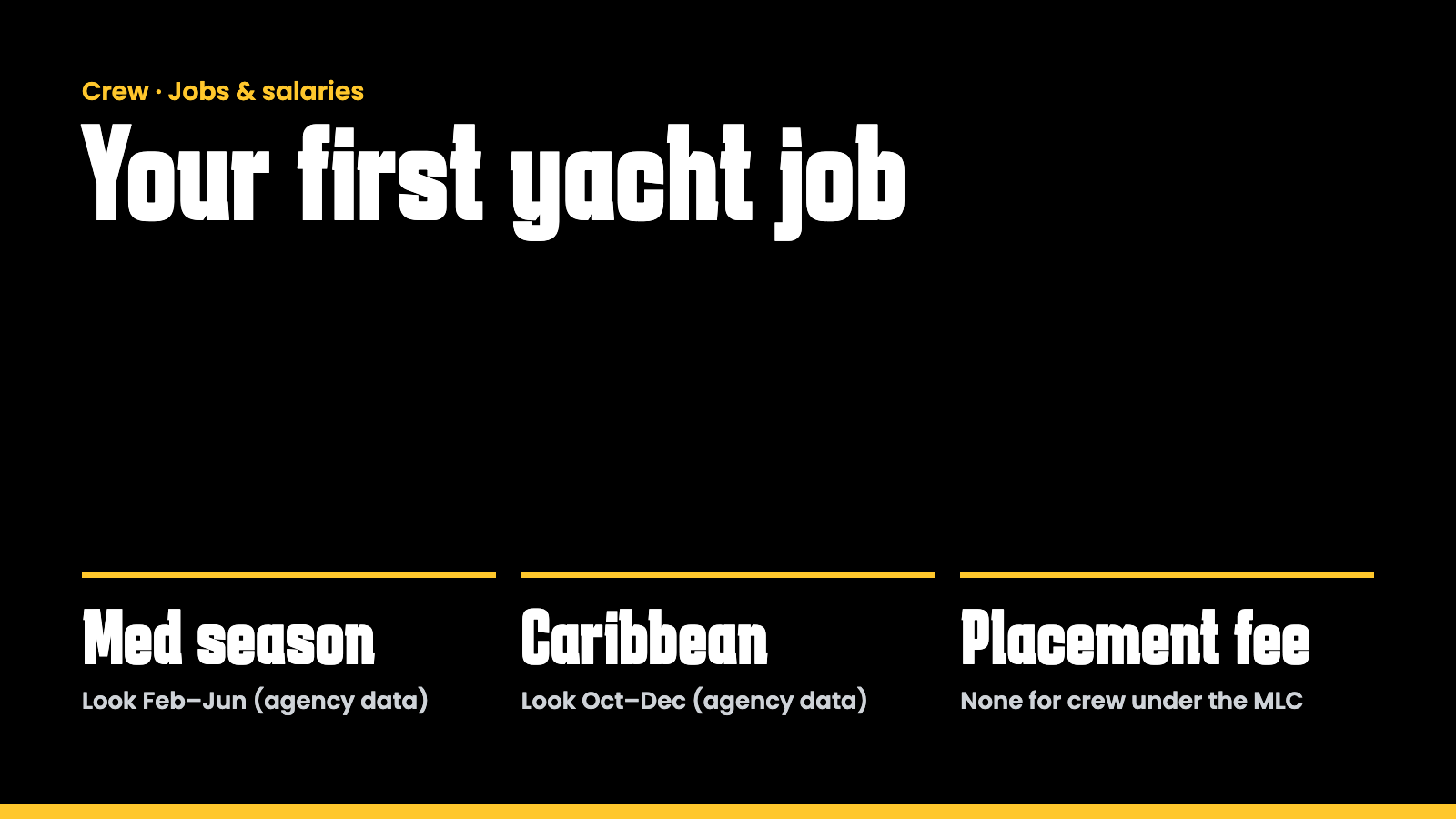
Start looking before the season starts: crew agencies name February to June for the Mediterranean and October to December for the Caribbean. Register with several agencies, which on commercial yachts may not charge you a placement fee, and carry your CV, references, a photo, your passport, certificate copies and a valid ENG1.
There is no official hiring timetable and no official rule on dockwalking; for both we rely on crew agencies and say so. Rules on fees and documents come from the Maritime Labour Convention (MLC) and the UK Maritime and Coastguard Agency (MCA).
Which certificates you need before your first season, and what entry courses cost, is covered in our guide how to become a deckhand or stewardess. This article is about the search itself.
When should you start looking for your first yacht job?
Agencies agree on two hiring peaks, one before each season. There is no official source for this; all of the following are agency statements:
| Season | Season runs | Best time to look | Source |
|---|---|---|---|
| Mediterranean | about May to October | February to June | YPI CREW |
| Caribbean | about November to February | October to December | YPI CREW |
Bluewater says it is busiest with new jobs from mid April to the end of May, before the Mediterranean summer season, and again in mid September and October, when yachts re-crew for the winter (Bluewater). Wilsonhalligan suggests arriving around March for Europe and November for winter destinations (Wilsonhalligan).
YPI CREW names Antibes and Palma as Mediterranean hotspots, and Antigua, St. Maarten and Fort Lauderdale as Caribbean hubs. Not every yacht moves south for the winter: some stay for yard periods and hire less (YPI CREW).
For the Caribbean season, YPI CREW says yachts mostly look for crew with a B1 visa, because they usually call at the US during the season (YPI CREW). The visa rules are in our guide to visas for yacht crew.
How do you register with a crew agency?
You upload your documents, then meet a consultant:
- Bluewater asks for your CV, references, copies of your certificates and a valid ENG1, followed by a face-to-face meeting in Palma, Antibes or Fort Lauderdale without an appointment. It recommends checking in online at least twice a week so the agency knows you are still available (Bluewater).
- Crewfinders asks for a CV, up to three references, a professional head-and-shoulders photo, your passport and your certificates and licences (Crewfinders).
- IYC Crew describes four steps: online application, personal interview with a crew consultant, profile review with reference checks, then introduction to suitable positions (IYC Crew).
Agencies have a legal reason to look at your papers: under the MLC, placement services must verify that the crew they place are qualified and hold the documents the job requires (MLC, Standard A1.4(5)(c)(iii)).
On age, Crewfinders names 18 as the recommended minimum (Crewfinders); IYC Crew says it does not place anyone under 18 (IYC Crew).
Can a crew agency charge you a fee?
Not on yachts covered by the MLC. No fees or other charges for recruitment, placement or employment may be borne by the seafarer, directly or indirectly (MLC, Standard A1.4(5)(b)). The only exceptions are the national medical certificate, the seafarer's book and your passport; visa costs explicitly stay with the shipowner. All seafarers must have access to a system for finding work on board "without charge to the seafarer" (MLC, Regulation 1.4(1)).
The catch for yacht crew: the MLC applies to ships "ordinarily engaged in commercial activities" (MLC, Article II(4)). On a purely private yacht it does not apply automatically. IYC Crew points this out itself and advises crew to sign a Seafarer Employment Agreement before joining any yacht (IYC Crew). See our guide to private or charter yacht crew.
What the agencies themselves state:
- Crewfinders: registration is free for crew; the owner, captain or hiring agent pays the placement fee on top of your salary (Crewfinders).
- IYC Crew: does not charge seafarers, directly or indirectly (IYC Crew).
- YPI CREW (France): charges no fees for registration or placement, citing MLC Standard A1.4 and French law (YPI CREW). According to YPI CREW, French law also requires the agency to check within 72 hours of you joining that your actual role matches your contract.
Since the 2022 MLC amendments, agencies must also have insurance or an equivalent system to compensate crew for money lost if the agency or the employer fails its contractual duties (MLC, Standard A1.4(5)(c)(vi)). Blacklists that keep qualified seafarers from work are prohibited (MLC, Standard A1.4(5)(a)).
How do you know an agency is regulated? The MLC requires private placement services to operate under a licensing, certification or other regulatory system (MLC, Standard A1.4(2)). The UK has no mandatory licence for crew agencies, only a voluntary MCA certification scheme. Ships calling at a port in an MLC country may still have to show that their crew were recruited through MLC-compliant services, even if the agency is based in, or the yacht flies the flag of, a country that has not ratified the MLC (MCA, MGN 475). More on who pays which cost is in our guide what yacht crew pay themselves.
What is dockwalking, and is it allowed?
Dockwalking means handing your CV directly to yachts in the marinas, mainly to find daywork (Bluewater). Whether it is allowed: we found no official source for Antibes, Palma or Fort Lauderdale. Everything below is what agencies say, and they do not agree:
- Timing: Bluewater recommends 7:30 to 9:30 in the morning or 5 to 6 in the afternoon, because captains are busy during the day, and the weeks before a boat show, when yachts may need crew at short notice (Bluewater FAQ; Bluewater). Crewfinders says the Fort Lauderdale International Boat Show generally takes place at the end of October (Crewfinders).
- South of France: besides Antibes, Bluewater lists Nice, Cannes, Golfe-Juan, Monaco and Marina Baie des Anges, plus San Remo, Viareggio and Imperia in Italy, and La Ciotat in autumn, when many yachts are in the shipyard (Bluewater FAQ).
- Palma: according to Bluewater (2018), the marinas and shipyards in the bay are gated; go alone, discreetly and in neat uniform (Bluewater FAQ).
- United States: Bluewater states that only US citizens, green card holders and holders of a work authorisation may walk the docks looking for work (Bluewater FAQ). Crewfinders in Fort Lauderdale advises against dockwalking altogether: for security reasons, it says, walking the docks is now prohibited unless you already have business on board (Crewfinders). YPI CREW adds that you should generally not enter the US to look for work (YPI CREW).
The Bluewater articles date from 2018 and 2019, so check locally before you go.
What should you bring?
Have these ready, on paper and as scans:
- CV, references and a professional photo. Agencies ask for all three (Crewfinders; Bluewater).
- Passport and, for US-bound yachts, a B1/B2 visa. Crewfinders notes that a C1/D visa covers commercial ships such as cruise lines, not private yachts (Crewfinders).
- STCW basic safety certificates. YPI CREW recommends that they are issued in English and certified by the MCA or the national maritime authority where you took the course (YPI CREW).
- A valid ENG1 or an accepted equivalent. Medical certificates for international voyages must be issued at least in English (MLC, Standard A1.2(10)). Details in our ENG1 guide.
Wilsonhalligan suggests that experience ashore, in hospitality or around marinas and small boats, strengthens a first CV (Wilsonhalligan).
Sources
Maritime Labour Convention 2006 as amended (ILO), UK MCA (MGN 475), UK SI 2026/260, and the published guidance of the crew agencies Bluewater, Crewfinders, IYC Crew, YPI CREW and Wilsonhalligan. Agency statements are marked as such. All checked on 4 October 2026 and linked above.
Sources and image rights
- Images
- Cedo Todorovic / Pexels (conditions)
- Checked
- 4 October 2026 by Andreas Lakeberg
Disclaimer. We research every article carefully and to the best of our knowledge. Salaries, prices, rules and port regulations change, and we cannot guarantee that all information is complete, current or correct. Please check anything important with the original source or the responsible authority before you rely on it. To the extent permitted by law, we accept no liability for errors or omissions.