Visas for yacht crew: B1/B2, C1/D and the Schengen 90/180 rule
Which US visa yacht crew need on private and commercial yachts, why ESTA does not fit arrival by private yacht, and how Schengen's 90/180 rule applies to crew.

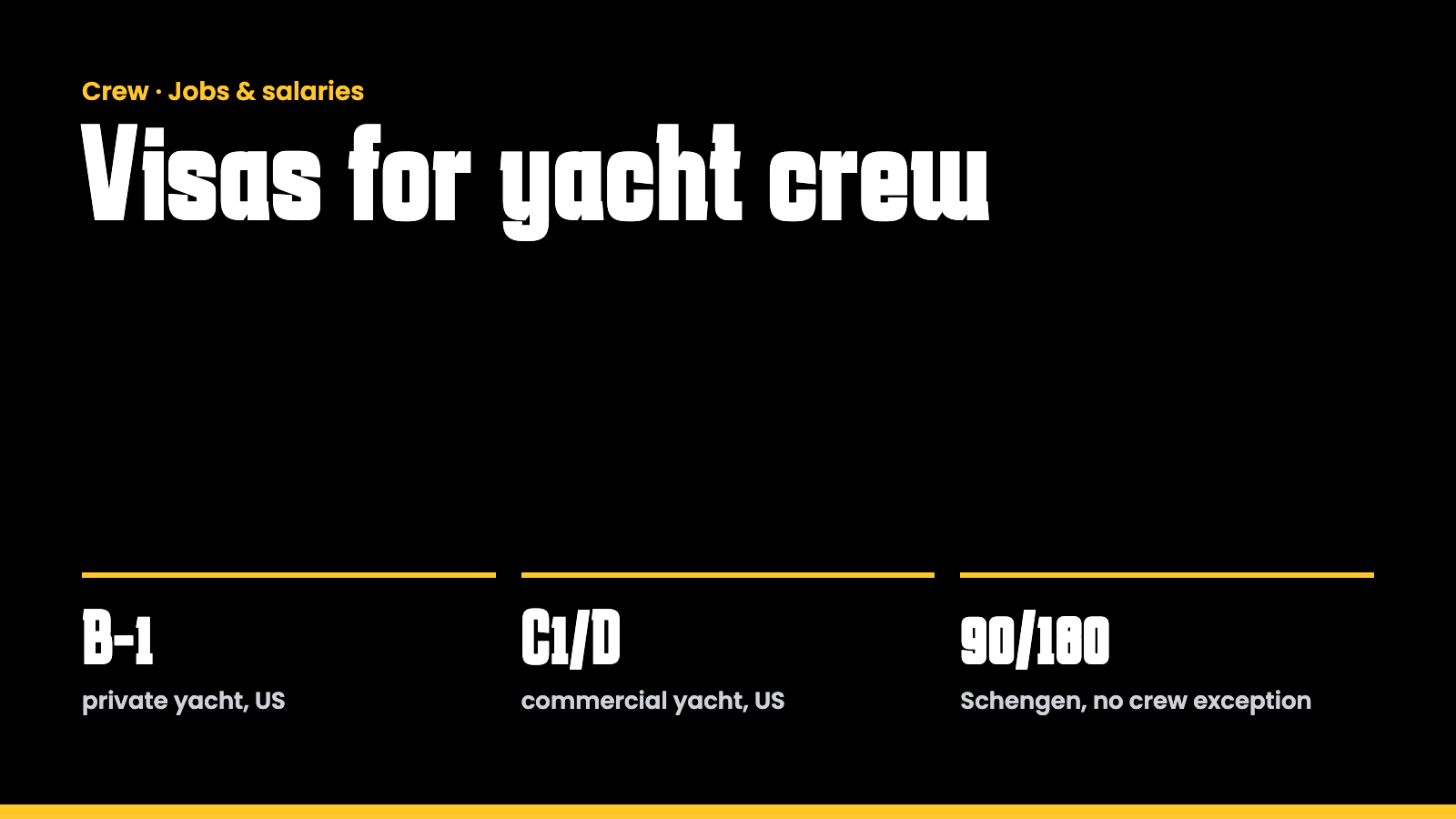
In the US, crew on a private yacht need a B-1 visa and crew on a commercial yacht a D crew visa, often combined with a C-1 transit visa as C1/D. In the Schengen area, crew from outside the EU may stay no more than 90 days in any 180, and there is no exception for crew of a yacht that stays within Schengen.
Visa rules are decided case by case by consulates and border officers. This article summarises the official rules; it is not legal advice.
Which US visa do yacht crew need?
The US State Department's Foreign Affairs Manual (FAM) sets the rules for consular officers (9 FAM 402.8-3):
- Private (pleasure) yacht → B-1. A pleasure yacht is one used mainly for the pleasure of the owner or guests. Crew get B-1 regardless of the yacht's flag, provided they have a residence abroad they do not intend to give up (9 FAM 402.2-5).
- Commercial yacht → D (crewmember). A commercial vessel is one used mainly for business, such as carrying passengers for payment.
- What counts is the purpose of the trip when entering the US. Whether a pleasure yacht is or was chartered elsewhere does not change the visa class.
- Crew who regularly work on both private and commercial yachts can hold B-1 and D at the same time, plus C-1 if eligible.
- Travelling to the US as a passenger to join a ship needs a C-1 transit visa, limited to 29 days. C-1 and D can be issued together as a C1/D visa (9 FAM 402.8-5).
- A D visa can be issued before you have a job, but used only if you are employed as crew when you arrive on the vessel.
- A seaman's book or seafarer's identity document is not required for the application but can prove your profession.
The State Department's public visa page describes B-1 for private yacht crew only when the yacht cruises in US waters for more than 29 days (travel.state.gov). The FAM does not have this 29-day limit; for consular decisions, the FAM is the governing text.
How long can you stay?
- B-1/B-2 visitors can be admitted for up to one year, with extensions of up to six months at a time (8 CFR 214.2(b)).
- Crew in D status get shore leave only while the ship is in US ports, for no more than 29 days in total. On arrival, all crew must stay on board until CBP admits them, and each crew member must appear in person before a CBP officer (8 CFR 252.1).
Can you use ESTA instead of a visa?
The Visa Waiver Program (ESTA) allows citizens of 42 countries to visit for up to 90 days without a visa (CBP). Arriving by sea under the program requires a carrier that has signed a VWP agreement, and the regulation defines a carrier as a commercial vessel or aircraft carrying passengers (8 CFR 217.2). As we read it, arrival by private yacht therefore does not fit the program. We found no official page that says this in so many words.
What do US arrivals by yacht involve?
Small pleasure boats arriving from abroad must report to CBP immediately, and entry must be applied for in person at a port of entry. A trip from a US port into international waters without calling at a foreign port does not count as leaving the US (CBP). Foreign yachts from eligible countries such as France, Germany or the UK can get a cruising licence for up to one year (19 CFR 4.94).
How does the Schengen 90/180 rule apply to crew?
- Non-EU nationals may stay in the Schengen area for no more than 90 days in any 180-day period. For each day of stay, the 180 days are counted backwards; the days of entry and exit both count (Schengen Borders Code, Art. 6).
- The passport must be valid for at least three months after the planned departure and issued within the last ten years.
- We found no official exception to the 90/180 rule for crew of a yacht that stays within Schengen. The rule applies.
- The EU offers an official short-stay calculator. The Schengen area has 29 countries; Cyprus and Ireland are not part of it.
What happens at the border when a yacht arrives?
- People on a yacht that comes from or goes to a Schengen port are not subject to border checks and may call at ports without a border crossing point; spot checks remain possible (Schengen Borders Code, Annex VI).
- A yacht arriving from outside Schengen may only exceptionally call at a port without a border crossing point; the list of people on board must then be handed to the port authority. In France, yachts can use 53 marinas without a border crossing point if the skipper sends the form with the list of people on board at least 24 hours before arrival (French customs).
- Seafarers holding a seafarer's identity document may go ashore in the port area or neighbouring municipalities, if they are on the checked crew list (Annex VII). Anyone who wants to travel further must meet the general entry conditions, including 90/180 (EU border guard handbook). No official source clarifies whether crew of a private yacht count as "seafarers" here.
What changed in 2026?
Since 10 April 2026, the Entry/Exit System (EES) has replaced passport stamping: it records name, passport data, fingerprints, facial image and the date and place of every entry and exit (European Commission). It does not change the 90/180 rule itself, but it makes overstays visible automatically (EES FAQ). We found no official information on how EES records arrivals by yacht. ETIAS, the travel authorisation for visa-free visitors, is not yet in operation (ETIAS).
Sources
US State Department (Foreign Affairs Manual 9 FAM 402.2 and 402.8, travel.state.gov), US Code of Federal Regulations (8 CFR 214.2, 217.2, 252; 19 CFR 4.94), US CBP, Schengen Borders Code (Regulation (EU) 2016/399), EU Practical Handbook for Border Guards, European Commission (short-stay calculator, EES, ETIAS) and French customs. All checked on 4 October 2026 and linked above.
Sources and image rights
- Images
- Marta Branco / Pexels (conditions)
- Checked
- 4 October 2026 by Andreas Lakeberg
Disclaimer. We research every article carefully and to the best of our knowledge. Salaries, prices, rules and port regulations change, and we cannot guarantee that all information is complete, current or correct. Please check anything important with the original source or the responsible authority before you rely on it. To the extent permitted by law, we accept no liability for errors or omissions.