AIS on a superyacht: who must carry it, Class A or B, and when you may switch it off
AIS rules for yachts under SOLAS, the EU, UK, REG, Marshall Islands, Bahamas, Cayman and US rules: size limits, classes, switching off and AIS-SART.

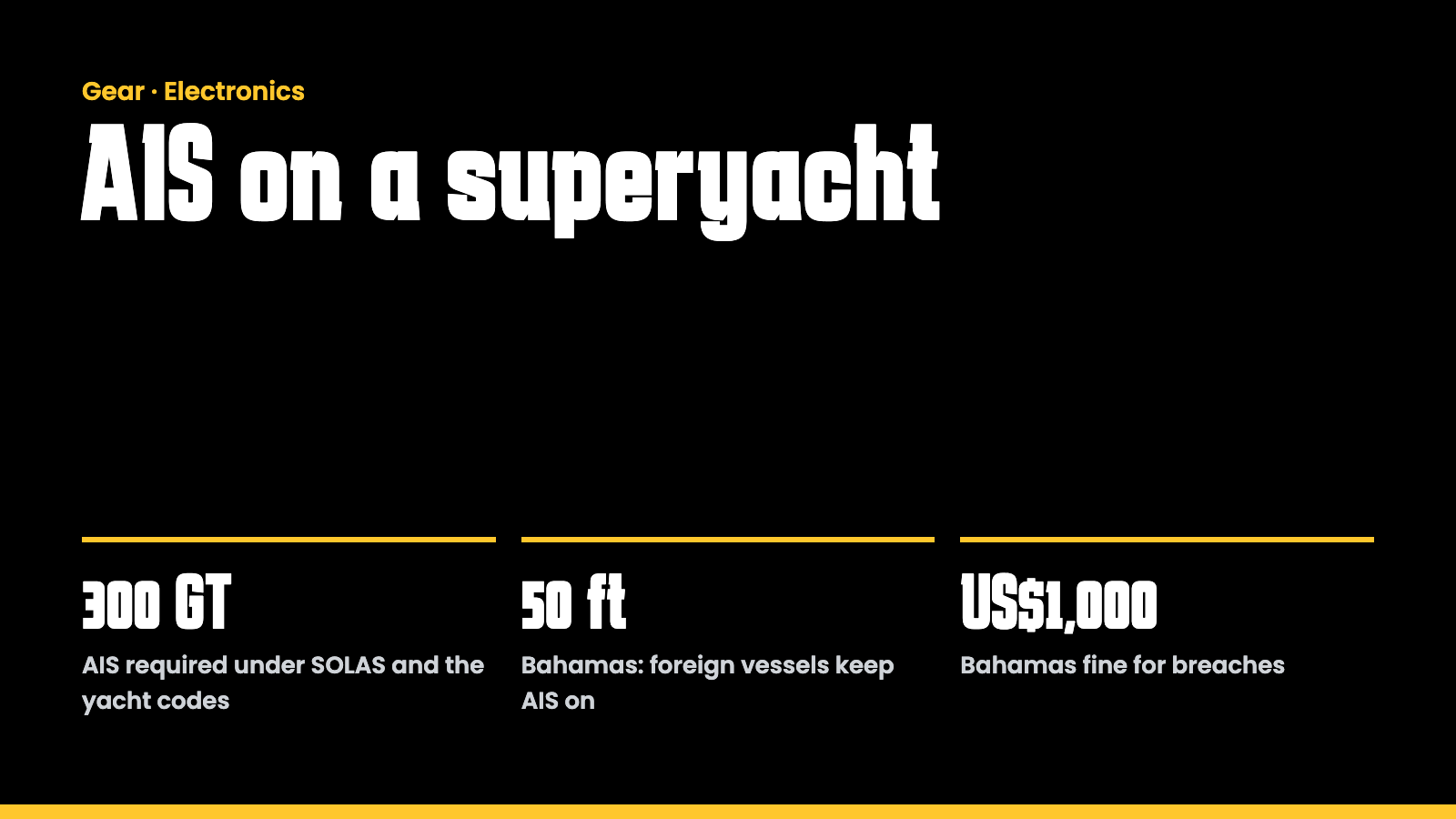
A yacht needs a type-approved AIS once it reaches 300 GT: SOLAS, the REG Yacht Code and the Marshall Islands and Bahamas codes all draw the line there. Below it, the flag decides. And since 1 July 2025, any foreign vessel over 50 feet in Bahamian waters must keep its AIS switched on at all times, or risk a US$1,000 fine.
Every rule below links to the official text. AIS, the Automatic Identification System, broadcasts a vessel's identity, type, position, course, speed and navigational status to shore stations, other ships and aircraft, and receives the same data from them (SOLAS V/19.2.4.5).
Which yachts must carry AIS?
Under SOLAS, AIS is required on every ship of 300 GT and more on international voyages, cargo ships of 500 GT and more on national voyages, and passenger ships of any size (SOLAS V/19.2.4). The yacht codes and flag states follow that threshold, with some differences:
| Rule | Who needs AIS | Source |
|---|---|---|
| REG Yacht Code Part A | commercial yachts of 24 m load line length and more with up to 12 passengers: AIS from 300 GT | REG Yacht Code, 1.2 and 18.2(1) |
| Marshall Islands | "all ships" under SOLAS V/19 expressly includes private, commercial and passenger yachts; commercial yachts from 300 GT need a type-approved AIS, below 300 GT Class B or Class A is allowed | MN 2-011-17, MI-103, II §19.2.4.2 |
| Bahamas | charter yachts of 24 m and more: AIS from 300 GT. In Bahamian waters, every foreign vessel over 50 feet: working AIS switched on underway, at anchor and alongside | Bahamas Yacht Code, 17.2.1, Port Department notice |
| EU | ships of 300 GT and more calling at EU ports; recreational craft under 45 m are excluded | Directive 2002/59/EC, Art. 2 and 6 |
| UK | the SOLAS V/19 equipment rule does not apply to pleasure vessels under 150 GT, which only need a radar reflector; the traffic monitoring rules exclude recreational craft under 45 m | SI 2020/673, reg. 5(3)(c)(ii), SI 2004/2110, reg. 4(2)(e) |
| Cayman Islands | the navigation rules apply to all Cayman ships worldwide; the exemption for pleasure vessels under 150 GT does not list the AIS paragraph 2.4 | Safety of Navigation Regulations 2004, reg. 3 |
| USA | SOLAS Class A AIS on vessels of 300 GT and more on international voyages and of 150 GT and more carrying more than 12 passengers internationally | 33 CFR 164.46(c) |
In the UK, a voyage counts as a pleasure voyage only if the owner receives no money for operating the vessel or carrying people, apart from a share of direct running costs (SI 2020/673, reg. 2). A yacht on charter is therefore not a pleasure vessel there. The Bahamas Yacht Code version 2 applies to new builds from 1 January 2021; older yachts generally stay on version 1 (MN 098, 3.3.1).
What is the difference between Class A and Class B?
Class A is the full SOLAS standard. It reports its position every 2 to 10 seconds depending on speed and course changes, at least every 3 minutes at anchor or moored, and its static and voyage data every 6 minutes (USCG; IEC 61993-2). Class B works with every AIS station but reports less often, transmits with less power and sends no voyage data (USCG). It is meant for craft outside the SOLAS duty (IEC 62287-1).
| Class A | Class B "SO" | |
|---|---|---|
| Transmit power | 1 W and 12.5 W | 1 W and 5 W |
| Voyage data (destination, ETA, draught) | yes | no |
| Standard | IEC 61993-2, IMO MSC.74(69) | IEC 62287 |
Power levels from ITU-R M.1371-6, the technical AIS standard since February 2026 (ITU). A receive-only set is not a Class B station (IEC 62287-1).
Can the tender have its own AIS?
Under the Marshall Islands code, yes: tenders and other daughter craft may carry their own Class B AIS. The flag issues a permanent MMSI for each, listed on the yacht's radio licence and programmed into the tender's AIS. If the yacht no longer carries that tender, the flag must be told (MI-103, II §19.2.4.3). Tenders and rescue boats with GMDSS equipment such as AIS or an EPIRB must be programmed with their own assigned MMSI (MI-103, II §20.6). More on tenders in our guide to yacht tenders.
When may you switch AIS off?
The rule is that an installed AIS stays on, underway and at anchor (SOLAS V/19.2.4.7; EU Directive, Art. 6(2)). The exception is safety and security: if the master believes running it endangers the vessel, AIS may be switched off.
- Log it: the switch-off and the reason go into the logbook, and AIS goes back on as soon as the danger has passed (MSN 1795, quoting IMO A.917, para. 21).
- Report it: in a mandatory reporting system, tell the authority, if that does not add to the danger (MSN 1795). Marshall Islands yachts also report to the Company Security Officer under the ship security plan (MN 2-011-17, 2.2). In US waters, report to the nearest Captain of the Port or Vessel Traffic Center (USCG FAQ 6).
- Switch on in time: in US waters, AIS-carrying vessels run it at all times underway and at anchor and switch it on at least 15 minutes before getting under way (33 CFR 164.46(d)). The UK asks for AIS to be switched on at the latest within 100 nautical miles of its coast (MGN 324 Amd 1, 4.2).
- In the Bahamas: foreign vessels over 50 feet keep AIS on even at anchor and alongside; breaches can cost US$1,000 (Port Department).
After switching back on, AIS needs about two minutes before it transmits again; in port, the port's own rules apply (MSN 1795).
What has to be checked and updated?
Ships with mandatory AIS have their Class A set tested every year by a radio surveyor approved by the flag or a recognised organisation, and keep a copy of the report on board (SOLAS V/18.9 via MGN 465; MN 2-011-17, 3.1.1). Where no annual test is required, the MCA recommends a yearly function test that a competent person such as the captain may do; the set should pick up a ship at least 10 nautical miles away (MGN 465, Annex 2).
At the start of each voyage and whenever they change, update draught, destination and ETA, route, navigational status and short safety messages; it belongs on the officer of the watch's checklist (MGN 324 Amd 1, 4.6). AIS does not replace the lookout or radar plotting, and the picture is never complete: leisure boats and fishing vessels often have none (MGN 324 Amd 1, 1.3 and 5.3). Under the REG Yacht Code, emergency power for yachts under 500 GT must run AIS, GNSS and the echo sounder for at least three hours (8A.4(1)).
What about AIS-SART and AIS man-overboard devices?
They are locating aids, not distress alerts. Search and rescue centres do not monitor AIS-MOB devices or AIS text messages as GMDSS distress alerts, and AIS must not be the main way to call for help (USCG FAQ 20).
- AIS-SART: once activated, it sends a burst of eight position reports every minute with the text "ACTIVE SART" (USCG; IEC 61097-14). The REG Yacht Code requires one SART on short-range yachts of 24 m and more and two from 500 GT or 85 m, stowed so it can be taken into any survival craft and mounted at least 1 m above the water (Table 13.1 and 13.9).
- AIS-MOB: shows "MOB ACTIVE" (ITU-R M.1371-6). Devices that combine AIS with DSC alerting are covered by IEC 63269:2022 (IEC).
- How to recognise them: the identity starts with 970 for an AIS-SART, 972 for an AIS-MOB device and 974 for an AIS-EPIRB, and all three appear on IMO-required navigation displays (USCG).
For the bigger picture, see our guides to man overboard on a yacht and the EPIRB.
What could we not verify?
- IMO Resolution A.1106(29), the current AIS operating guidelines, could not be read in the original; the switch-off rules are cited through the UK's MSN 1795, which quotes the older A.917.
- The Malta Commercial Yacht Code 2025, the REG Yacht Code Part B, and type approval under the EU Marine Equipment Directive.
- A flag-state rule that requires AIS-MOB devices on yachts: we found none.
Sources
SOLAS Chapter V (via the US Coast Guard); EU Directive 2002/59/EC (consolidated May 2025); UK SI 2004/2110 and SI 2020/673, MGN 324 Amendment 1, MGN 465 and MSN 1795; REG Yacht Code Part A (July 2024); Marshall Islands MN 2-011-17 and MI-103 (Rev. May 2026); Bahamas Yacht Code v2.0, MN 098 and the Port Department notice to boaters; Cayman Islands Safety of Navigation Regulations 2004; US 33 CFR 164.46 and USCG AIS pages; IEC and ITU standards. All checked on 7 October 2026 and linked at each point above.
Sources and image rights
- Images
- AI-generated (Magnific)
- Checked
- 7 October 2026 by Andreas Lakeberg
Disclaimer. We research every article carefully and to the best of our knowledge. Salaries, prices, rules and port regulations change, and we cannot guarantee that all information is complete, current or correct. Please check anything important with the original source or the responsible authority before you rely on it. To the extent permitted by law, we accept no liability for errors or omissions.