Crew quarters on a superyacht: cabin sizes, sharing and what the MLC requires
How big a crew cabin must be, how many crew may share, what else crew quarters need, which yachts the rules cover and where crew can complain.

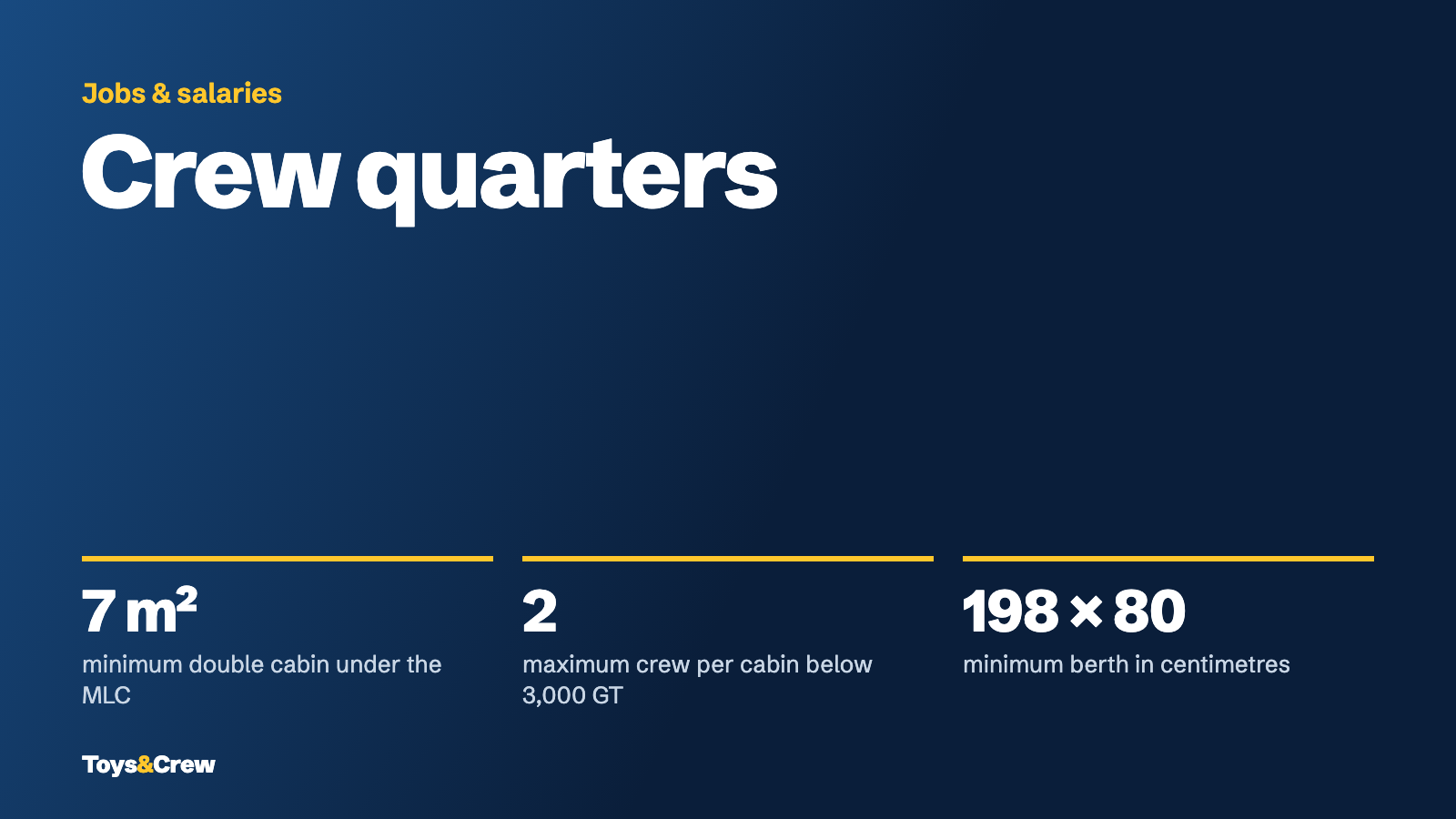
On most superyachts under 3,000 GT you will share a cabin with one other crew member. The Maritime Labour Convention (MLC) starts from a cabin per person, but lets flag states allow sharing on smaller ships: never more than two per cabin, a double cabin of at least 7 m², your own berth of at least 198 × 80 cm and separate cabins for men and women. Yacht flags have their own equivalent rules that allow smaller cabins on smaller yachts, and yachts built before the MLC are largely exempt.
The figures below come from the MLC and from three flags common on yachts: the UK and the Red Ensign Group's REG Yacht Code, the Marshall Islands and the Cayman Islands.
Do you get your own cabin?
Usually not on a yacht. The MLC rule is a separate sleeping room for every seafarer, but on ships under 3,000 GT the flag state may allow exceptions after consulting shipowners' and seafarers' organisations; then no more than two may share (MLC, Standard A3.1, paragraph 9). In every case:
- each seafarer has their own berth;
- men and women get separate sleeping rooms;
- a non-binding guideline adds that watchkeepers and day workers should not share a room where possible (Guideline B3.1.5).
Under the REG Yacht Code, officers should not have to share. On yachts of 3,000 to 5,000 GT, ratings share at most two to a twin cabin of at least 11 m² with its own bathroom and at least one window; mixed cabins are not allowed, though a couple may choose to share, never be made to (REG Yacht Code 2024, Part A, 21B.8). Yachts of 5,000 GT and above built from 20 August 2012 must meet the MLC standard in full.
How big must a crew cabin be?
It depends on the yacht's size and flag:
| Rule | Double cabin | Further published figures |
|---|---|---|
| MLC, ships under 3,000 GT | 7 m² | Single cabin: 4.5 m² |
| REG Yacht Code, standard up to 3,000 GT | 7 m² (own bathroom may be included) | Single cabin: 4.5 m² where possible |
| REG Yacht Code, 200 to under 500 GT, if the standard is not practicable | 7 m² without bathroom, 6.2 m² with bathroom | Single cabin: 3.6 m², with bathroom 4.5 m² |
| Marshall Islands, under 1,250 GT | 6.2 m² without bathroom, 7 m² with bathroom | Single cabin: 3.6 m², with bathroom 4.5 m² |
| REG Yacht Code 3,000 to 5,000 GT; Marshall Islands 3,000 GT and over | 11 m² with own bathroom |
Sources: MLC, A3.1; REG Yacht Code, 21B.8; Marshall Islands, MI-103, 9.11.
Note the contradiction: for small double cabins, the REG Yacht Code and the Marshall Islands code give the same two figures the other way round (with and without a bathroom). Both documents say so word for word; check the code of your yacht's flag. Where reduced sizes apply, the REG Yacht Code still requires at least 1.45 m² of free floor per person, in exceptional cases 1 m². Under the same code, officers' single cabins without a day room rise from 4.5 m² at 500 GT to 7.5 m² at 1,250 GT.
Other minimum dimensions:
- Berth: 198 cm long and 80 cm wide (MLC). The REG Yacht Code allows it to taper towards the foot, but never below 50 cm; under 200 GT, 190 × 70 cm without tapering is also allowed. Berths should not be stacked more than two high, the lower one at least 30 cm off the floor (MLC Guideline B3.1.5).
- Headroom: 203 cm where you need to move freely (MLC and REG); the REG Yacht Code accepts 190 cm in other spaces where you stand for long periods, the Marshall Islands ask for 200 cm.
- Storage: a lockable locker of at least 475 litres plus a 56-litre drawer (MLC). On yachts at least 300 litres must be inside the cabin if the rest does not fit (REG); under 200 GT, at least 125 litres per person (REG, Marshall Islands).
What else must crew quarters have?
- Air and temperature: air conditioning, unless the yacht only sails in temperate climates (MLC); at least 25 m³ of fresh air per person per hour (REG Yacht Code). UK heating must keep 21 °C inside at −1 °C outside (MCA, MSN 1844 Amendment 1).
- Light: daylight and enough artificial light (MLC); in the UK, 150 lux at a cabin desk (MGN 481 Amendment 2).
- Bathrooms: one toilet, washbasin and shower per six crew without their own bathroom, separate for men and women (MLC, REG); the Marshall Islands require one set per four (per six under 200 GT). UK showers need an anti-scald mixer, with thermostatic valves set to a maximum between 38 and 43 °C (MSN 1844).
- Mess and deck space: a crew mess of at least 1.5 m² per planned seat, and open deck space for crew to relax, 1.5 m² per person under the REG Yacht Code. Under 200 GT the mess may be shared with guests with the flag's approval.
- Laundry: washing, drying and ironing facilities (MLC; in the UK on every vessel where crew sleep on board).
- Safety below the waterline: if a cabin floor is below the deepest waterline, a bilge flood alarm is required; cabins with their ceiling below the waterline are not allowed (REG Yacht Code).
- Hospital: required with 15 or more crew on voyages over three days (MLC); under the REG Yacht Code not for yachts staying within 60 nautical miles of the coast, which must instead set aside a cabin with bathroom for medical use on longer trips.
According to a non-binding MLC guideline, the owner should provide bedding, towels, soap and toilet paper, and internet at no more than a reasonable charge (Guidelines B3.1.10 and B3.1.11); more on internet in relationships at sea. Crew quarters should be as far as possible from machinery and ventilation units (Guideline B3.1.12). We found no official source giving noise limits in decibels for yacht crew cabins.
Which yachts do these rules cover?
Mainly commercial yachts built after the MLC took effect:
- Build date: the MLC's construction rules only apply to ships whose keel was laid after the convention came into force for the flag (MLC, Regulation 3.1). For the Cayman Islands that was 7 August 2014 (Cayman Shipping Notice 03/2014); the Marshall Islands' rules exclude ships built before 20 August 2013 (Marine Notice 2-011-33). Older yachts keep their previous standard unless the crew quarters are substantially altered.
- Private yachts: in the UK, vessels not ordinarily engaged in commercial activities are outside the MLC (MGN 471 Amendment 2). The Marshall Islands treat commercial and passenger yachts as ships under the MLC regardless of size, but not purely private yachts. In the Cayman Islands, every yacht that is chartered or commercially registered must comply, and a charter permit is only granted once this is confirmed (Guidance Note 04/2023). More in private or charter yacht.
- Small yachts: under 200 GT, flags may waive air conditioning, washbasins in cabins, laundry and the minimum floor areas (MLC, A3.1, paragraph 20). The UK uses these exemptions in its own standard for small commercial vessels, including yachts (MGN 601 Amendment 1).
- Crew numbers: in the Cayman Islands, crew may not exceed the approved MLC accommodation; on private yachts without MLC obligation, the number of berths counts (Guidance Note 02/2025).
Who checks crew quarters, and where can you complain?
- The captain, every week: crew quarters must be inspected at least every 7 days and the result logged; in the UK by the captain or an officer together with another crew member (MCA, Master's Guide to the UK Flag; Cayman and Marshall Islands alike).
- The flag: the MCA inspects MLC conditions on yachts at least every three years; the Cayman Islands check yachts under 500 GT without an MLC certificate every year during the Large Yacht Code survey.
- Port state control: inspectors compare the crew list with the number of cabins and berths. Typical deficiencies are cabins that are too small or too few, more than one person per berth and no separate cabins for men and women (ILO guidelines for port State control officers). Across all ship types, Paris MoU inspectors recorded 3,752 deficiencies on accommodation, recreation and catering in 2025, 7.2 % of all deficiencies (Paris MoU Annual Report 2025).
Complaints: start with the onboard complaint procedure; ashore, UK-flagged crew can contact the MCA at mlc@mcga.gov.uk (MGN 481). The Cayman registry investigates MLC complaints and accepts them directly through an online form (Guidance Note 02/2025). Breaches are an offence by the owner in the UK (MSN 1844); in the Cayman Islands, sailing without meeting the accommodation rules can cost up to $10,000 on summary conviction or $50,000 on indictment (Cayman Crew Accommodation Regulations 2014(Crew%20Accomodation)%20Regulations%202014.pdf)). Your wider rights are in our MLC guide.
Sources
Maritime Labour Convention 2006 as amended and ILO guidelines for port State control officers; REG Yacht Code (July 2024), Part A; UK MCA: MSN 1844 Amendment 1, MGN 481 Amendment 2, MGN 601 Amendment 1, MGN 471 Amendment 2 and the Master's Guide to the UK Flag; Marshall Islands MI-103 and Marine Notice 2-011-33; Cayman Islands Crew Accommodation Regulations 2014, Shipping Notice 03/2014, Guidance Notes 04/2023 and 02/2025; Paris MoU Annual Report 2025; PYA. All checked on 22 October 2026 and linked above.
Sources and image rights
- Images
- Memet Besa / Pexels (conditions)
- Checked
- 22 October 2026 by Andreas Lakeberg
Know something we missed – a rule, a fee, a marina detail? Write to editor@toysandcrew.com. We check every tip against the source and note updates at the top of the story.
Disclaimer. We research every article carefully and to the best of our knowledge. Salaries, prices, rules and port regulations change, and we cannot guarantee that all information is complete, current or correct. Please check anything important with the original source or the responsible authority before you rely on it. To the extent permitted by law, we accept no liability for errors or omissions.