Relationships at sea: how yacht crew keep a partnership going on long contracts
What the MLC says about internet, partner visits and leave, what surveys of yacht crew show, and where crew and partners can find confidential support.


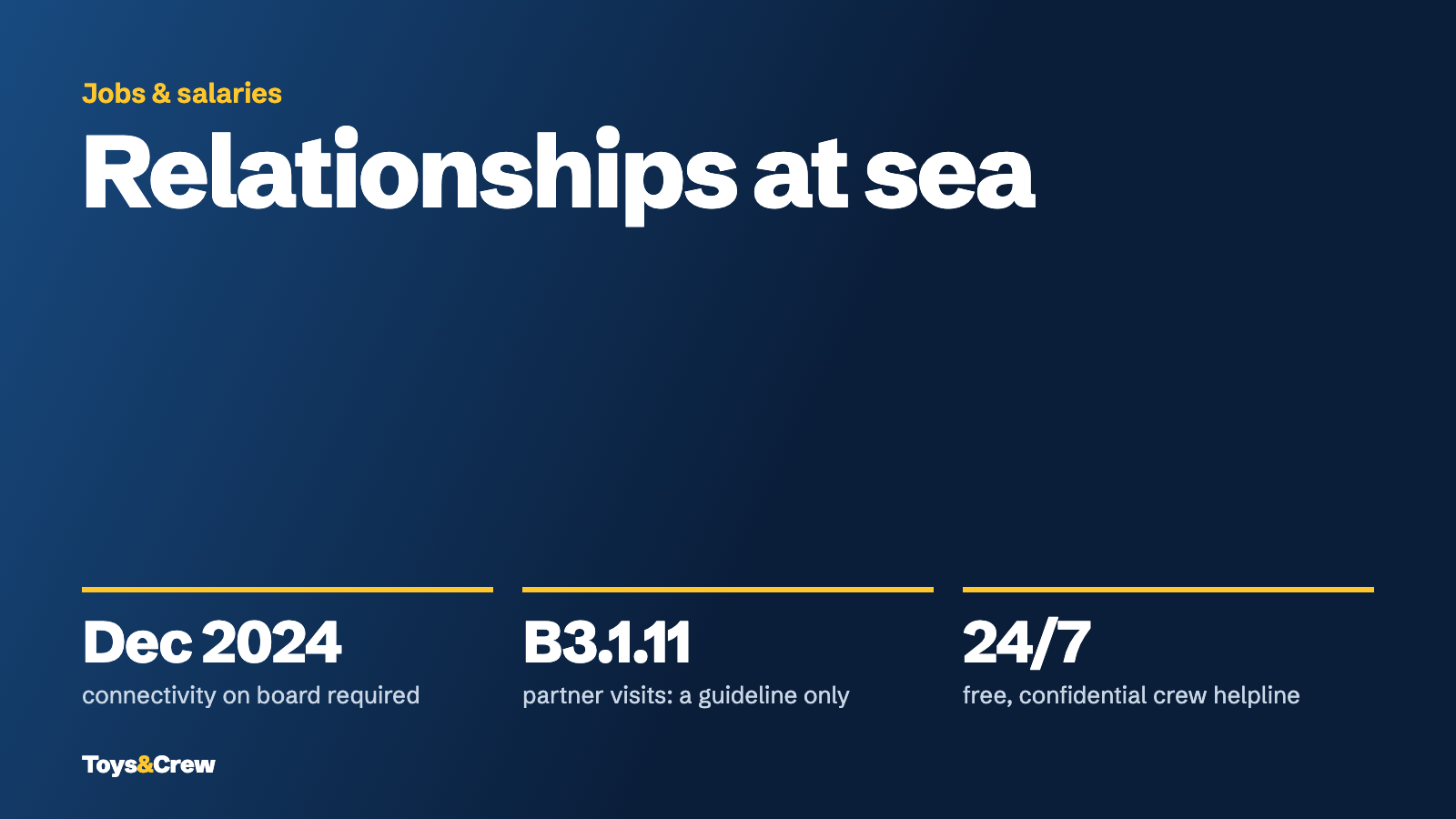
No law regulates relationships at sea, but several rules shape them. Since 23 December 2024 the Maritime Labour Convention (MLC) requires social connectivity on board, partner visits in port are only a non-binding recommendation, and leave and repatriation rules decide how often you get home. Surveys show isolation is common among yacht crew, and free, confidential helplines exist.
The MLC covers yachts ordinarily engaged in commercial activities; whether yours is one is explained in private or charter yacht.
Is there a rule about relationships on board?
No. We found no official source on relationships between crew members, and no guidance on it from the PYA, Nautilus or ISWAN. For partner visits, the REG Yacht Code and the flag states we checked have no rule; the only text is an MLC guideline, covered below. What does exist are rules on staying in touch, leave and getting home.
Do you have a right to internet to stay in touch?
Yes, on ships covered by the MLC: since 23 December 2024, facilities on board must include social connectivity for all seafarers (MLC, Standard A3.1, paragraph 17; date: ILO FAQ 2026).
- Owners should provide internet access as far as reasonably practicable, with charges, if any, reasonable in amount (MLC, Guideline B3.1.11).
- According to the ILO, there is no absolute right to free or unlimited internet, but internet for social connectivity should, in principle, be free of charge (ILO FAQ 2026, C3.1.o).
- UK: connectivity must be available in all crew accommodation except storerooms, and a breach is an offence by the owner; sea areas without service and short outages are exempt. The MCA recommends enough free daily bandwidth per person for messaging, calls, photos, short videos, email and online banking; streaming is not required (MCA, MGN 707 (M), 19 March 2026). Whether MGN 707 applies to pleasure vessels is open.
- The REG Yacht Code (July 2024) requires recreational facilities from 200 GT but does not mention "social connectivity" (REG Yacht Code, Part A).
What the hardware can deliver is in our article on Starlink Maritime.
Can your partner visit or travel with you?
Only as a recommendation, not as a right. A non-binding MLC guideline says seafarers should quickly be allowed visitors on board in port, including partners, relatives and friends, subject to security clearance. Owners should consider letting partners occasionally sail along, insured against accident and illness, and help arrange that cover (MLC, Guideline B3.1.11, paragraphs 6–7). Berths should be as comfortable as possible, also for a partner on board (Guideline B3.1.5). In practice, the yacht decides.
How do leave and repatriation rules affect time at home?
They set the framework, but the owner sets the dates. The binding minimums are in our guide to the MLC. The MLC guidelines add (Guidelines B2.4.1 to B2.4.3):
- The owner sets the timing of leave, after consultation and, where possible, in agreement with the crew.
- Leave should be taken where you have a substantial connection, usually your place of repatriation. If it must start elsewhere, the owner should pay the travel, and travel time should not reduce your leave.
- Leave should normally be taken in one block, and you should only be recalled in an extreme emergency and with your consent.
- Shore leave during the contract should not count as annual leave.
For repatriation, owners may not demand an advance payment (Standard A2.5.1). Travel should normally be by air, you should be able to choose the destination from options such as your place of engagement or country of residence, and waiting and travel time should not be deducted from leave (Guideline B2.5.1).
What changes in 2027?
Amendments adopted in 2025 are expected to take effect on 23 December 2027 and are not yet in force (ILO FAQ 2026). Owners will then have to allow shore leave when a seafarer is off duty and the ship is in port, unless authorities, safety or operations prevent it, and states may not require a visa for shore leave (ILO, ILC 113 instruments).
What do surveys say about yacht crew and relationships?
Isolation and time away from home appear in every survey we found, though size, year and method differ:
- ISWAN, "The Welfare of Superyacht Crew" (online, June to October 2018, 402 yacht crew evaluated): 45 % sometimes, often or always felt isolated or lonely on board (women 57 %, men 39 %), and 74 % wanted more reliable internet. 75 % could only sometimes, rarely or never plan private events ashore because of unpredictable itineraries. Only 26 % were sure they had paid compassionate leave. Crew sailing with a partner described themselves as happy, though some said working together puts pressure on a relationship (ISWAN, 2018).
- Quay Crew for Mental Health Support Solutions (online, September to October 2021, 1,019 yacht crew from an agency's candidate base, not a random sample): 41 % had experienced isolation or loneliness; 33 % named being away from home as a factor for poor mental health. With a problem, 30 % would talk to family first, 30 % to crewmates (Quay Crew, 2021).
- Yale University for the ITF Seafarers' Trust (1,572 merchant seafarers, not a yacht study; survey to January 2019, report October 2019): isolation from family and contract length were among the main reasons for low mood, which was worst when a voyage was extended and best on the way home (Seafarers' Trust, 2019).
- Mission to Seafarers, Seafarers Happiness Index Q2 2026 (voluntary and anonymous, all seafarers including superyachts, sample size not stated): satisfaction was highest at 3 to 6 months on board (8.01/10) and lower beyond 12 months (6.48); shore leave scored lowest at 5.72 (Mission to Seafarers).
Helpline figures point the same way but are case statistics, not representative surveys. In 2023, ISWAN's helplines supported 92 seafarers with private-life problems; trouble with a partner or a break-up was the most frequent issue, and almost 60 % of those callers also sought help for their mental health (ISWAN). In YachtCrewHelp's 2025 review, mental health contacts were up 55.2 % on the previous year (ISWAN, 2025 review).
Where can crew and partners find support?
Several services are free, confidential and open around the clock, and most also help families:
- YachtCrewHelp (ISWAN): for yacht crew and their families, multilingual, 24 hours a day, 365 days a year (ISWAN); live chat, WhatsApp, email, phone +44 20 3713 7273 or the "ISWAN for Seafarers" app (YachtCrewHelp).
- SeafarerHelp (ISWAN): for seafarers and families, 24/7, phone +44 20 7323 2737, always a person, not AI (SeafarerHelp).
- Sailors' Society: 24/7 helpline, including for relationship problems at home or with a crewmate, phone +1 938 222 8181 (helpline), plus peer support groups for family members (family groups).
- Mission to Seafarers: chaplains on board and in seafarers' centres, for example with SIM cards to call home (Mission to Seafarers).
- Nautilus 24/7 for Nautilus members (Nautilus) and the PYA Member Assistance Service for members with contract or pay disputes (PYA).
Ashore, states must make welfare facilities accessible to all seafarers, whatever their nationality or flag; these should include counselling where appropriate, and seafarers' hotels should offer family accommodation where possible (MLC, Regulation 4.4, Standard A4.4 and Guideline B4.4.2).
ISWAN's own advice: agree with your loved ones how often you will call or write, and what you expect of each other (ISWAN, #ConnectingCrew).
Sources
Maritime Labour Convention 2006 as amended and the 2025 amendments (ILO), ILO MLC FAQ 6th edition 2026, UK MCA (MGN 707), REG Yacht Code Part A (July 2024), ISWAN, Yale University for the ITF Seafarers' Trust, Quay Crew for Mental Health Support Solutions, Mission to Seafarers, Sailors' Society, Nautilus International and the PYA. All checked on 15 October 2026 and linked above.
Sources and image rights
- Images
- Helena Lopes / Pexels (conditions)
- Checked
- 21 October 2026 by Andreas Lakeberg
Know something we missed – a rule, a fee, a marina detail? Write to editor@toysandcrew.com. We check every tip against the source and note updates at the top of the story.
Disclaimer. We research every article carefully and to the best of our knowledge. Salaries, prices, rules and port regulations change, and we cannot guarantee that all information is complete, current or correct. Please check anything important with the original source or the responsible authority before you rely on it. To the extent permitted by law, we accept no liability for errors or omissions.