Difficult charter guests: what crew really deal with, and what protects them
What the data says about harassment of yacht crew, what the MYBA charter agreement says about guests, and how crew can complain under MLC and flag rules.

Crew are protected from abusive guests mainly by the charter contract and by the complaint rights of the Maritime Labour Convention. The MYBA charter agreement states that no crew member may be harassed by the charterer or guests, and the captain can warn in writing and the owner can end the charter.
Below are the contract terms, the rules and the published data, each linked to its source.
What do the figures say about harassment of yacht crew?
The available figures cover harassment on yachts in general; none of them separates guests from crew, senior officers or owners.
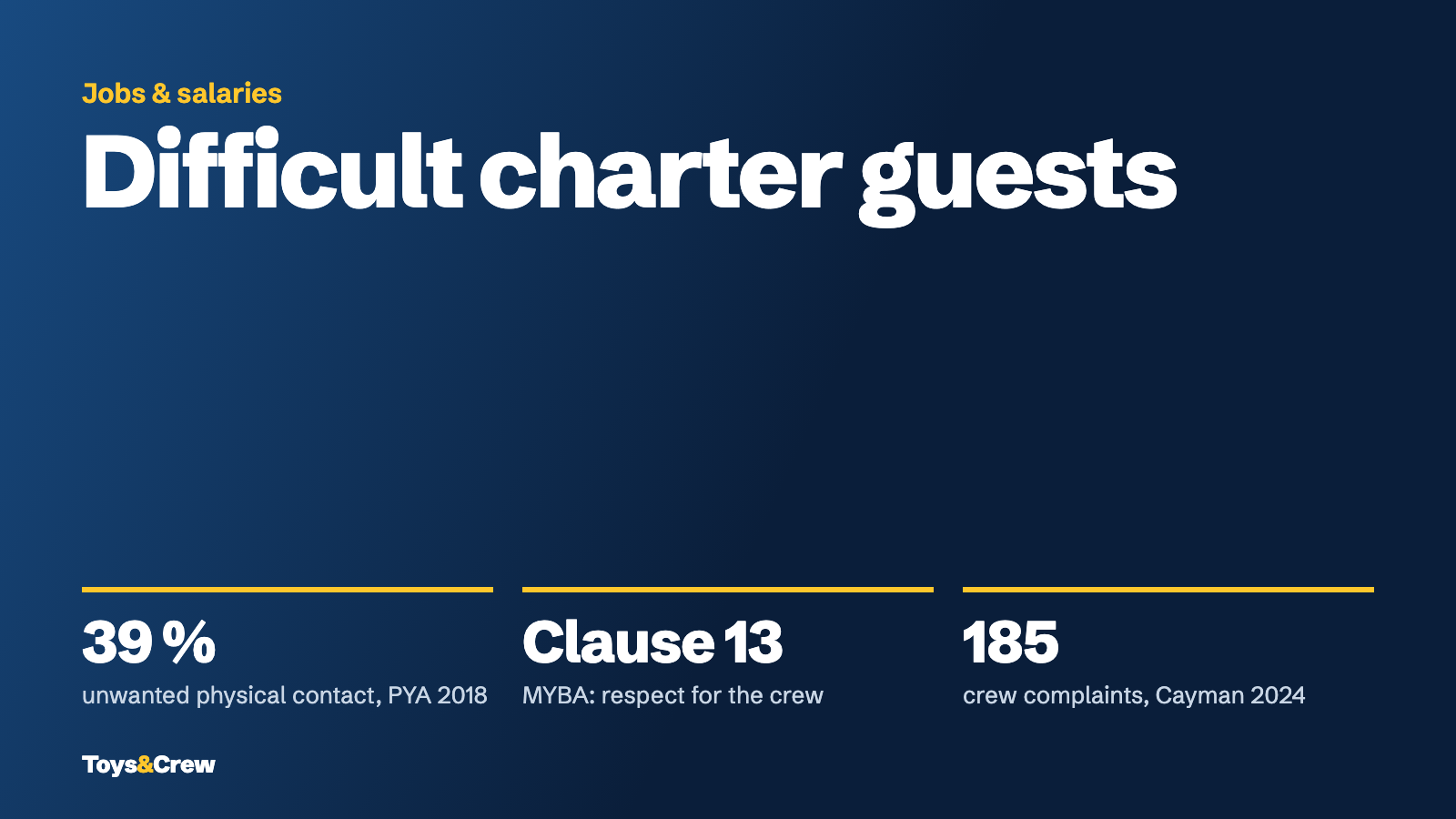
- PYA study 2018 (633 Professional Yachting Association members, surveyed 13 March to 25 September 2018): 39 % said they had personally received unwanted physical contact while working on board. Only 34 % said their yacht had a written policy on sexual harassment; 36 % said it did not, 30 % did not know. 49 % had not been given a copy of the complaint procedure when joining, and 56 % did not know their rights and the flag state rules on sexual harassment (PYA, Sexual Harassment in Yachting 2018).
- ISWAN YachtCrewHelp 2025 (helpline contacts from yacht crew): contacts about abuse, bullying, harassment, discrimination and violence rose by 29.4 %; bullying came up in 61.4 % of these cases (ISWAN). Onboard harassment was raised in 29.5 %, and in 29.4 % of such contacts from women the issue was sexual assault or sexual harassment (ISWAN Annual Review 2025).
- Cayman Islands registry 2024: of 185 crew complaints, 10 alleged bullying or harassment, the highest number since records began (MACI Complaints Report 2024).
The ISWAN and Cayman figures are helpline and complaint counts, not representative surveys. ISWAN itself notes that more contacts do not necessarily mean more incidents; they can also reflect greater awareness of the helpline (ISWAN Annual Review 2025).
One finding does concern guests directly: ISWAN reports that speaking up was especially hard for crew where senior officers, owners or guests were involved, and women described pressure from guest-facing roles with blurred boundaries (ISWAN Annual Review 2025).
What does the charter contract say about guest behaviour?
The MYBA charter agreement names harassment of crew by guests explicitly. We read the public 2009 edition of the MYBA agreement (MYBA Charter Agreement, revised 2009):
- Clause 13: the charterer and guests must treat the crew with respect at all times. "No Crew member shall be subjected to any type of harassment, sexual or otherwise, by the CHARTERER or Guests at any time during the Charter Period."
- Clause 13: the charterer must ensure that their own and their guests' behaviour does not cause a nuisance to anyone or bring the yacht into disrepute.
- Clause 7 a): if the charterer breaches clause 13, the captain must first give a specific written warning. If the behaviour continues, the owner can end the charter without refunding the charter fee.
- Clause 7 b): the captain can exclude the charterer or guests from water toys if they act unsafely or irresponsibly or are under the influence of alcohol.
- Clause 13: the yacht has a zero tolerance policy; possession or use of illegal drugs or weapons entitles the owner to end the charter at once without refund.
Damage alone is different: according to the P&I insurer Shipowners' Club, it gives no right to terminate and is settled through clause 3 and the security deposit (Shipowners' Club). On drugs and alcohol rules for crew, see our guide to drugs and alcohol on superyachts.
What can the captain do during the charter?
The captain has the final say on safety, and good records are what count afterwards. The REG Yacht Code requires that the master has authority at all times to decide on the safety of the yacht and everyone on board, and that this is set down in writing (REG Yacht Code, Part A, 23A.10).
MYBA's guidance for charter captains recommends a briefing at the start of the charter covering, among other things, safety, water sports, smoking, recreational drugs and local laws. Damage caused by guests should be reported at once to the broker and central agent, shown to the charterer as soon as possible and photographed (MYBA, Information for Charter Yacht Captains & Crew).
The Shipowners' Club also points out that breaches of clause 13 are hard to prove and that disputes are likely to turn on the strength of the evidence gathered at the time (Shipowners' Club).
Which rules protect crew from harassment by third parties?
The main international rule is ILO Convention 190, but it binds only the countries that have ratified it. C190 defines violence and harassment as unacceptable behaviour, single or repeated, that aims at or results in physical, psychological, sexual or economic harm, and it includes sexual harassment. It covers employer-provided accommodation, where crew live, and requires states to take into account harassment involving third parties such as clients (ILO C190).
The UK ratified on 7 March 2022 (ILO).
At sea, three further steps apply:
- Since 8 January 2019, states should take the latest ICS/ITF guidance on harassment and bullying into account in their health and safety rules on board (ILO MLC compendium 2026).
- Since 1 January 2026, STCW basic training includes a mandatory competence on preventing and responding to violence and harassment. The MCA offers the online module free of charge; it takes about an hour (MCA, MGN 718).
- The MLC amendments of 2025 require flag states to prohibit shipboard violence and harassment in law, require shipowners to adopt policies, and require "seafarers and others concerned" to comply with them (ILO, ILC 113 instruments). They are not yet in force; entry into force is expected on 23 December 2027 (ILO).
How can crew complain about a guest?
Under the MLC, crew can always complain directly to the captain and, where necessary, to outside authorities, and victimisation for a complaint is prohibited and penalised. With the employment agreement, every crew member must receive the complaint procedure, the flag state's contact details and the name of a person on board who gives confidential, impartial advice (ILO MLC compendium 2026). Complaints should go from head of department to captain to the company ashore, recorded in writing; in the port of an MLC state, crew can also go to port state control. Whether your yacht falls under the MLC is explained in private or charter yacht; the general complaint rights are in our MLC 2006 guide.
By flag:
| Flag | Where to complain | Source |
|---|---|---|
| United Kingdom | captain, owner, MCA (mlc@mcga.gov.uk) or port state; also for crew on foreign yachts in UK ports | MSN 1849, MGN 487 |
| Cayman Islands | on board, then management ashore, then the Shipping Master (shipping.master@cishipping.com); not anonymous, but strictly confidential | CIGN 05/2025 |
| Marshall Islands | Maritime Administrator (seafarers@register-iri.com) | MN 7-053-1 |
| Bahamas | Director of Labour if no settlement after 20 days | MN 33 |
The Cayman guidance adds three points that matter on charter yachts: NDAs, even signed, cannot stop crew from reporting a safety or wellbeing issue; the lack of MLC compliance on a private yacht is no barrier to a remedy; and sexual assault is invariably a criminal matter for the relevant authorities (CIGN 05/2025).
Outside the formal routes, ISWAN's YachtCrewHelp is free, confidential and available around the clock by chat, WhatsApp, email or phone on +44 20 3713 7273 (ISWAN).
Sources
MYBA Charter Agreement (2009 edition) and MYBA guidance for charter captains and crew, ILO (Convention 190, MLC compendium 2026, MLC amendments 2025), REG Yacht Code Part A (July 2024), UK MCA (MSN 1849, MGN 487, MGN 718), Cayman Islands Shipping Registry (CIGN 05/2025, Complaints Report 2024), Marshall Islands Maritime Administrator, Bahamas Maritime Authority, Shipowners' Club, PYA and ISWAN. All checked on 15 October 2026 and linked above.
Sources and image rights
- Images
- Furkan Tumer / Pexels (conditions)
- Checked
- 21 October 2026 by Andreas Lakeberg
Know something we missed – a rule, a fee, a marina detail? Write to editor@toysandcrew.com. We check every tip against the source and note updates at the top of the story.
Disclaimer. We research every article carefully and to the best of our knowledge. Salaries, prices, rules and port regulations change, and we cannot guarantee that all information is complete, current or correct. Please check anything important with the original source or the responsible authority before you rely on it. To the extent permitted by law, we accept no liability for errors or omissions.