“Female only due to cabin”: why yacht job ads name a gender and whether that is allowed
Why yacht job ads ask for a man or a woman, what UK, French and Maltese law say about it, and why the flag decides which rules apply.


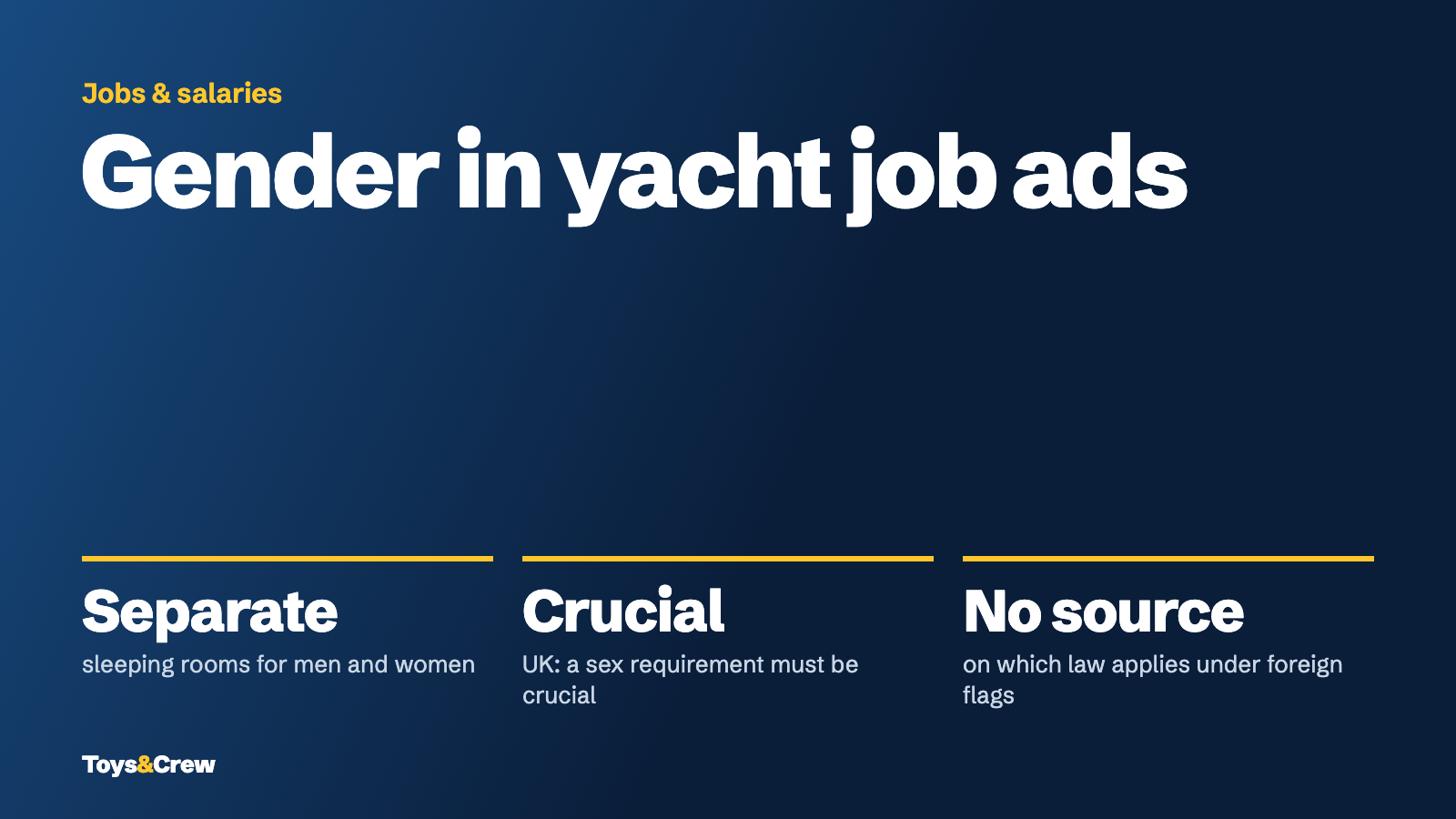
Where crew share sleeping rooms, the accommodation rules require separate sleeping rooms for men and women. Whether a job ad that names a gender is lawful depends on which law applies to the job. UK law allows a sex requirement only in narrow cases; France and Malta ban gendered job ads with tight exceptions.
This article summarises the official rules; it is not legal advice.
Why do yacht job ads ask for a man or a woman?
Because the cabin rules keep men and women apart. Cabin sizes and sharing are covered in detail in crew quarters on a superyacht; for gender, these rules matter:
- UK flag: where sleeping rooms are shared, separate sleeping rooms must be provided for male and female persons (MCA, MSN 1844 (M) Amendment 1, section 11.11). These rules apply to UK ships and to foreign ships without a Maritime Labour Convention certificate in UK waters; failing to comply is a criminal offence (MSN 1844, summary).
- REG Yacht Code, smaller yachts (chapter 21A): sleeping rooms should, as far as practicable, be placed or fitted out to give appropriate levels of privacy for men and for women (REG Yacht Code Part A, 21A.10(4)).
- REG Yacht Code, larger yachts (chapter 21B): "Separate sleeping rooms shall be provided for men and for women" in several size bands, and in one band of larger yachts seafarer cabins are approved only as twin cabins, not double cabins (21B.8). The largest yachts must meet the full Maritime Labour Convention Standard A3.1 (21B.8(6)), including its rule on separate sleeping rooms (A3.1, paragraph 9(b)).
The cabin rules explain the ad; they do not make it lawful.
Is a gender-specific yacht job ad allowed?
It depends on whose law governs the job. In the UK, France and Malta, a gendered ad is the exception that the employer must justify, not the norm.
What does UK law say about "male only" or "female only" ads?
UK law forbids discrimination already in the arrangements an employer makes for deciding who gets a job offer, and in not offering someone a job (Equality Act 2010, section 39). "You must not state or imply in a job advert that you'll discriminate against anyone" (GOV.UK, discrimination in recruitment).
The statutory Code of Practice of the Equality and Human Rights Commission adds (EHRC Employment Code):
- An advert must not include wording that suggests direct discrimination, such as looking for a "waitress" or a "salesman" (paragraph 16.24).
- Whether an advert is discriminatory depends on "whether a reasonable person would consider it to be so"; adverts on the internet count (3.33).
- "Only people who are eligible to apply for the job in question can make a claim" over a discriminatory advert (3.32).
When may a UK employer require a man or a woman?
Only when being a man or a woman is a genuine occupational requirement for that specific job and the employer can show it is proportionate. The Act allows "a requirement to have a particular protected characteristic" if it is an occupational requirement, given the nature or context of the work, and "a proportionate means of achieving a legitimate aim" (Equality Act 2010, Schedule 9, Part 1). For a sex requirement, the employer cannot rely on merely having doubts; the person must actually not meet it (paragraph 1(4)).
The government's explanatory notes set the bar (Explanatory Notes, Schedule 9 Part 1):
- Crucial, not just important: "The requirement must be crucial to the post, and not merely one of several important factors."
- No pretext: "It also must not be a sham or pretext."
- Burden of proof: it "rests on those seeking to rely on it".
- Example: privacy or decency might require a changing room or lavatory attendant to be of the same sex as the users.
- Direct discrimination only: "None of these exceptions can be used to justify indirect discrimination or harassment."
Acas adds that the requirement can only be for a specific job, "not for all jobs with an employer", and must be checked again each time the job is filled (Acas, using protected characteristics; Acas, types of sex discrimination).
How the ad should look: where a job has an occupational requirement, "the advertisement should state this so that it is clear that there is no unlawful discrimination". The EHRC's example advert carries the line "Permitted under Schedule 9, part 1 of the Equality Act 2010" (EHRC Code, 16.27). A bare "female only due to cabin" does not do that.
Does the shared cabin itself count as an exception?
The Act has a separate exception for admitting people to communal accommodation by sex (Equality Act 2010, Schedule 23, paragraph 3). Its definition: "Communal accommodation is residential accommodation which includes dormitories or other shared sleeping accommodation which for reasons of privacy should be used only by persons of the same sex." The exception has conditions:
- the accommodation must be "managed in a way which is as fair as possible to both men and women";
- at work, it only applies if "such arrangements as are reasonably practicable are made to compensate" the person refused. The government's example: where the only communal accommodation is used by men, the employer "must make alternative arrangements to compensate her where reasonable, for example by arranging alternative accommodation" (Explanatory Notes, Schedule 23 paragraph 3).
Does UK equality law apply on a yacht at all?
Only in defined cases. The work part of the Act (Part 5) applies to work on ships and to seafarers "only in such circumstances as are prescribed", whether the employment arises or the work is done inside or outside the UK (Equality Act 2010, section 81). The reason: "seafarers work on ships that may be constantly moving between waters under the jurisdiction of different States" (Explanatory Notes, section 81). Without regulations, Part 5 "will not apply to work on ships and hovercraft, and seafarers" (Explanatory Memorandum to SI 2011/1771).
The regulations that set those circumstances (SI 2011/1771):
- UK ship, working in Great Britain or adjacent UK waters: Part 5 applies to a seafarer who works "wholly or partly within Great Britain (including United Kingdom waters adjacent to Great Britain)" on a UK-registered ship whose port of choice is in Great Britain, whatever the seafarer's nationality (regulation 3(1)). A UK ship "means a ship registered in the United Kingdom under Part II of the Merchant Shipping Act 1995".
- EEA-flagged ship: only while the ship "is in United Kingdom waters adjacent to Great Britain", for British, EEA or designated-state nationals whose employment is in, or closely connected with, Great Britain (regulation 3(2) and (3)).
- Working wholly outside UK waters: only on UK ships, and only for British, EEA or designated-state nationals with a close connection to Great Britain (regulation 4).
- Close connection is judged on all the circumstances, including where the seafarer pays tax, where the employer is based and "where the ship or hovercraft on which the seafarer works is registered" (regulation 2(2)).
The memorandum also notes that the UN Convention on the Law of the Sea "restricts the ability of states to apply legislation to foreign flagged ships" (section 7.5).
What do France and Malta say?
Both ban gendered job ads on land, with narrow exceptions:
- France: it is forbidden to "mentionner ou faire mentionner dans une offre d'emploi le sexe ou la situation de famille du candidat recherché", for any form of recruitment advertising, and to refuse to hire someone on grounds of sex, family situation or pregnancy (Code du travail, L1142-1). The ban does not apply where belonging to one sex is an essential and determining occupational requirement, the aim is legitimate and the requirement proportionate (L1142-2). The decree listing such jobs names only artists playing a female or male role, fashion mannequins and models (R1142-1).
- Malta: advertising a job in a way that discriminates between applicants, or asking job seekers about "their private life or family plans", is forbidden; the exception requires the employer to prove the work "can only be performed by a person of a specific sex". Word of mouth counts as advertising, and breaches are an offence. Complaints go to the National Commission for the Promotion of Equality (Equality for Men and Women Act, Cap. 456, articles 10 and 12). The employment law has a similar exception for "a genuine and determining occupational requirement" (Cap. 452, article 26).
EU: Directive 2006/54/EC prohibits sex discrimination in access to employment and requires member states to ensure "real and effective compensation or reparation" (EU-OSHA on Directive 2006/54/EC). Interview questions under the directive are covered in the yacht crew interview.
Sources
UK Equality Act 2010 (sections 39 and 81, Schedule 9 Part 1, Schedule 23 paragraph 3) with the government's explanatory notes; SI 2011/1771 and its explanatory memorandum; EHRC Employment Statutory Code of Practice; GOV.UK; Acas; MCA MSN 1844 (M) Amendment 1; REG Yacht Code Part A; French Code du travail L1142-1, L1142-2 and R1142-1; Malta Cap. 456 and Cap. 452; EU-OSHA on Directive 2006/54/EC. All checked on 28 October 2026 and linked above.
Sources and image rights
- Images
- Elyne Anthonissen / Unsplash (conditions)
- Checked
- 29 October 2026 by Andreas Lakeberg
Know something we missed – a rule, a fee, a marina detail? Write to editor@toysandcrew.com. We check every tip against the source and note updates at the top of the story.
Disclaimer. We research every article carefully and to the best of our knowledge. Salaries, prices, rules and port regulations change, and we cannot guarantee that all information is complete, current or correct. Please check anything important with the original source or the responsible authority before you rely on it. To the extent permitted by law, we accept no liability for errors or omissions.