The yacht crew interview: how it works and which questions are off limits
Who interviews yacht crew, what captains ask, what to bring, which questions UK and EU law rule out, and how to spot a fake job offer.


A yacht crew interview is usually a conversation with the captain, a head of department, the owner or an agency recruiter, in person or by video. It is often followed by one or two days of trial daywork and a reference check. Captains test whether you fit into a small team as much as your skills. Under UK and EU law, questions about your health before a job offer, a pregnancy or plans to have children are generally off limits.
The first part of this guide is based on crew agencies; the legal part on UK and EU sources. Before the interview comes the CV; see the yacht crew CV.
How does a yacht crew interview work?
According to agencies:
- Who interviews: depending on the position, the owner, the captain, a head of department or an agency recruiter (YPI Crew). Some agencies do not interview newcomers at all; Bluewater says it offers every new crew member a meeting and CV advice, on weekday mornings without an appointment (Bluewater FAQ).
- Direct calls: at Bluewater, captains and heads of department with an account search the candidate database themselves and call candidates directly; the agency confirms on request whether a caller is genuine. Agents see the most recently active candidates first, so newcomers should check in online every weekday during the season (Bluewater).
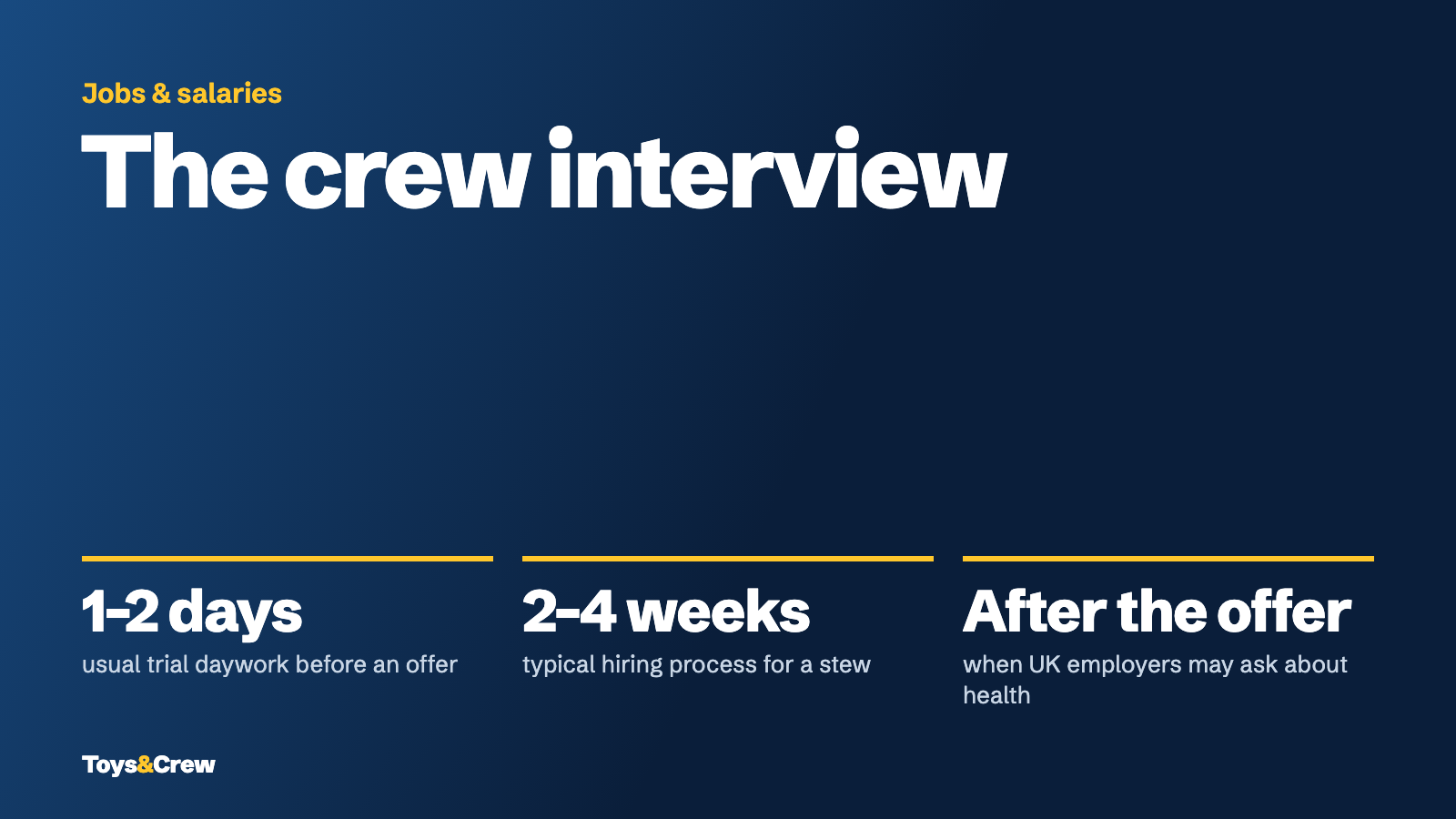
- Video and trial days: video calls are not enough to judge practical skills and crew chemistry, so a meeting in person or trial daywork should come before a decision. Trial daywork of 1 to 2 days shows skills and fit, and hiring a stew typically takes 2 to 4 weeks, including skills tests and references (Lighthouse Careers, guide for owners 2026).
- References: reference checks are a fixed part of screening and often decide whether a yacht makes an offer. Give written references plus names and phone numbers, and tell your referees a call may come (Wilsonhalligan). Gaps in your CV will be questioned, and having no verifiable references is a red flag (Lighthouse Careers). Some yachts give no references as company policy; explain that to your agency.
- Drug tests: more and more, mostly larger, yachts test new crew for illegal drugs, some again every 6 or 12 months (Bluewater). The rules are in drug and alcohol testing on yachts.
What do captains ask?
Questions about you, not just your skills. Agencies list these as common:
- Your career goals, why you want to work on a yacht, strengths and weaknesses, your biggest achievement and "why should we hire you?" (YPI Crew).
- What bothers you in your current job, your last three jobs, and why you took and left each one (Wilsonhalligan, top 10 questions).
- How you cope with long days and living in close quarters, what you would do if a crew member bullied you, working under pressure, long periods away from home, safety drills and first aid, and what you know about the yacht (Meridian Go).
- For stews: turndown service, difficult guests, setting a formal dinner table, barista or bar experience, caring for delicate fabrics (Meridian Go), keeping guests' privacy, and how you contribute to a good crew dynamic on long contracts (Lighthouse Careers, interview questions).
How agencies suggest you answer:
- Do not give travel or the lifestyle as your only motivation (YPI Crew).
- Show respect for the chain of command and never speak badly about former captains or crew (YPI Crew); describe a bad last job diplomatically, for example as different working styles (EL Crew Co).
- Be honest about why you changed jobs, because the reference check will show inconsistencies; building sea time is a legitimate reason (Wilsonhalligan).
- Describe a weakness as an area you are working on (EL Crew Co).
- Ask your own questions: about the yacht's programme, the culture on board, why your predecessor left and the next steps (YPI Crew). Do not ask about salary, benefits or rotation too early (Meridian Go).
- If you get an offer on the spot, asking for 24 hours to think is acceptable; mention another interview honestly, but do not use it as leverage (Wilsonhalligan).
What should you bring and wear?
- Documents: CV, references, STCW, ENG1 and other certificates in a tidy folder (Meridian Go, EL Crew Co).
- Logistics: note the phone number, yacht name, berth number and interviewer's name, in case you get stuck at the marina gate. If you come straight from daywork, bring a clean shirt and say so (EL Crew Co). For video calls, log in a few minutes early (YPI Crew).
- Clothing: a clean polo shirt or blouse with plain dark shorts or skirt (YPI Crew). Grooming advice is in tattoos and yacht jobs.
- Don't: order alcohol, even if the interviewer does; couples applying together should come across as colleagues (EL Crew Co). Common mistakes are being late, forgetting documents, dressing too casually, too much perfume and interrupting (Meridian Go).
Which questions are off limits?
It depends on the law that applies to your job, which in yachting depends on the flag, the employer and where you are hired.
UK:
- Health: an employer, and also an agency building a candidate pool, may not ask about your health or disability before a job offer, including past sickness absence, and may not get around this by sending you to an occupational doctor. Exceptions: to arrange adjustments for the interview, to find out whether you can carry out a function essential to the job, and for diversity monitoring. After an offer, even a conditional one such as "subject to medical", health questions are allowed (Equality Act 2010, section 60; EHRC, recruitment guide). Only the Equality and Human Rights Commission can enforce the ban itself, but if you bring a discrimination claim, the question counts as evidence. The ENG1 you need for the job is a separate matter; see our ENG1 guide.
- Family: you do not have to disclose a pregnancy, and rejecting you because of it is unlawful. Employers should not ask whether you plan to have children, whatever your age or marital status, nor about marital status or childcare before an offer (EHRC). Asking only women whether they will need time off for family duties is a textbook example of discrimination.
- Other protected characteristics such as age, disability, marriage or pregnancy may only be asked about if clearly linked to the job, for example a legal minimum age (Acas). More on age in am I too old for yachting?.
EU: Directive 2006/54/EC prohibits direct and indirect sex discrimination in access to employment, including selection criteria; any less favourable treatment linked to pregnancy counts as discrimination. If you present facts that suggest discrimination, the employer must prove there was none (Directive 2006/54/EC, Articles 2, 14 and 19).
Agencies under the MLC: agencies should have procedures against exploiting seafarers, should inform you of special conditions of the job and the owner's policies, and must check that your employment agreement complies with the law (MLC, Standard A1.4 and Guideline B1.4.1). UK agencies must verify your identity, experience and qualifications (MCA, MGN 475 Amendment 2); the Marshall Islands expect agencies to declare that they charge seafarers no fees (Marine Notice 7-045-1).
Do you have to work a trial day for free?
In the UK, an unpaid work trial should be short, for example two hours or one shift, and normally no longer than one day. If it is not really used to assess you, or the tasks differ from the job, the minimum wage is due; the government considers trials of more than a day to trigger it except in very rare cases (Acas, interviewing; GOV.UK, minimum wage eligibility). On ships, the UK minimum wage applies in four cases: in UK internal waters and ports, regardless of your nationality or the ship's flag; on ships on domestic trips in UK territorial waters or the UK sector of the continental shelf; on UK-flagged ships abroad if the work is not wholly outside the UK and you ordinarily live there; and on non-UK-flagged ships outside the UK if you ordinarily work in the UK.
How do you spot a fake job offer?
The PYA has warned repeatedly about yacht job scams, which can expose crew to human trafficking, identity fraud or sexual assault. Most cases reported in 2020 targeted female crew, including video "interviews" by supposed captains with inappropriate requests and demands for photos in underwear (PYA, 2020). Warning signs (PYA scam alert):
- you are asked to pay for online courses first, with a promise of a refund later;
- logos of organisations such as Lloyd's Register or the ILO are shown as course "accreditation"; they do not accredit courses;
- you are asked for money, card or bank details or personal data as a condition of the offer; according to the PYA, upfront payments for a job are not allowed in any reputable jurisdiction.
Report scams to info@pya.org. If a captain calls you via an agency database, the agency can confirm whether the caller is genuine (Bluewater).
Your data: under UK draft guidance from the Information Commissioner's Office, you can request interview notes about you with a subject access request, but references given in confidence are exempt, and employers should usually only verify the details of the successful candidate (ICO, draft guidance).
Sources
UK Equality Act 2010, Equality and Human Rights Commission, Acas, GOV.UK minimum wage guidance and ICO draft guidance; EU Directive 2006/54/EC; Maritime Labour Convention 2006 as amended; UK MCA MGN 475 Amendment 2; Marshall Islands Marine Notice 7-045-1; PYA; agencies YPI Crew, Meridian Go, EL Crew Co, Wilsonhalligan, Bluewater and Lighthouse Careers. All checked on 22 October 2026 and linked above.
Sources and image rights
- Images
- Ron Lach / Pexels (conditions)
- Checked
- 22 October 2026 by Andreas Lakeberg
Know something we missed – a rule, a fee, a marina detail? Write to editor@toysandcrew.com. We check every tip against the source and note updates at the top of the story.
Disclaimer. We research every article carefully and to the best of our knowledge. Salaries, prices, rules and port regulations change, and we cannot guarantee that all information is complete, current or correct. Please check anything important with the original source or the responsible authority before you rely on it. To the extent permitted by law, we accept no liability for errors or omissions.