Visible tattoos and yacht jobs: what agencies say, and what the rules say
No rule bans tattoos on yachts, but many yachts set their own. What agencies advise on tattoos, piercings and grooming, and when the law protects you.


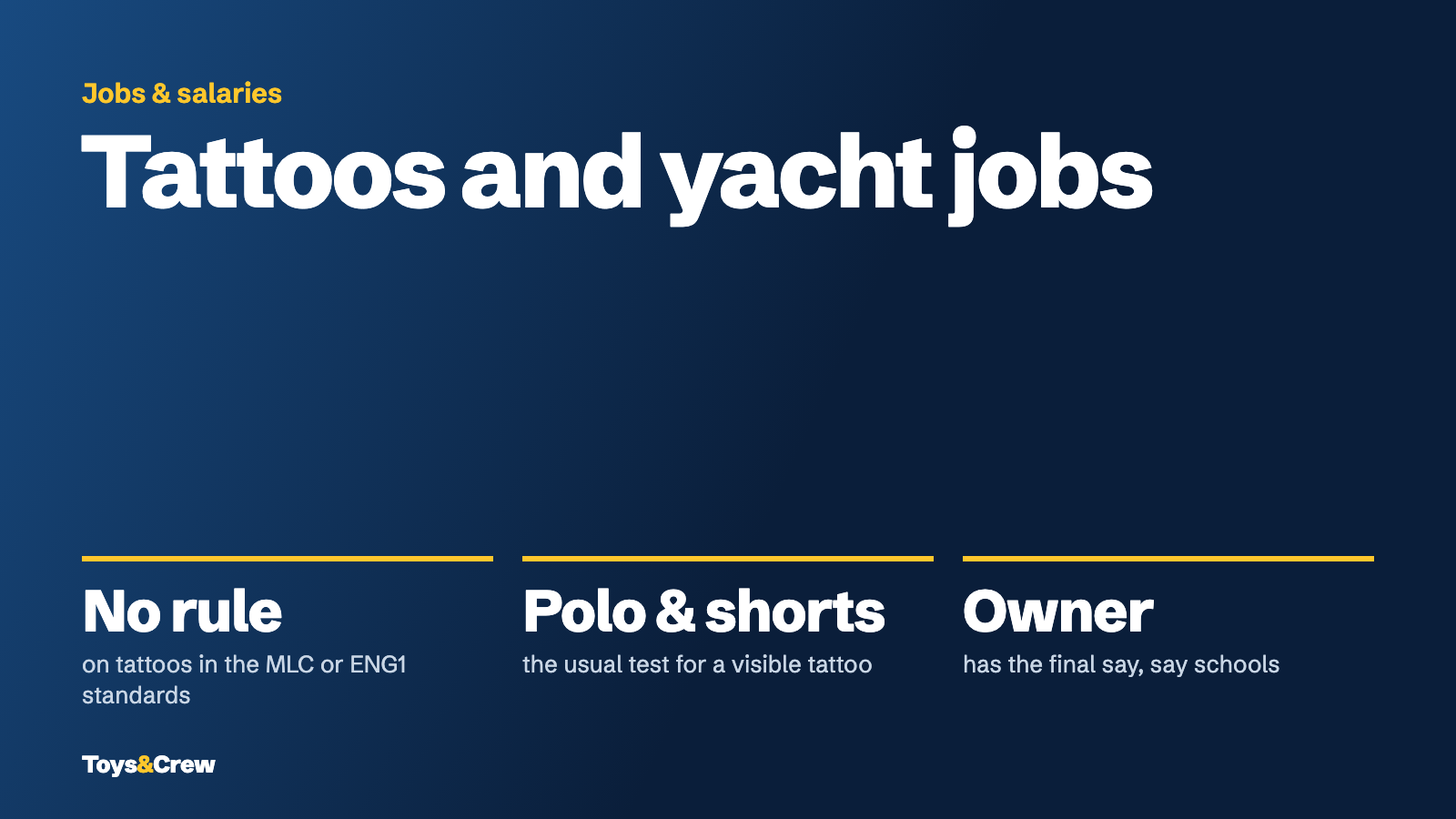
You can work on a superyacht with tattoos. No maritime rule mentions them: not the Maritime Labour Convention (MLC), not the ENG1 medical standards, not the REG Yacht Code. What limits you is the yacht's own appearance standard. Agencies say some yachts want no tattoos visible in the standard uniform of polo and shorts, many are more relaxed, and large face, neck or offensive tattoos are the real obstacle in guest-facing roles.
Everything about hiring practice below comes from crew agencies and training schools, not from authorities, and they do not always agree. We say who says what.
Is there a rule against tattoos on yachts?
No. We checked the sources where such a rule would have to be:
- The MCA's binding ENG1 fitness standards list skin infections and skin diseases such as eczema or psoriasis under "Skin", but no tattoos or piercings (MCA, MSN 1886 Amendment 2, Annex A). The doctor looks at your skin for findings that affect fitness, not appearance; the manual mentions tattooing only as an infection risk from poor sterilisation (MCA, Approved Doctor's Manual, July 2020). More in our ENG1 guide.
- The ILO/IMO guidelines on seafarers' medical examinations (2011) only list general points such as "skin" and "general appearance" (ILO/IMO).
- The MLC commits states to eliminating discrimination in employment, but says nothing about appearance, tattoos or uniforms (MLC, Article III).
What do agencies and schools say about tattoos?
That it depends on the tattoo, the role and the owner:
- What "visible" means: a tattoo that the standard uniform does not cover (TWW Yachts). Some yachts have strict standards up to "no visible tattoos", meaning nothing may show in polo and shorts or skirt (YPI Crew FAQ). A school says many traditional or high-end private motor yachts still hold this line (Certified Training, July 2026).
- Why: one recruiter quoted by a training provider names charter yachts, where guests change every week and come from different countries, so their attitude to tattoos is unknown (UKSA).
- Which roles: according to an agency head quoted by UKSA, tattoos are not a problem for chefs and engineers, and in senior positions experience usually decides. Large face or neck tattoos make a guest-facing role in high-end hospitality unlikely (UKSA).
- What is a real obstacle: offensive tattoos or tattoos covering much of the face make employment very unlikely (Get Onboard); offensive motifs are the main problem for another agency too (Insignia Crew).
- The trend: visible tattoos are increasingly accepted (Insignia Crew), and many yachts are becoming more flexible, especially if tattoos are easy to cover (Superyacht Crew Academy). Facial piercings, flesh tunnels and visible tattoos do not stop a career but can narrow the choice of yachts (TWW Yachts).
- Who decides: in the end the owner or captain (Get Onboard).
Should you tell the agency about your tattoos?
Visible ones, yes; on hidden ones, the advice differs:
- Talk about tattoos with your recruiter, who knows which yachts have restrictions (YPI Crew); be open with agency and yacht from the start (TWW Yachts).
- Many agencies ask about tattoos in the online application and may want a photo of large tattoos on forearms, calves, neck or face. Small tattoos that make-up, a plaster or the uniform can cover should be declared but hardly hurt your chances (Get Onboard).
- Hidden tattoos: one school says you do not need to disclose tattoos that are not visible (Superyacht Crew Academy). An agency advises declaring them anyway, because they may show when you swim with the owner's family; many yachts do not mind small tattoos (Bluewater).
On board, many crew cover tattoos with skin-coloured sleeves or waterproof cover-up make-up while on duty (Certified Training).
What about piercings, hair and beards?
Most advice concerns interviews and dockwalking, and here too sources differ:
- Piercings: facial piercings must be removed or replaced with clear retainers on duty, says one school (Certified Training); an agency says visible piercings and jewellery may have to come out at work, often for safety (TWW Yachts). For dockwalking, men should remove or cover body piercings other than in the ears (Wilsonhalligan).
- Beards: one captain's advice allows a well-groomed beard as an alternative to clean-shaven (Superyacht Crew Academy); two agencies ask men to be clean-shaven for dockwalking or interviews (Wilsonhalligan; Recrewt).
- Hair and nails: hair tied back, also for hygiene in service; usually only a simple watch and small stud earrings, because large rings and chains can catch; no strong perfume, which can affect food and trigger allergies in closed spaces (Certified Training). One agency asks for no nail polish at its interviews (Recrewt), another for short, clean nails, also for men (TWW Yachts).
- What to wear to an interview: a white, navy or beige polo or shirt, plain shorts, a skirt or trousers that are not too short, and boat shoes; no dangling jewellery (YPI Crew). Once hired, the yacht provides the uniform. More in how to become a deckhand or stewardess and dockwalking.
When does the law protect you?
Rarely when it comes to tattoos, but more often for religion and sex. We only checked UK and EU law, and whether it applies to your job depends on the flag and your employer.
- Tattoos and decorative piercings are not protected in the UK: they are expressly excluded from counting as a severe disfigurement under disability law (Equality Act 2010 (Disability) Regulations 2010, regulation 5). An Acas-published study notes the same; it cites a 2015 survey of 578 UK employers in which almost three quarters had a dress code and about 41 % allowed tattoos and piercings, though not on ships (Acas, Dress codes and appearance at work).
- Dress codes are legal in the UK, but codes for men and women must be equally demanding. Requiring make-up, skirts, manicured nails, certain hairstyles or high heels only for women is likely unlawful. A rule that staff look "smart" is fine if "smart" is defined reasonably, and you are protected if you complain about a dress code. The government guide applies to job applicants too (UK Government Equalities Office, May 2018). Free advice: Acas 0300 123 1100 and the Equality Advisory and Support Service 0808 800 0082.
- Religion: people show their faith through clothing, hair, beards, make-up or jewellery; appearance rules should be flexible enough, and restrictions need a legitimate aim such as safety, hygiene (covering hair when preparing food) or a company image (Acas). In the EU, a private employer's rule banning all visible political, philosophical or religious signs is not direct discrimination, but it must be applied consistently, serve a real need and may indirectly discriminate. A customer's wish not to be served by someone wearing a headscarf is not a genuine occupational requirement (Court of Justice of the EU, C-157/15; press releases 2017 and 2021).
How appearance plays into hiring decisions in general is covered in am I too old for yachting?.
Sources
UK MCA: MSN 1886 Amendment 2 and Approved Doctor's Manual (2020); ILO/IMO medical examination guidelines (2011); Maritime Labour Convention 2006 as amended; Equality Act 2010 and Disability Regulations 2010; UK Government Equalities Office dress code guidance (2018); Acas; Court of Justice of the EU (C-157/15 and 2021 rulings); agencies and schools YPI Crew, TWW Yachts, Insignia Crew, Bluewater, Wilsonhalligan, Recrewt, UKSA, Get Onboard, Superyacht Crew Academy and Certified Training. All checked on 22 October 2026 and linked above.
Sources and image rights
- Images
- Willians Huerta / Pexels (conditions)
- Checked
- 22 October 2026 by Andreas Lakeberg
Know something we missed – a rule, a fee, a marina detail? Write to editor@toysandcrew.com. We check every tip against the source and note updates at the top of the story.
Disclaimer. We research every article carefully and to the best of our knowledge. Salaries, prices, rules and port regulations change, and we cannot guarantee that all information is complete, current or correct. Please check anything important with the original source or the responsible authority before you rely on it. To the extent permitted by law, we accept no liability for errors or omissions.