Jetboard or eFoil for guests on a yacht? Learning time, run time, water and space compared
Which electric board gets first-time guests riding faster, which suits an anchorage, and which to take if the yacht has room for only one.

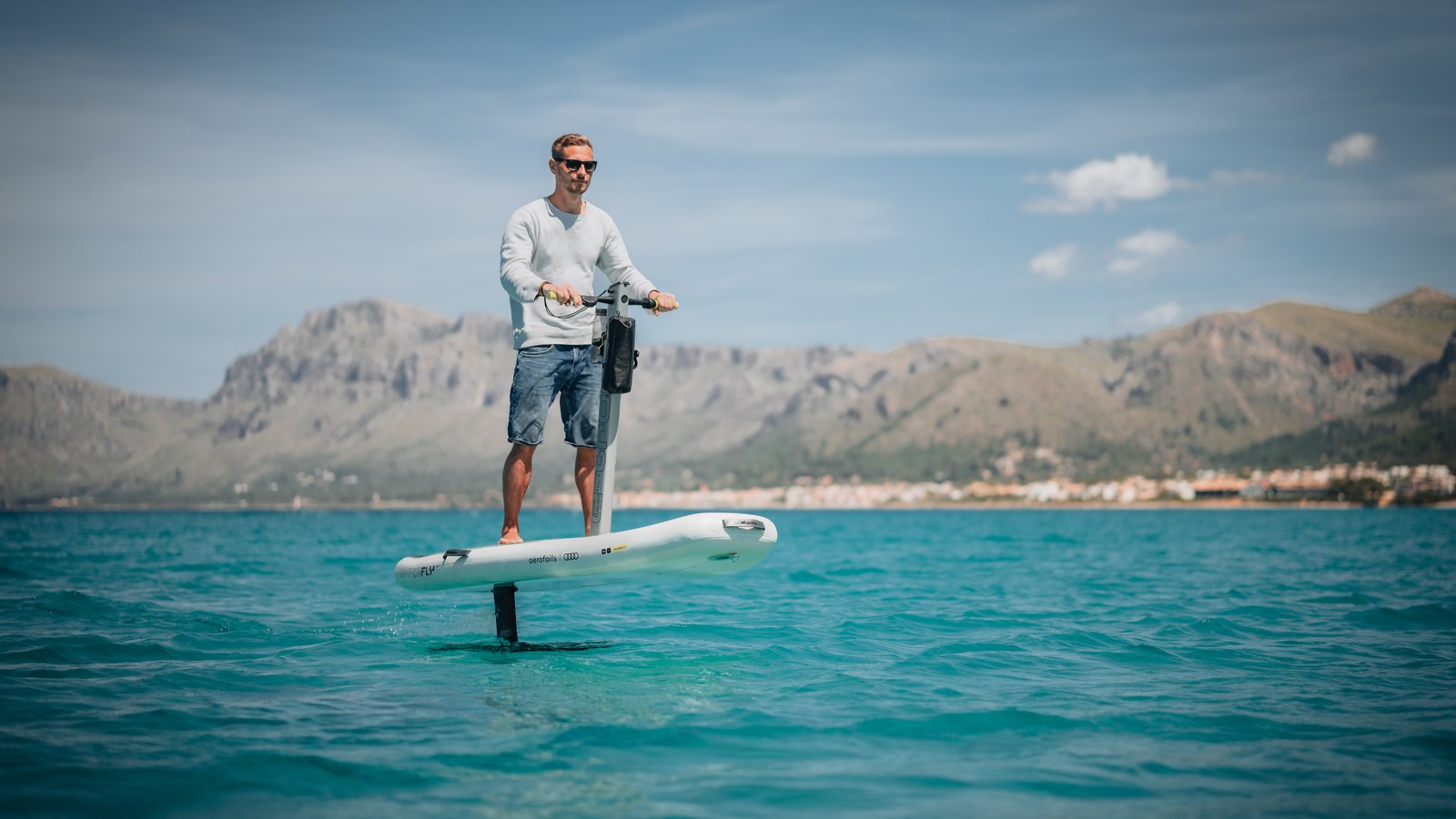
For guests who have never ridden, an eFoil scooter with a handlebar is the easiest start of all, followed by a large jetboard; on a regular eFoil, most beginners lift off within 20 to 60 minutes. On a yacht, the eFoil usually wins on run time, weight and noise, the jetboard on top speed and the classic surfing feel in open water.
The practical advice in this guide comes from E-SURFER, which began in 2017 as the first blog and YouTube channel about electric surfboards and has tested eFoils and jetboards and trained hundreds of beginners ever since. Disclosure: E-SURFER is the trading name of Lakeberg GmbH, which publishes Toys & Crew and sells Aerofoils, Lift Foils, Awake, JETSURF and mo-jet. Models are named only as examples.
How do jetboards and eFoils compare on board?
| Jetboard | eFoil | |
|---|---|---|
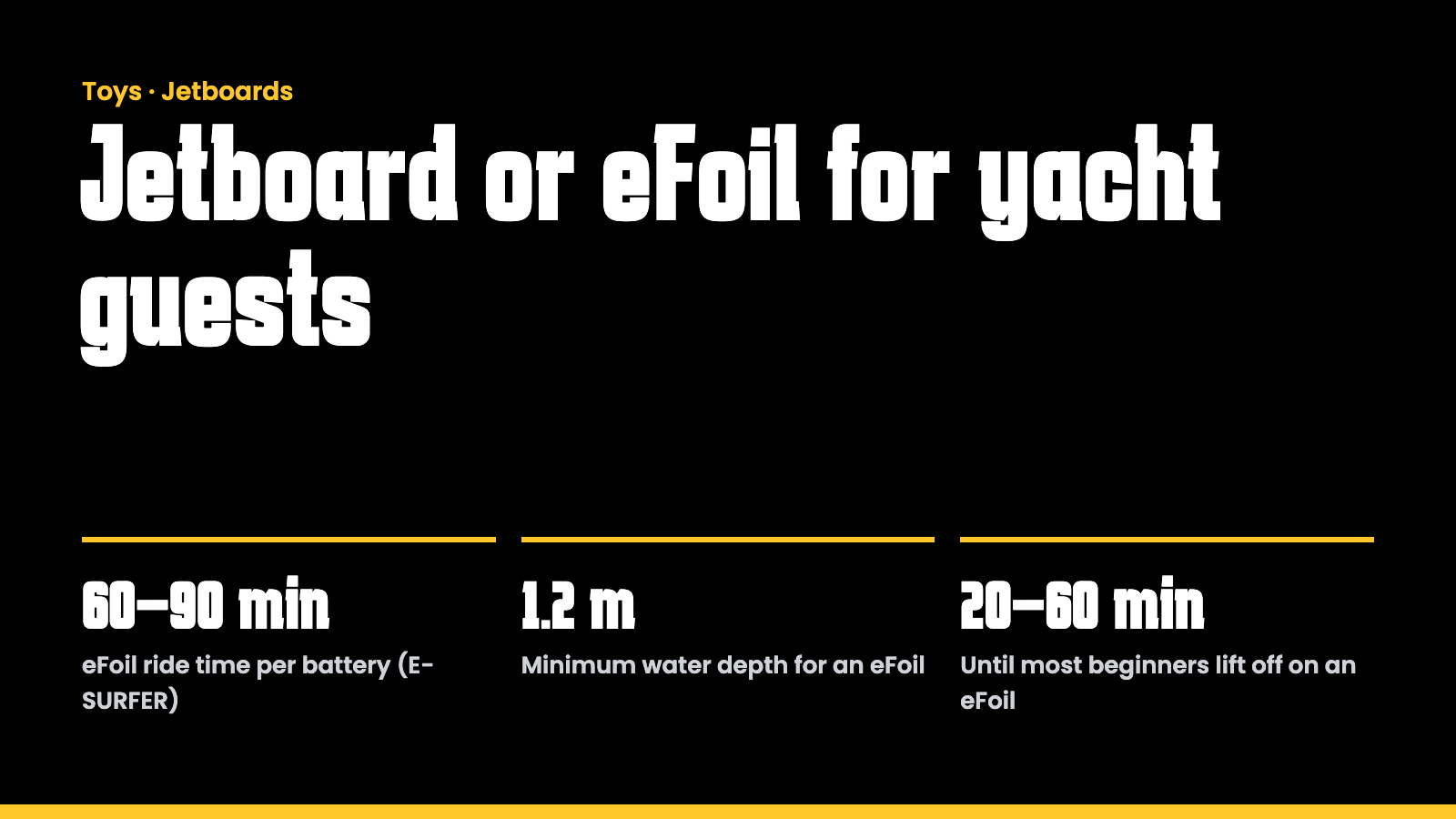
| Ride time per battery | 20–40 min in E-SURFER's experience; manufacturers quote up to 60 min | 60–90 min, up to two hours with high-efficiency wings |
| Weight | 50 kg or more, according to E-SURFER | about 30 kg including battery |
| Speed | up to about 60 km/h | up to about 45 km/h, cruising at 25–30 km/h |
| Ride | on the surface, with spray | above the surface on a foil, quiet |
| Water depth | no minimum given | at least 1.20 m |
| First ride | large boards: stand on and go | 20–60 min to the first controlled take-off; eFoil scooter with handlebar: within minutes |
The difference in run time is physical: once an eFoil lifts off, drag drops sharply and so does energy use, while a jetboard keeps pushing through the water. For the published specifications of current jetboards, see electric jetboards on a yacht.
Which is quicker for first-time guests to learn?
A large jetboard is the quickest start: guests stand on it and ride. E-SURFER names the mo-jet SURF, with 210 litres of volume, as easier than any eFoil. Size matters more than the type, though: a small sports jetboard such as the Awake RÄVIK Ultimate, with 61 litres, is harder to ride than a large eFoil with a big wing, especially for heavier riders.
On an eFoil, the set-up decides. With a board of 100 litres or more, a front wing of about 2,000 cm² and a short introduction, most beginners lift off in a controlled way within 20 to 60 minutes and glide safely after one to two hours. Riding alone without an instructor takes three to five sessions in E-SURFER's experience. No surfing background is needed; a basic sense of balance is enough.
Why is an eFoil scooter the easiest start?
An eFoil scooter is an eFoil with a handlebar on a stem, like a bicycle. In E-SURFER's experience, it is the easiest of all electric boards to learn: with hands on the bar and feet on the deck, most beginners fly within the first few minutes, often in under five. That makes it the natural choice for guests who want to try once rather than learn a sport, and E-SURFER considers it suitable for charter guests without a trainer.
eFoil scooters are now made by Aerofoils (HyperFly), Fliteboard (Flitescooter), Jetwave and Waydoo. The HyperFly, for example, is inflatable, has 230 litres of volume, so it stays stable even at a standstill, and is approved for riders up to 120 kg. Its handlebar can be removed later, so guests who catch the bug can move on to riding it as a regular eFoil.
What about children and older guests?
Look at the drive first. On many eFoils the propeller is open; an enclosed jet drive, as on jetboards and some eFoils, has no exposed blades that can catch fingers or toes. A large, stable board and a handlebar reduce falls. Minimum ages are not a matter of taste but of law, and they differ by country: see our guide to jetboard licence rules in Europe.
Which conditions suit which board?
- Anchorage with calm water: the eFoil's home ground. It is quiet, causes none of the wave impact of a jet drive, and the long run time suits guests taking turns.
- Shallow water and sandbars: a problem for the eFoil, which needs at least 1.20 m under the board. A jetboard does not have this limit.
- Open sea: the jetboard's strength, with the classic surfing feel on the surface. Rules at sea still differ by country; see our licence guide.
- Speed limits near the shore: many small, sporty jetboards cannot be ridden much below 25 km/h because they stop planing. An eFoil cruises in that range. Where the coast has slow zones, check the local rules in our port guides.
Which needs more space and effort on board?
The eFoil is lighter, at about 30 kg including battery against 50 kg or more for a jetboard. Its batteries are smaller and charge faster. On current jetboards, a single battery weighs about 17 to 18.5 kg (mo-jet uses smaller packs of 8.3 kg), which matters when crew carry it across the swim platform. Both use lithium-ion packs; storage and charging rules are in our guide to lithium batteries on yachts.
If the yacht can take only one, which should it be?
E-SURFER's answer after hundreds of comparison rides: the eFoil, for its run time, quiet ride and the gliding sensation guests remember. The jetboard is the better choice where guests want maximum speed and spray, or no learning curve at all.
Further reading: eFoil – The Complete Guide, a book on buying, learning and riding an eFoil, written for beginners and yacht owners by our editor Andreas Lakeberg (Amazon).
Sources
Practical advice is based on E-SURFER's published guides and experience since 2017; rules link to official sources via our licence and port guides. Jetboard specifications come from the manufacturers' websites, checked on 7 October 2026, as listed in electric jetboards on a yacht.
Sources and image rights
- Images
- © Aerofoils
- Checked
- 7 October 2026 by Andreas Lakeberg
Disclaimer. We research every article carefully and to the best of our knowledge. Salaries, prices, rules and port regulations change, and we cannot guarantee that all information is complete, current or correct. Please check anything important with the original source or the responsible authority before you rely on it. To the extent permitted by law, we accept no liability for errors or omissions.
Toys & Crew is published by Lakeberg GmbH, Berlin, the company behind E-SURFER, which began in 2017 as the first blog and YouTube channel about electric surfboards and today also sells eFoils and jetboards. We sell some of the brands we write about. That never decides what we cover or how we rate it.