Rotational contracts on superyachts: how rotation works, and which roles get it
What rotation means, what the MLC and flag states say about leave and time on board, which positions usually rotate, and whether rotation costs salary.


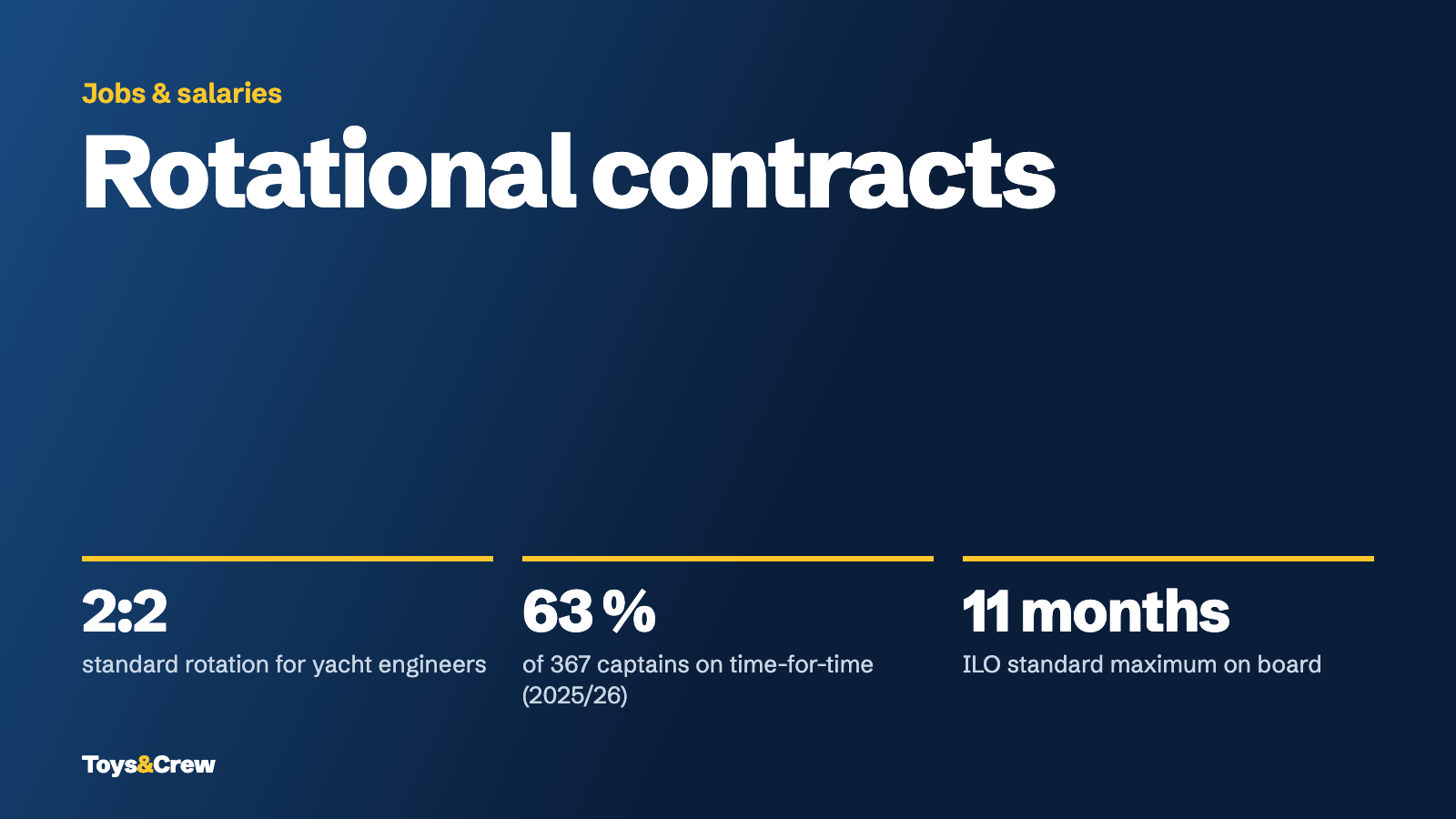
Rotation means two or more crew members share one position and take turns on board, for example two months on and two months off (2:2). It is an industry practice built on the leave and repatriation rules of the Maritime Labour Convention (MLC). It is most common for captains, engineers, chefs and senior crew on larger yachts, and increasingly offered further down the crew list.
What rotation patterns are common?
A crew agency lists these formats (YOA Crew, June 2025):
| Pattern | Meaning | Crew per position |
|---|---|---|
| 2:2 | 2 months on, 2 months off | 2 |
| 10:10 | 10 weeks on, 10 weeks off | 2 |
| 2:1 | 2 months on, 1 month off | 3 |
| 3:1 | 3 months on, 1 month off | 4 |
| 5:1 | 5 months on, 1 month off | 6 |
Equal time on and off is called time-for-time. A yacht management company describes the typical case as two crew members sharing a post, 6 to 8 weeks on and 6 to 8 weeks off, mostly on yachts of 40 m and above (Foreland Marine, April 2026). The same crew agency says 5:1 posts often attract fewer applications than posts with 60 days of leave, and that the yacht, not the agency, sets the leave model (YOA Crew).
Which positions usually get rotation?
Mostly senior positions, according to agencies and surveys:
- Captains: equal rotation is the standard expectation on yachts of 50 m and above and is spreading on 40 to 50 m (YPI Crew, 2026). In a survey of 367 captains on yachts from 20 m to over 120 m, 63 % had time-for-time rotation (Quay Crew, Captain Salary & Leave Report 2025/26). In 2021 it was 20.59 % of 476 captains, with patterns from 1:1 to 4:4 (Dockwalk Salary Survey 2021). The two surveys differ in method and sample, so the numbers are not directly comparable.
- Engineers: 2:2 has become the standard for Chief and Second Engineers (YPI Crew, 2026).
- Chefs: structured 2:2 rotation has become established in the galley, and most experienced yacht chefs expect it (YPI Crew, 2026).
- Deck officers: rotation is unusual on yachts under 500 GT and typically offered to all senior officers above 3,000 GT (YPI Crew, 2026).
- Interior: rotational posts are standard on yachts over 60 m (YPI Crew, 2026).
- Junior crew: on yachts of 70 m and above, one in three deckhands and stews had some form of rotation in 2022; across all sizes, 15 % of deckhands and 23 % of stews had 3:1 or better (Quay Crew survey of 170 captains covering more than 1,500 crew, June 2022). In 2024 the agency saw more time-for-time among heads of department and senior crew, and fewer junior crew than ever with under 45 days of leave (Quay Crew 2024).
How to get one: for stew rotation posts, heads of department ask for around 18 months in the industry, at least 12 of them on the same yacht, and experience on yachts of similar size, according to an agency (YPI Crew). Long stays in previous jobs matter for officers too (YPI Crew, officers 2026). What these positions earn is in our salary guide.
Does rotation mean a lower salary?
A yacht management company puts the salary of a rotational post typically 10 to 15 % below an equivalent permanent post (Foreland Marine, 2026). In 2024 an agency saw the gap between full-time and rotational packages closing (Quay Crew 2024), and in 2022 it noted that the largest yachts sometimes offer better rotation but lower pay (Quay Crew 2022).
How rotation is paid varies: among captains on rotation in Dockwalk's 2021 survey, 70 were paid every month regardless of the pattern, while 12 were only paid for the months they worked. The owner usually pays the flights at the start and end of each rotation, according to Foreland Marine. Check both points in your contract.
What do the rules say about leave and time on board?
The MLC sets the frame for yachts it covers; see private or charter yacht for whether yours is one.
- Leave cannot normally be paid out. Agreements to pay instead of leave are generally not MLC-compliant, and exceptions must be read narrowly (ILO FAQ, 6th edition 2026, C2.4). Justified absences from work may not be counted as annual leave, so off-weeks only replace leave if they are actually granted as leave (MLC, Standard A2.4). Dividing or accumulating leave can be allowed by the authority, which is what makes block rotation possible (Guideline B2.4.3).
- Contract length is not time on board. The MLC sets no maximum length for an employment agreement; contract duration and the maximum continuous time on board are two different things (ILO FAQ, C2.1.j). Refusing due repatriation can push a seafarer past the standard maximum of 11 months on board without leave (ILO FAQ, C2.5.1.h).
- The contract must say it. Every seafarer employment agreement (SEA) must state the paid annual leave or how it is calculated, and the repatriation entitlement (MLC, Standard A2.1). More on the SEA in our MLC guide.
Flag states fill in the details:
- UK: leave may be taken in parts but not replaced by money, except when employment ends; the rule does not apply to pleasure vessels. Refused leave or leave pay can go to an Employment Tribunal (SI 2018/58, regulations 3, 15 and 26). The SEA must state the maximum time on board before repatriation, at most 12 months minus the statutory paid leave days; failing to repatriate then is an offence by the owner (SI 2014/1613). Both regulations as originally made.
- Cayman Islands: at least 38 days of annual leave including public holidays, accrued at 3.20 days a month. Giving up leave for money is void unless the SEA ends before the leave can be taken. Leave entitlement runs from leaving home to join the yacht until repatriation, and travel time is not leave. Maximum time on board: 12 months minus leave days (Cayman Islands, MLC Regulations 2014, regulation 10 and Schedule(Seafarer%20Employment%20Agreement,%20Shipowners'%20Liability%20and%20Wages)%20Regulations%202014.pdf)). Since 2024, crew on Cayman pleasure yachts also need a written contract that states leave and repatriation, even if the entitlement is "nil" (Guidance Note 05/2024).
- Marshall Islands: no limit on SEA length; contracts over 11 months are allowed if they provide MLC leave and repatriation. Forfeiting paid leave is strictly prohibited, and seafarers have the right to be repatriated at least once in 12 months. The flag explicitly allows 11 months or more on board in industries where rotational crews are common, naming yachting; a voluntary extension needs a written addendum to the SEA (Marine Notice 7-052-2, October 2016). The same notice points out that 11 months of service give only 27.5 days of leave and full 30 days need 12 months, which is why it treats the leave and repatriation periods separately.
Does rotation count as sea time for your licence?
The days you are signed on count; your off-rotation does not. For the MCA, onboard yacht service is the time you are signed on a yacht, whatever the yacht is doing, and the testimonial asks separately for leave of absence (MSN 1858 Amendment 2, 5.2 and Annex A). The PYA advises crew on rotation to prepare one testimonial for the whole time on the yacht, state the on/off pattern and enter the off-periods as leave of absence (PYA).
Why do crew want rotation?
Time at home. In ISWAN's 2018 welfare study of 402 yacht crew, 13 % named more rotational positions as the one change that would most improve life on board, as many as named better leadership (ISWAN, 2018). In a separate 2022 agency survey of candidates, more leave was the top priority for 41 % (Quay Crew 2022). In a recruiter's survey published by ISWAN, 66 % said they would accept a pay cut for some form of rotation (Impact Crew via ISWAN).
Time off is not always free time, though: 62 % of the 367 captains in Quay Crew's 2025/26 report work at least partly during their time off, and only 28 % switch off completely. How partners and families cope with long contracts is covered in relationships at sea.
Sources
Maritime Labour Convention 2006 as amended and ILO MLC FAQ 6th edition 2026; UK SI 2018/58 and SI 2014/1613 (as made), MCA MSN 1858 Amendment 2; Cayman Islands MLC Regulations 2014 and Guidance Note 05/2024; Marshall Islands Marine Notice 7-052-2; PYA; ISWAN; Quay Crew (2022, 2024, 2025/26), Dockwalk Salary Survey 2021, YPI Crew salary guides 2026, YOA Crew, Foreland Marine. All checked on 22 October 2026 and linked above.
Sources and image rights
- Images
- Victor Freitas / Pexels (conditions)
- Checked
- 22 October 2026 by Andreas Lakeberg
Know something we missed – a rule, a fee, a marina detail? Write to editor@toysandcrew.com. We check every tip against the source and note updates at the top of the story.
Disclaimer. We research every article carefully and to the best of our knowledge. Salaries, prices, rules and port regulations change, and we cannot guarantee that all information is complete, current or correct. Please check anything important with the original source or the responsible authority before you rely on it. To the extent permitted by law, we accept no liability for errors or omissions.