Specialist roles on superyachts: ETO, chef, purser, spa, nanny and watersports – what each needs
Which specialist yacht jobs need an official certificate, which only need STCW basic training, and what agencies and associations expect on top.


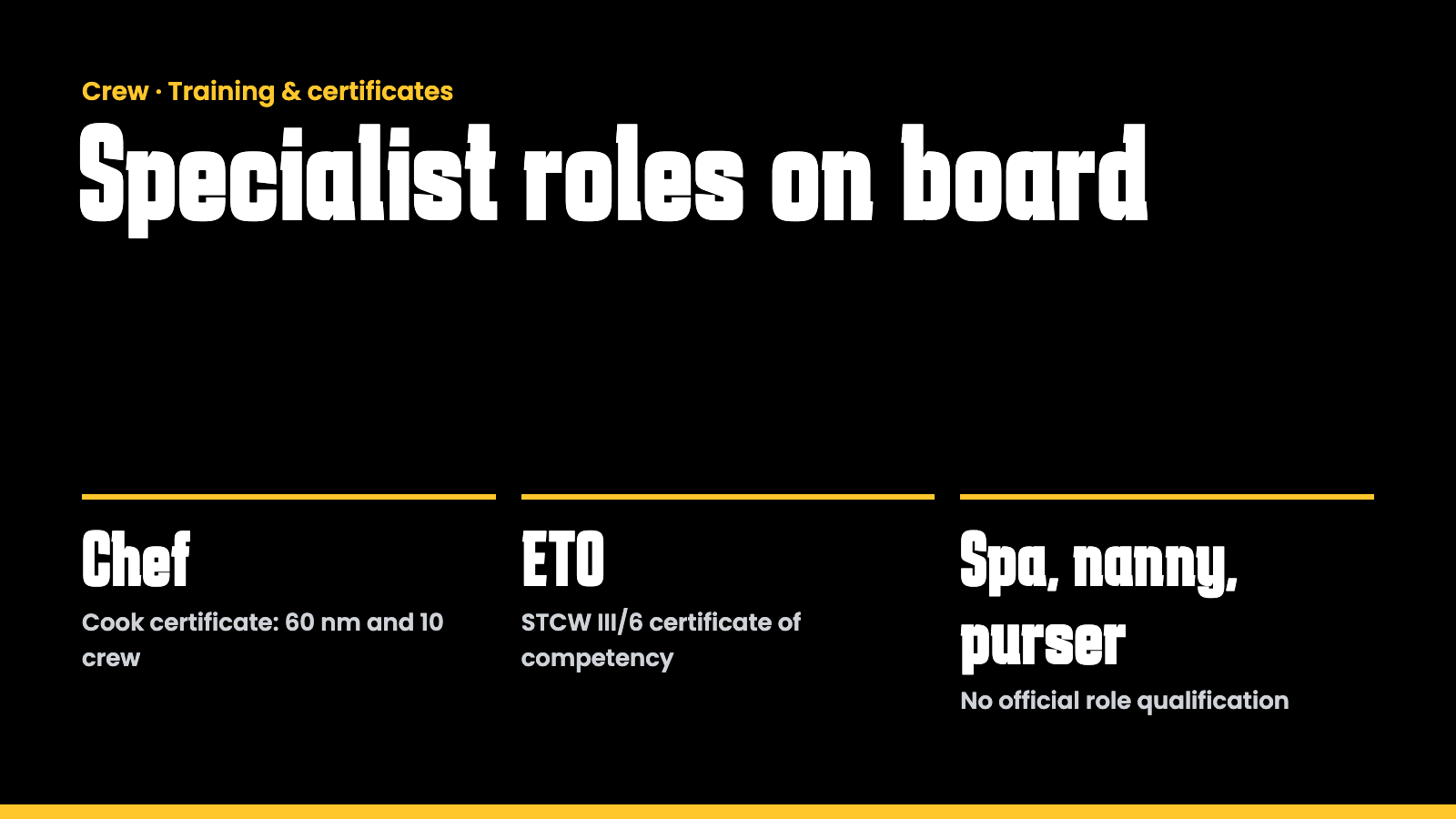
Only two specialist roles on a superyacht come with an official qualification of their own: the chef, who may need a Ship's Cook Certificate, and the electro-technical officer (ETO), who needs an STCW certificate of competency. For pursers, spa therapists, nannies and watersports instructors we found no official role qualification; legally, only STCW basic training applies.
We use the UK Maritime and Coastguard Agency (MCA) as our reference, because it publishes its rules in full. Other flag states can differ in detail. Requirements from agencies or associations are marked as such. Pay is not covered here; see yacht crew salaries by position.
Which specialist roles need an official certificate?
| Role | Mandatory proof | Source |
|---|---|---|
| Chef / cook | Ship's Cook Certificate where the UK duty applies; food hygiene at Level 2 or above; minimum age 18 | MSN 1846, MIN 689, MLC 2006 |
| ETO | STCW III/6 certificate of competency for anyone employed as ETO | MSN 1860, SI 2022/1342 |
| Purser, spa therapist, nanny, watersports instructor | No role qualification found; STCW basic training if the person has safety duties | MSN 1860, footnote 2 (STCW A-VI/1) |
Under STCW section A-VI/1, anyone employed on board in any capacity with designated safety or pollution-prevention duties must complete the relevant parts of basic training before taking up shipboard tasks (MSN 1860, footnote 2 to section 1.4). That includes spa staff, nannies or pursers with muster duties. Agencies go further and say every crew member, whatever the position, needs STCW basic safety training and a recognised seafarer medical, most often the ENG1 (YPI Crew, agency). Details: STCW basic safety training and ENG1 medical.
What does a yacht chef need?
A chef needs the UK Ship's Cook Certificate only if the yacht goes more than 60 miles from a safe haven and also carries 10 or more seafarers, according to the MCA. The requirement depends on the number of crew, not on tonnage (MCA, MSN 1846 Amendment 1, summary and section 2).
A contradiction to be aware of: the Professional Yachting Association (PYA) describes the certificate as mandatory on commercially registered vessels operating more than 60 miles offshore or with 10 or more crew (PYA, association). The MCA's own notice links the two conditions with and. We treat MSN 1846 as authoritative, because it is the regulator's text.
- International baseline: under the Maritime Labour Convention (MLC 2006), cooks responsible for food preparation must be trained and qualified for the position (Regulation 3.2, para. 3), and no one under 18 may work as a ship's cook (Standard A3.2, para. 8). On ships with a prescribed manning of fewer than ten, a fully qualified cook may not be required, but anyone preparing food in the galley must be trained in food and personal hygiene and in handling and storing food (Standard A3.2, para. 5) (ILO, MLC 2006). The MLC itself does not require a cook's certificate; that is left to national law (ILO, MLC FAQ C3.2.c).
- UK certificate: you must be at least 18, have one month of sea service in any capacity, hold STCW basic training and an ENG1 or equivalent, and apply on form MSF 4395 (MSN 1846, sections 3.1 and 4.1).
- Pure private yachts: the UK MLC minimum requirements regulations do not apply to pleasure vessels (MSN 1846, section 1.3). More in private or charter yacht: what changes for crew.
- Large yachts: the MCA can recognise experience or standing as a chef as equivalent to the certificate, case by case (substantial equivalence SE013) (MCA, MGN 472 Amendment 4, Annex A).
- Food hygiene: Level 2 is the minimum for ship's cooks, catering staff and anyone processing food in the galley. The MCA does not approve courses itself, accepts those of the relevant awarding bodies and rejects courses delivered solely by computer-based training (MCA, MIN 689 Amendment 3). This notice expires on 30 November 2026 (MIN 689 Amendment 3, PDF), so check for its successor.
According to the agency YPI Crew, galleys are staffed by a head chef (sometimes a sole chef), a sous chef and, on larger yachts, a crew chef, who also handle budget and provisioning (YPI Crew, agency).
What does an ETO need?
Anyone employed as an ETO must hold an STCW ETO certificate of competency, whether or not the role is on the Safe Manning Document. A yacht is not obliged to carry an ETO unless owner and flag have agreed it (MCA, MSN 1860 Amendment 1, section 1.5).
We found no separate "MCA yacht ETO" certificate. UK law defines the ETO as an officer qualified under STCW Regulation III/6 and attaches the certificate to ships with at least 750 kW propulsion power (UK STCW Regulations 2022, SI 2022/1342).
- STCW III/6: minimum age 18 and at least 12 months of combined workshop training and approved sea service, of which at least six at sea, in an approved programme; otherwise at least 36 months, of which 30 at sea in the engine department (STCW Regulation III/6, as reproduced in Directive 2008/106/EC).
- UK additions: an MCA-approved high voltage course at management level, an ENG1 and an MCA oral exam. Without the high voltage course, the certificate is not valid on ships with systems over 1000 V (MSN 1860, sections 3.2 and 7.4).
- Sea service: must be in the engineering department on vessels over 750 kW, on any flag. Time in a shipyard or dry dock counts for at most 25 % or 3 months, whichever is less (MSN 1860, sections 6.1, 6.4 and 6.6), which matters during refits.
- Career changers with an electrical degree, HND/HNC or apprenticeship can have parts recognised; the required sea service is then set individually, between 6 and 33 months (MSN 1860, sections 3.3.1 and 4.2).
Yacht engineers certified under the UK small vessel scheme also cover STCW function 5, electrical, electronic and control engineering (MCA, MSN 1904, section 2.3). Coming from the merchant navy? See from merchant navy to superyacht.
What does a purser need?
There is no official purser qualification; only STCW basic training applies. Everything else comes from agencies. Wilsonhalligan lists accounts, payroll, budgeting, port clearance and knowledge of the ISM and ISPS Codes, and recruits mainly former chief stewardesses or cruise ship pursers (Wilsonhalligan, agency). YPI Crew adds crew certificates, crew and passenger lists and customs formalities (YPI Crew, agency). The purser reports to the captain, and hiring straight from a land job is unusual (The Crew Network, agency).
What does a spa therapist need?
No official spa qualification exists for yachts; legally, only STCW basic training applies. Agencies expect a recognised spa qualification and experience in a high-end spa ashore; on board, the job is split between spa and stewardess duties (YPI Crew, agency). Wilsonhalligan says beauty therapists usually need an NVQ Level 3 (Wilsonhalligan, agency); another agency names CIDESCO, CIBTAC or ITEC (yachtcrew.agency).
What does a yacht nanny need?
There is no official nanny qualification for yachts. The Norland Agency places nannies with at least Level 3 in Early Years, a DBS check from the last three years and a 12-hour paediatric first aid certificate from the last three years (Norland Agency). Lumière Placements calls STCW basic training "recommended though not always mandatory" on private yachts (Lumière Placements, agency). Under STCW A-VI/1, however, it is required as soon as the nanny has designated safety duties.
What does a watersports instructor need?
No regulator sets a qualification for watersports crew. The RYA and PYA published a voluntary code of practice in 2015, with no inspection or validation; where no recognised qualification exists, responsibility for crew skills lies with those on board (RYA/PYA code of practice, association).
- Jet skis: an RYA Personal Watercraft Instructor must be 18, have two years of experience and pass a three-day course, and may teach the RYA introduction course for charter guests (RYA, association).
- Powerboats: an RYA Powerboat Instructor must be 18 with five seasons of logged experience (RYA, association).
- Diving: PADI requires a Divemaster certified for six months, 60 logged dives (100 for the instructor exam) and a minimum age of 18 (PADI, association; PADI blog). The Red Ensign Group Yacht Code regulates only diving equipment, such as compressor air quality and cylinder testing, not the diver (REG Yacht Code 2024, Annex Q).
What could we not verify?
We found no official source for spa, nanny, purser or watersports qualifications, and no qualification rule for dive instructors on yachts. The STCW competence table A-III/6 was not checked word for word. PADI Divemaster prerequisites, ISA and IKO/BKSA (kitesurfing), VTCT and City & Guilds (spa) and dedicated purser courses were not researched.
Sources
UK Maritime and Coastguard Agency (MSN 1846 Amendment 1, MSN 1860 Amendment 1, MSN 1904, MIN 689 Amendment 3, MGN 472 Amendment 4), UK STCW Regulations 2022, STCW Chapter III as reproduced in Directive 2008/106/EC, ILO (MLC 2006 and FAQ), Red Ensign Group Yacht Code 2024, the associations PYA, RYA and PADI, and the agencies YPI Crew, Wilsonhalligan, The Crew Network, yachtcrew.agency, Norland Agency and Lumière Placements. All checked on 4 October 2026 and linked above. MIN 689 Amendment 3 is due to expire on 30 November 2026.
Sources and image rights
- Images
- Rene Terp / Pexels (conditions)
- Checked
- 4 October 2026 by Andreas Lakeberg
Disclaimer. We research every article carefully and to the best of our knowledge. Salaries, prices, rules and port regulations change, and we cannot guarantee that all information is complete, current or correct. Please check anything important with the original source or the responsible authority before you rely on it. To the extent permitted by law, we accept no liability for errors or omissions.