How to store eFoils and jetboards after the season: cleaning, drying and batteries
Rinse, dry, protect the contacts and set the battery right: how crew lay up eFoils and jetboards for winter, on board or ashore.

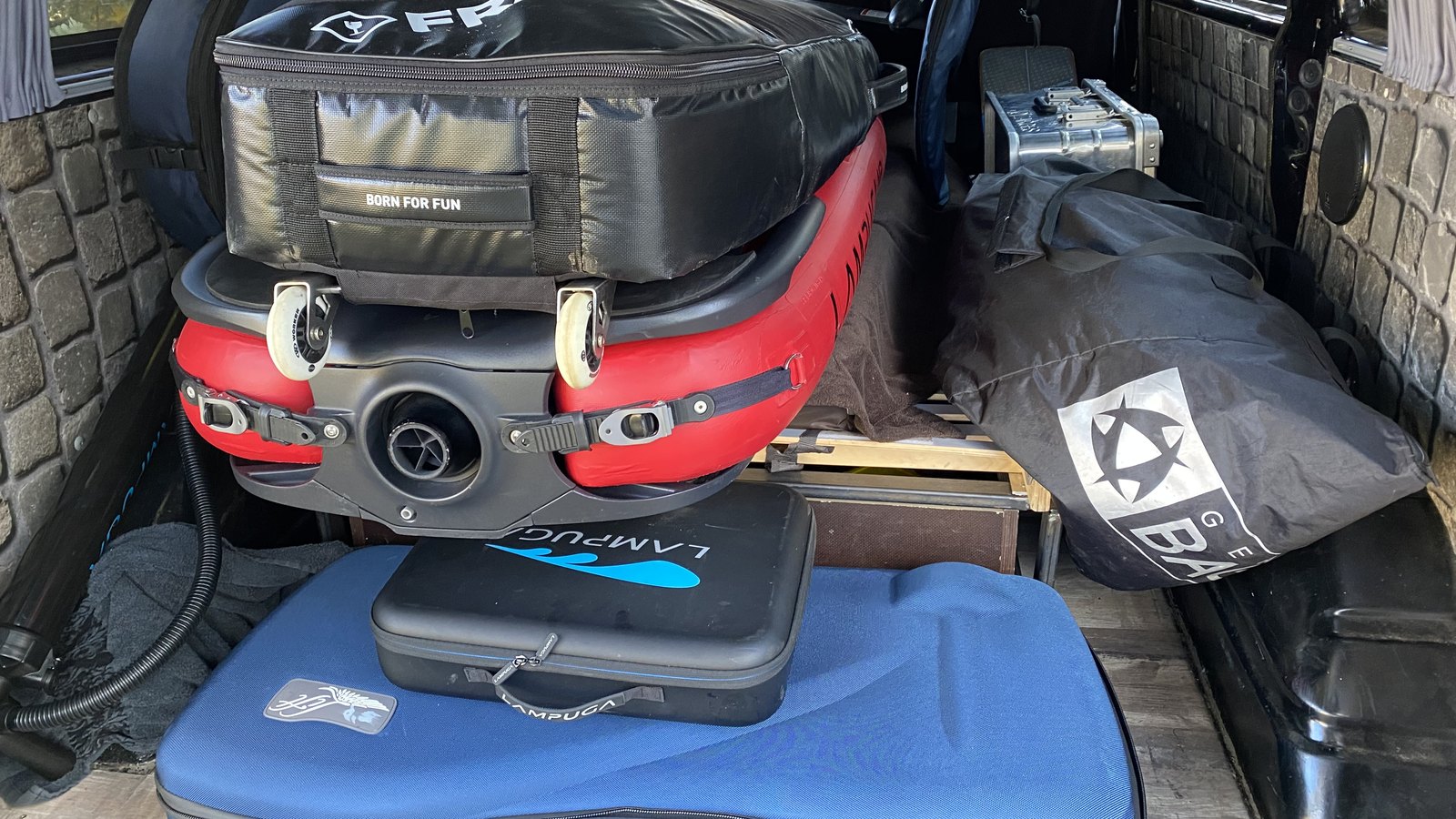
Before eFoils and jetboards go into winter storage, rinse board, hoses, contacts and cavities with fresh water, dry everything with the hatches open for at least 24 hours, clean and grease the electrical contacts, and store the batteries separately at the charge level their maker specifies. Never charge a battery below 10 °C.
The practical advice in this guide comes from E-SURFER, which began in 2017 as the first blog and YouTube channel about electric surfboards, has tested eFoils and jetboards ever since and has collected the manufacturers' own storage advice. Disclosure: E-SURFER is the trading name of Lakeberg GmbH, which publishes Toys & Crew and sells eFoils and jetboards from Aerofoils, Lift Foils, Awake, JETSURF and mo-jet.
What has to happen before the boards go into storage?
- Rinse with fresh water. After salt water this should happen after every ride anyway. Before the lay-up, go further: flush the hoses, the jet or drive, the contacts and every cavity, not just the deck.
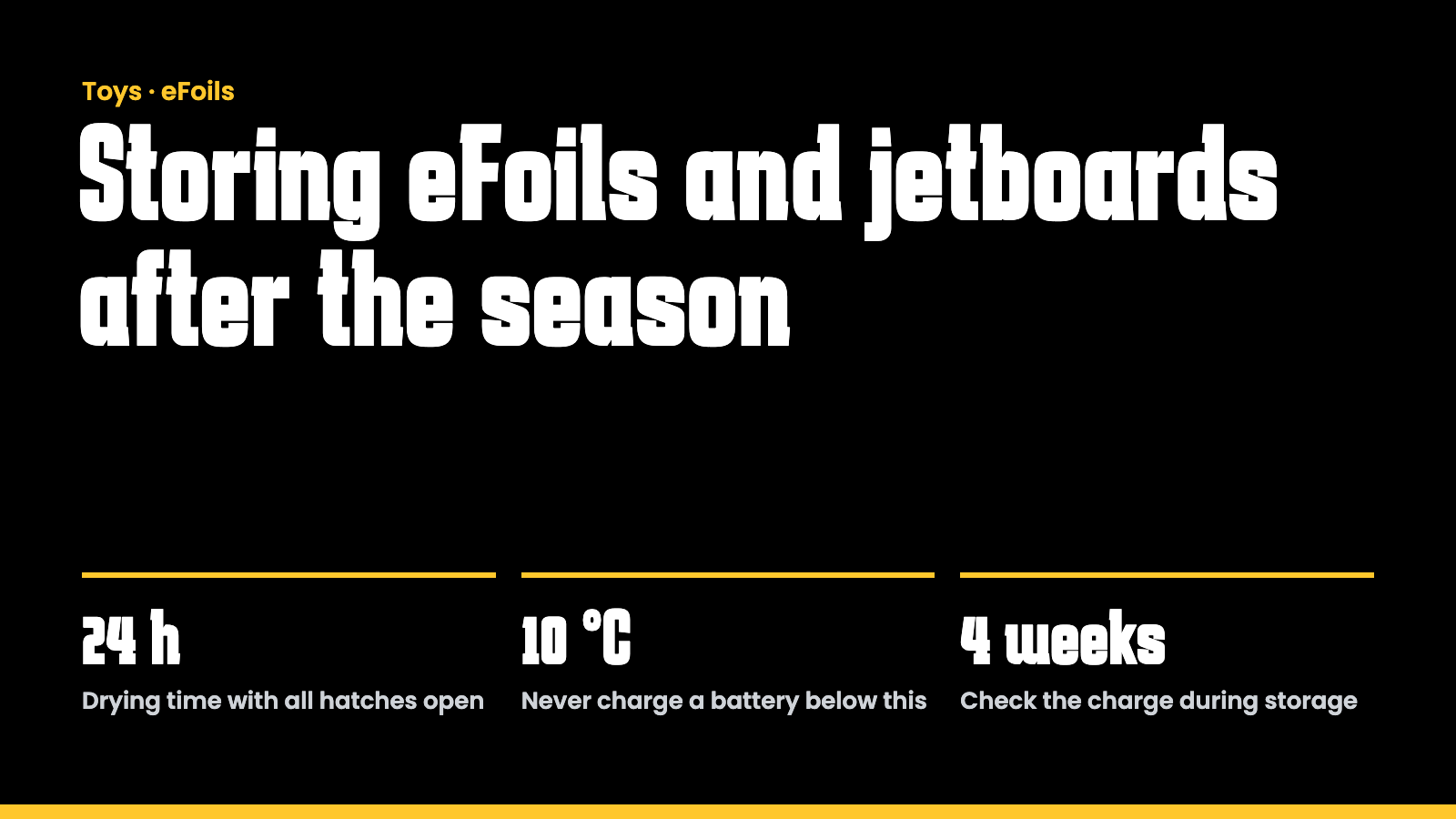
- Dry completely. Open all compartments and leave the board in a warm, dry room for at least 24 hours. Board and hoses must be 100 % dry.
- Clear the water channels. Lift Foils points out that water left in the tubing can freeze; store the board indoors with the hatch open, but not opened beyond 90 degrees.
- Treat the contacts. Clean the electrical contacts with contact cleaner, then seal them with a seawater-resistant grease.
- Remote controls: rinse them too and make sure they are not fully discharged over the winter.
Where should the board be stored?
Without its battery, the board is undemanding. Room temperature is best, and short spells below zero do no harm as long as everything is completely dry. Store it flat, dry and protected, ideally in its bag.
How should the batteries be stored?
Separately from the board and the charger, cool, dry and out of the sun, and away from anything flammable. The right charge level differs by brand, from around 30 % to 80 %; our guide to lithium batteries on yachts lists each maker's figure and the UK rules for battery stowage on yachts.
What the manufacturers agree on:
- Never charge below 10 °C. A battery that has been stored cold must warm up at room temperature for several hours before it goes on the charger.
- Check the charge regularly. Batteries can lose 50 to 75 % of their charge over a winter. E-SURFER checks every four weeks; lithium-ion batteries do not tolerate deep discharge.
- No frost for the battery. Lift Foils says moderate cold of 0 °C or even −5 °C will not damage a pack, but −20 °C will; do not leave batteries in a shed or outdoor store. Fliteboard says its batteries must not be used, charged or stored below 0 °C or above 40 °C, and recommends 22 to 28 °C.
- Storage mode: Aerofoils recommends 30 to 60 % for long-term storage, and its batteries have a function that discharges them to storage voltage by themselves.
- Back into service: Fliteboard asks owners to charge to 100 % after long-term storage, which can take up to 24 hours.
Can several batteries share one fire-resistant box?
E-SURFER advises against it. A fire-resistant battery box is designed for a certain amount of energy, and two packs can exceed it; if one battery fails, it can set off the other. Its own practice is one battery per box. In E-SURFER's experience as of 2024, boat insurers were increasingly asking for fire-resistant boxes for water toy batteries on yachts. For a large underwater scooter such as a SEABOB, E-SURFER knew of no box large enough at that time.
On board or ashore over winter?
The source guides do not compare the two. What follows from them: wherever the toys spend the winter, the battery needs a dry, frost-free place at moderate temperature where its charge can be checked every few weeks, and a charging spot at 10 °C or more for the spring. On board, the yacht's own rules for lithium batteries apply; see our battery guide. Jetboard makers' charging and storage limits are also listed in electric jetboards on a yacht.
Sources
Practical advice is based on E-SURFER's published guides and experience since 2017, including statements E-SURFER collected from Lift Foils, Fliteboard and Aerofoils; rules link to official sources via our guide to lithium batteries on yachts.
Sources and image rights
- Images
- Toys & Crew
- Checked
- 7 October 2026 by Andreas Lakeberg
Disclaimer. We research every article carefully and to the best of our knowledge. Salaries, prices, rules and port regulations change, and we cannot guarantee that all information is complete, current or correct. Please check anything important with the original source or the responsible authority before you rely on it. To the extent permitted by law, we accept no liability for errors or omissions.
Toys & Crew is published by Lakeberg GmbH, Berlin, the company behind E-SURFER, which began in 2017 as the first blog and YouTube channel about electric surfboards and today also sells eFoils and jetboards. We sell some of the brands we write about. That never decides what we cover or how we rate it.