Switching departments on a superyacht: deck, interior, galley, engineering – is it possible?
Which certificates each department needs, what sea time counts when you move from deck to engine room or galley, and what agencies say about dual roles.

Yes, you can switch departments, but no rule covers the switch itself. What decides it are the certificates each department requires and the fact that sea time for a licence usually only counts in the department where you served it. The most common routes are deck to engineering via the Approved Engine Course, and any role to the galley via a ship's cook qualification.
Most yacht crew hold UK certificates, so this guide uses the UK Maritime and Coastguard Agency (MCA) as its main example and adds the Cayman Islands and the Marshall Islands where they differ. We did not evaluate Malta.
What does every department require?
Everyone starts with the same base: STCW Basic Training, Security Awareness and a seafarer medical such as the ENG1 (PYA FAQ; for engine crew MCA, MSN 1904, section 1.5). Details are in our guides to STCW and the ENG1 medical. On top of that, each department has its own path:
| Department | First step | Next level |
|---|---|---|
| Deck | UK Yacht Rating: from 16, at least 6 months on yachts, 2 months of it at sea, on vessels of 15 m load line length or more | Officer of the Watch (yachts under 3,000 GT): needs an Efficient Deck Hand certificate and Yachtmaster Offshore, among others |
| Engineering | Approved Engine Course (AEC) parts I and II | MEOL (SV) from 19, or Small Vessel Engineer Officer of the Watch (SV EOOW) from 18 |
| Galley | Ship's cook "trained and qualified for their position" (MLC), minimum age 18 | Flag state cook certificate or recognition |
| Interior | Food and personal hygiene training for anyone handling food | Optional interior courses |
Sources: deck MSN 1862, 3.1 (b) and MSN 1858 Amendment 2, 3.3; engineering MSN 1904, 3.2 and 4.2; galley MLC, Regulation 3.2 and Standard A3.2; interior Marshall Islands, MI-118, 7.3.1. In the UK, stewards and stewardesses count as catering staff and fall under the same hygiene training duty (MSN 1846 Amendment 1, 6.3). The full deck ladder is in from deckhand to captain.
Does your sea time count when you switch?
Mostly only in the department where you earned it:
- Deck: yacht service for deck certificates should be in the deck department, counted from the day you sign on to the day you sign off (MSN 1858 Amendment 2, 5.1). For deck rating certificates it must be in the deck department, on vessels of any flag (MSN 1862, 6.2 and 6.4).
- Engineering: sea time must be in the engineering department, with at least 6 months of it in the 5 years before you apply. Engine room time spent only on cleaning is not accepted (MSN 1904, 4.4 and 5.2).
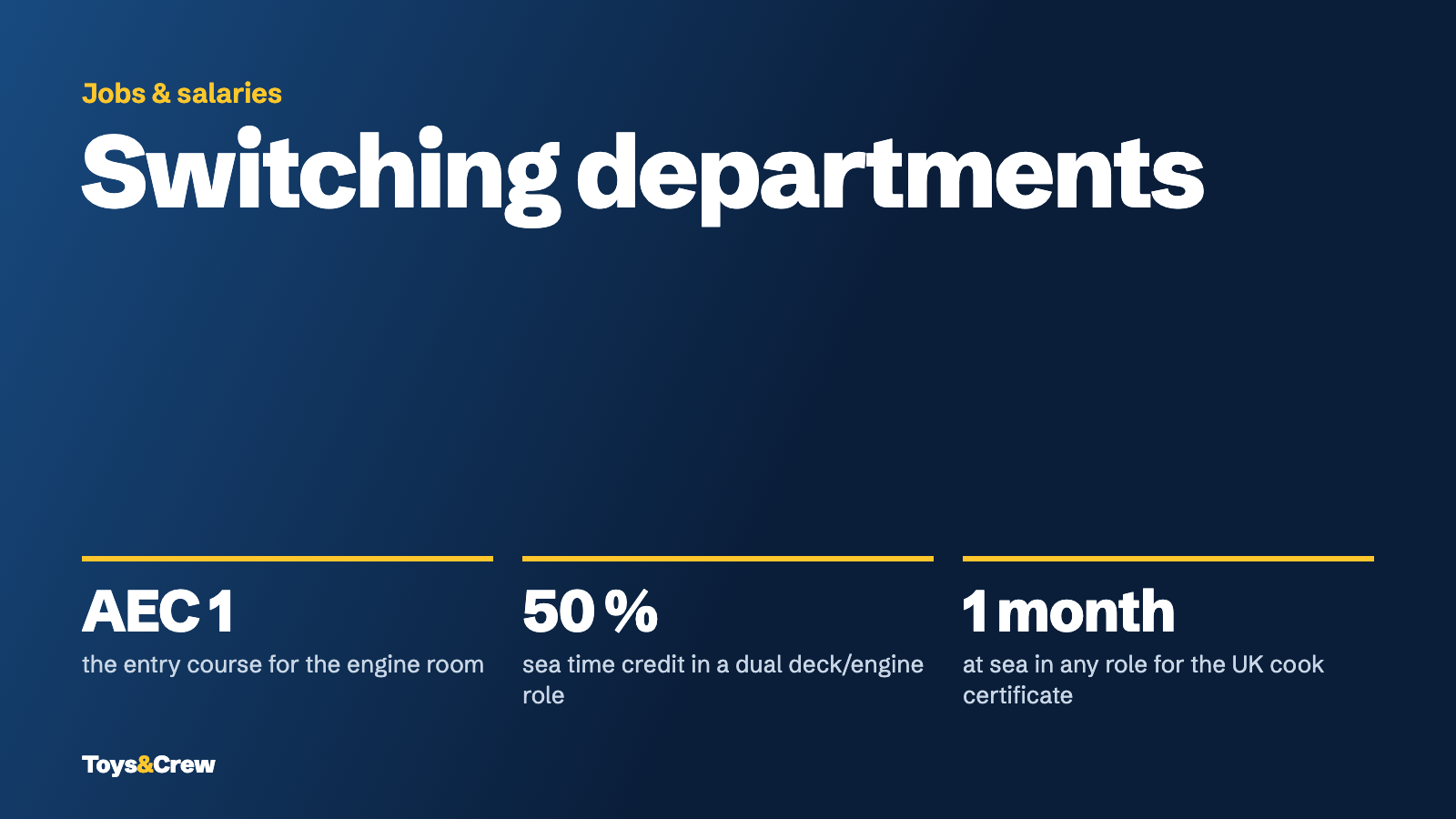
- Dual role deck and engine: the time counts only 50 % towards deck certificates (MSN 1858 Amendment 2, 5.1).
- Galley: for the UK Ship's Cook Certificate, 1 month of actual sea time in any capacity is enough, so time as a stew or deckhand counts (PYA).
Does interior time count towards deck certificates? The MCA documents we checked require deck service in the deck department but say nothing explicit about interior time. Before you count on it, ask the PYA or Nautilus International. The MCA wants all yacht sea time verified by one of them in advance; otherwise processing can take around 160 days longer (GOV.UK, Certification for Engineer Yachts).
How do you move from deck to the engine room?
Through the Approved Engine Course and engine room sea time. This is the best documented switch:
- AEC 1 is the entry point. A school in Palma lists 5 days (30 hours), no experience required, at €1,200; it is aimed at deckhands who want a deck/engineer dual role (Palma Sea School, school's figure). A crew agency gives 4 or 5 days (YPI Crew). AEC part II is about half practical, half theory and must be done with an MCA-approved provider (MSN 1904, 8.2).
- MEOL (SV): 36 months on board as a combined deckhand/engineer on vessels of 200 kW or more, at least 6 months of it at sea in the engine department, or 24 months as an engineer only. You also need AEC I and II, an ENG1 and an oral exam, minimum age 19. The licence covers small vessels with 200 to 750 kW propulsion where STCW does not apply; it is not an STCW certificate and is not guaranteed to be recognised abroad (MSN 1904, 3.1 to 3.4).
- Experienced Seafarer Route to SV EOOW: for crew already working on board, without a degree. You qualify after 24 months on board with 6 months of engine department sea time on vessels of 200 kW or more, plus AEC I and II and the STCW basic courses. After registering with an approved training provider follow another 11 months at sea on vessels of 350 kW or more, at least 6 of them on watch or in unmanned machinery space (UMS) duty, plus 2 weeks of workshop training. Training record book tasks only count after registration (MSN 1904, 4.4 and 4.5).
- Yacht-restricted route: an EOOW limited to yachts needs 12 months on board with 5 months at sea (up to 1 month of it workshop training); Chief Engineer under 500 GT follows after 6 months on board with 4 months at sea (MSN 1904, 5.9.2).
Useful details from the same notice: engine room service counts as watchkeeping if you keep at least 4 hours of watch in 24, and up to 90 days of shipyard or dry dock time may count towards yacht service for the SV EOOW, but not as actual sea time for the yacht-restricted certificate (MSN 1904, 5.4 and 5.5.2). Engineer certificates also require Survival Craft and Rescue Boats, Advanced Fire Fighting and Medical First Aid (section 6). On UK yachts, the manning tables in most cases allow an EOOW instead of a Second Engineer (GOV.UK).
Is there demand? A crew agency reports a shortage of qualified engineers and recruits engineer/deckhand dual roles (YPI Crew). A dual role deck and engine is allowed if the officer is qualified for both and is not the captain (MSN 1858 Amendment 2, section 14). If you come from commercial shipping instead, see merchant navy to superyacht.
How do you move into the galley?
By qualifying as a ship's cook, or by having your chef experience recognised. The MLC says anyone employed as a ship's cook responsible for food preparation must be trained and qualified; the course covers practical cookery, food and personal hygiene, storage, stock control, and environmental and safety aspects in the galley. On ships with a prescribed crew of fewer than ten that do not need a fully qualified cook, everyone preparing food must at least be trained in hygiene and storage. Nobody under 18 may work as a ship's cook (MLC, Standard A3.2, paragraphs 4, 5 and 8). A non-binding guideline adds a minimum sea time set by the flag state and an exam (Guideline B3.2.2).
- UK: 1 month at sea in any role counts for the Ship's Cook Certificate (see above). On large yachts, the MCA can accept experience or standing as a chef as equivalent to the certificate; this is agreed with UK Ship Register Large Yacht Services as part of the DMLC Part I approval (MGN 472 Amendment 3, Annex A, SE013).
- Cayman Islands: a fully qualified cook is required if the yacht normally sails with 10 or more seafarers on voyages of over 3 days or more than 36 hours from a safe haven. Accepted evidence includes an NVQ Level II in catering or hospitality, an MLC cook certificate from another state, or experience as a chef in a professional kitchen, on a commercial yacht or a passenger ship, plus hygiene and storage training. A guest chef who only cooks for guests is not a ship's cook under the MLC. The voluntary recognition is valid for 5 years (Cayman Islands, Guidance Note 02/2018).
- Marshall Islands: certificates as General Steward Utility, Cook or Chief Cook are available from 18 after a course. They are voluntary but count as evidence that the MLC is met (MI-118, 7.3).
Can you switch between deck and interior?
Yes, and it is mostly a question of the yacht, not of certificates. What we found here comes from agencies and schools, not from authorities:
- A crew agency advises talking to your head of department or the captain first and helping out in the department you want to join. For a move to interior it recommends a food hygiene certificate on top of STCW and ENG1 (yachtcrew.uk, February 2024).
- A training school says deck/stew dual roles exist mainly on yachts up to 55 m; the larger the yacht, the more specialised the departments. Stews move into dual roles more often than deckhands move into interior, and in the long run you have to choose. When departments clash, guest service usually comes first and the captain decides. According to the school, dual roles are usually paid like single roles, about €2,500 to €3,000 a month (Flying Fish, school's figure). Salary ranges by position are in our salary guide.
Sources
Maritime Labour Convention 2006 as amended (ILO); UK MCA: MSN 1846 Amendment 1, MSN 1858 Amendment 2, MSN 1862 Amendment 1, MSN 1904, MGN 472 Amendment 3 and the GOV.UK guide "Certification for Engineer Yachts"; Cayman Islands Guidance Note 02/2018; Marshall Islands MI-118 (March 2026); PYA; YPI Crew, yachtcrew.uk, Flying Fish and Palma Sea School. All checked on 22 October 2026 and linked above.
Sources and image rights
- Images
- Jan van der Wolf / Pexels (conditions)
- Checked
- 22 October 2026 by Andreas Lakeberg
Know something we missed – a rule, a fee, a marina detail? Write to editor@toysandcrew.com. We check every tip against the source and note updates at the top of the story.
Disclaimer. We research every article carefully and to the best of our knowledge. Salaries, prices, rules and port regulations change, and we cannot guarantee that all information is complete, current or correct. Please check anything important with the original source or the responsible authority before you rely on it. To the extent permitted by law, we accept no liability for errors or omissions.