Yacht crew contracts and leave: permanent, seasonal, temp, daywork and how many days off
Permanent, seasonal, relief, temp or daywork: what the MLC actually recognises, how much paid leave you get, and what agencies call usual.


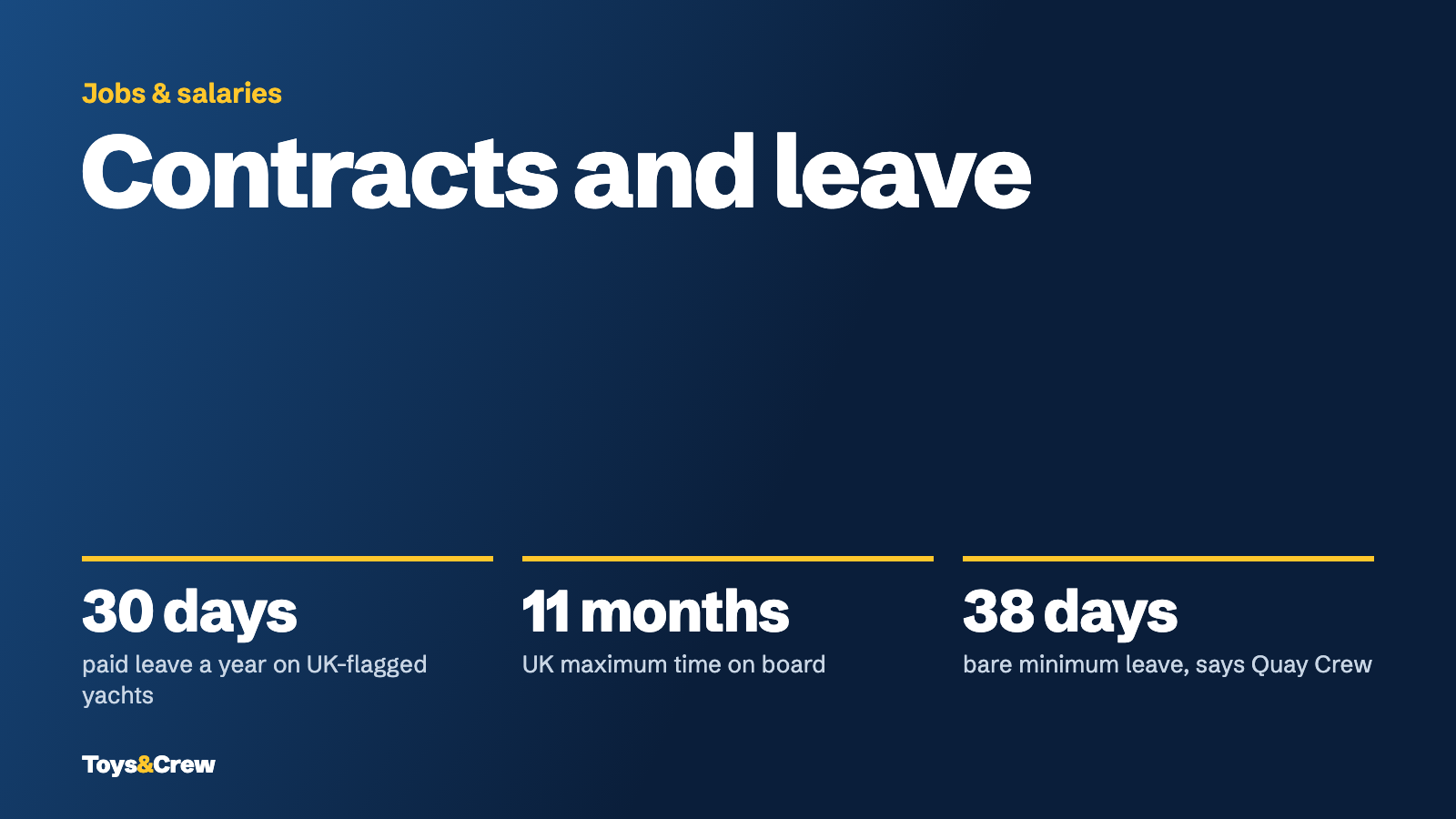
The Maritime Labour Convention distinguishes seafarer contracts only by duration: for an indefinite period, for a definite period, or for a voyage. "Permanent", "seasonal", "relief", "temp" and "daywork" are industry labels, not legal categories. Your minimum leave is set by the flag state; on UK-flagged yachts it is two and a half days per month, which over a full year totals 30 days, plus additional paid leave of eight days in each leave year, pro rata for incomplete years. Our own sum for a full year: 30 + 8 = 38 days.
Where we describe common practice, the source is a crew agency or the PYA, and we say so. The rules come from the MLC, the ILO's official FAQ and UK guidance. Rotation has its own guide: rotational contracts on superyachts. This article summarises the official rules; it is not legal advice.
Which contract types does the MLC recognise?
Only contracts for an indefinite period, a definite period or a voyage; the MLC's own wording knows no "permanent", "seasonal" or "relief" contract.
- Indefinite: "Standard A2.1 envisages SEAs of an indefinite period" (ILO MLC FAQ, sixth edition, C2.1.j). Under UK guidance, such an agreement must state the notice period and the grounds for notice.
- Definite period: the agreement must state the termination date (MCA, MGN 477, Annex 1).
- Voyage: the agreement must name the port of destination and the time after arrival before you are discharged (MLC, Standard A2.1 paragraph 4(g)(iii)).
Consecutive contracts are allowed: asked whether you can sign consecutive SEAs covering more than 12 months, the ILO answers "Yes" (ILO FAQ, C2.1.l). Your continuous time on board is still limited by the leave and repatriation rules: on UK-flagged ships the MCA calls 11 months the "maximum permitted time on board" (MGN 477, section 8.3).
What do "permanent", "seasonal", "temp" and "relief" mean in yachting?
They describe how long and why you are hired, not a separate legal status; the MLC rules apply whichever label is used. According to the crew agency Quay Crew:
- Permanent: "The majority of superyacht jobs are now on a permanent basis", with seasonal and contract roles for junior and senior crew alongside (Quay Crew, guide to joining the superyacht industry). Quay adds that "99% of the time you are employed as you would be in any other job", with paid leave or rotation and a permanent contract unless stated otherwise.
- Seasonal: mostly on smaller yachts that only do one season, or when a yacht needs extra crew for a charter season.
- Temp or relief: "a yacht may need a temp to cover holiday or a specialist to join for a certain boss trip" (Quay Crew).
Not every agency paints the same picture. YPI Crew quotes a recruiter saying that before the Mediterranean season, yachts in France, Spain and Italy "are hiring Temp crew to help get the yachts ready for the season", and describes this as a route to experience, references and later a permanent job (YPI Crew, yachting seasons). Quay's guide is undated, so read "majority permanent" as one agency's view, not a statistic.
The risk with temp work: an older PYA article warns that crew are often given a poor contract "or they're given no contract at all – especially if they're hired for a temporary period" (PYA, what to do when things go wrong).
Relief crew and going home: if you are waiting for a relief before you can leave, note that the MLC does not allow repatriation to be refused because of the shipowner's "inability or unwillingness to replace a seafarer" (MLC, Standard A2.5.1). If you have to stay longer than your contract, the UK rule is: "A valid SEA must remain in force until repatriation" (MGN 477, section 8.4). Some SEAs allow the contract to be shortened or extended by 30 days; an extension beyond the end date should be a last resort (MGN 477, section 8.2). If an extension takes you past 11 months on board, the MCA should be notified at mlc@mcga.gov.uk (MGN 477, section 8.3).
Is a dayworker a seafarer?
It depends on how long you are on board and whether the ship is your main place of work, not on your job title; in case of doubt, the flag state decides.
- UK rule: "Seafarer" does not include people working on a ship "on an occasional and short-term basis", such as fitters or repair technicians. According to the MCA, "it is not the matter of the role title that is the deciding factor, it is the duration of time onboard and whether the principal place of work is onboard a ship" (MCA, MGN 471, Annex 1).
- When in doubt: the competent authority of the flag state "must make a determination on the question" after consulting shipowners' and seafarers' organisations (ILO FAQ, B1).
- Sleeping on board: an older trade press article quotes a chief officer: "Once the dayworker sleeps on board or goes out to sea with the yacht, they become a seafarer and a full SEA will need to be issued" (SuperyachtNews, a MLC-compliant contract for dayworkers).
- Local law: a Nautilus International statement quoted in the trade press says "A dayworker is subject to the local and national laws of the place where the vessel is docked" (SuperyachtNews, all in a day's work). The PYA advises: "Before undertaking dockwalking or daywork, make sure that local immigration, employment and port regulations allow you to do so" (PYA FAQ). Where to look for daywork this winter: dockwalking in November.
Can you work on a yacht as a freelancer?
Yes, but you are still protected by the MLC, and the paperwork differs.
- Protection: the MLC covers anyone employed or working on board in any capacity, "irrespective of whether the seafarers concerned have been recruited directly by a shipowner or are employed under a subcontracting arrangement" (ILO FAQ, B2).
- Contract: "Where seafarers are not employees (for example, if the seafarer is self-employed), they are not required to have a SEA"; there must instead be contractual or similar arrangements that secure decent working and living conditions on board (ILO FAQ, C2.1.g). The UK goes further: non-employees also get an SEA, with a separate "Part 3 - Provision to be included where seafarer is not an employee" covering pay or the pay formula and payment at least monthly (MGN 477, Annex 1).
- Records: in the UK, a self-employed seafarer "may not be entitled to a discharge book, but may be issued with a certificate of discharge" (MGN 477, section 6.8.2). That matters for proving sea time.
Who is your employer if an agency places you?
- Placement agencies: YPI Crew states that it "does not issue SEAs and is not a party to them"; the employment relationship is between you and the yacht or its employer or management company (YPI Crew, MLC 2006).
- Third-party employers: if a manning agency or other company employs you, "the shipowner will still have the overall responsibility vis-à-vis the seafarer", according to the ILO (ILO FAQ, C2.1.f). In the UK, the third-party employer "must be a party to the SEA", and the shipowner signs as well, as guarantor (MGN 477, section 4.3).
- France: private seafarer recruitment services based in France either only place crew or act as the employer themselves ("Le service intervient en tant qu'employeur des gens de mer"), which includes temporary work agencies. They must be listed in a national register, which "est destiné à informer les gens de mer et les armateurs" (French Ministry of the Sea, SPRPGM).
- Private yachts outside the MLC: YPI Crew advises you "to request written terms covering salary, leave, medical arrangements, repatriation and notice provisions" (YPI Crew, MLC 2006). Our MLC 2006 guide explains when the convention applies.
How many days off do you get?
The flag state sets the legal minimum; on UK-flagged yachts it is two and a half days of paid leave per month, which over a full year totals 30 days. In addition, an employed seafarer is entitled to eight days' paid leave in each leave year in respect of public holidays (MSN 1877, section 10.3). Our own sum for a full year: 30 + 8 = 38 days.
- The MLC: "Each Member shall adopt laws and regulations determining the minimum standards for annual leave for seafarers serving on ships that fly its flag"; how length of service is counted is also left to each country (MLC, Standard A2.4).
- UK: paid annual leave "calculated on the basis of two and a half days for each month of employment in the leave year and pro rata for incomplete months" (Hours of Work Regulations, SI 2018/58, regulation 15); over a full year this "totals 30 days" (MCA, MSN 1877, section 10.2).
- What agencies call usual: "The bare minimum you are likely to get as yacht crew is 38 days annual leave, but this is fast becoming very rare", according to Quay Crew. For rotation, see our rotation guide.
How is leave calculated on short contracts?
Pro rata, whatever the contract type.
- Short service: "For shorter periods of service, the corresponding number of days should be calculated on a pro rata basis" (ILO FAQ, C2.4.a). In the UK this applies to short contracts, to employment covering only part of a leave year or month, and to part-time crew (MSN 1877, section 10.4).
- Compensatory leave of any kind should not count towards your paid annual leave (MLC, Guideline B2.4.1).
- Rotation time off can include paid annual leave; "The nature of this leave should be made clear in the seafarer's employment agreement" (MSN 1877, section 10.11). Statutory leave keeps accruing during periods of employment off articles, such as the shore phase of a rotation (section 10.12).
- Deferring leave: you should take leave in the year you earn it; "If seafarers wish to defer leave, that is a matter for agreement between the seafarer and the employer" (section 10.7).
- Under 18: for young seafarers "under the age of 18 who have served six months" without leave on a ship in international service, special measures such as free repatriation for leave should be considered (MLC, Guideline B2.4.4).
Can untaken leave be paid out?
In the UK only when your contract ends: "Seafarers cannot be paid in lieu of their annual leave entitlement under the regulations, unless their contract is terminated" (MSN 1877, section 10.2).
When a fixed-term contract ends normally, your right to repatriation should arise on expiry of the notice period set in the SEA (MLC, Guideline B2.5.1). What you may have to pay yourself is covered in what yacht crew pay themselves.
Sources
Maritime Labour Convention 2006 as amended (Standards A2.1, A2.4, A2.5.1; Guidelines B2.4.1, B2.4.4, B2.5.1); ILO MLC FAQ, sixth edition; UK Hours of Work Regulations SI 2018/58, regulation 15; MCA MSN 1877, MGN 477 and MGN 471; French Ministry of the Sea (SPRPGM); PYA; SuperyachtNews (including a statement by Nautilus International); agencies Quay Crew and YPI Crew. All checked on 28 October 2026 and linked above.
Sources and image rights
- Images
- RDNE Stock project / Pexels (conditions)
- Checked
- 29 October 2026 by Andreas Lakeberg
Know something we missed – a rule, a fee, a marina detail? Write to editor@toysandcrew.com. We check every tip against the source and note updates at the top of the story.
Disclaimer. We research every article carefully and to the best of our knowledge. Salaries, prices, rules and port regulations change, and we cannot guarantee that all information is complete, current or correct. Please check anything important with the original source or the responsible authority before you rely on it. To the extent permitted by law, we accept no liability for errors or omissions.