The off-season for yacht crew: rotation, leave, daywork and tax
How yacht crew get through the off-season: rotation and leave models, daywork in the yard, and what the UK Seafarers' Earnings Deduction requires.

Your contract decides the off-season. Senior crew are usually employed year-round, often on rotation; junior crew more often work seasonal contracts and fill gaps with daywork in yards. For tax, UK residents working abroad on ships for at least 365 days can claim the Seafarers' Earnings Deduction, though HMRC does not name yachts.
Rotation, contract and season details come from crew agencies and are marked as such; tax points come from the tax authorities. This is not tax advice.
When is the off-season?
According to crew agencies, there are two main seasons, but they do not agree on the exact months. One agency describes the Mediterranean season as May to October and the Caribbean season as November to April (Bluewater, Starting out guide). Another says seasonal contracts typically run April to September in the Mediterranean and October to March in the Caribbean (YPI Crew, FAQ).
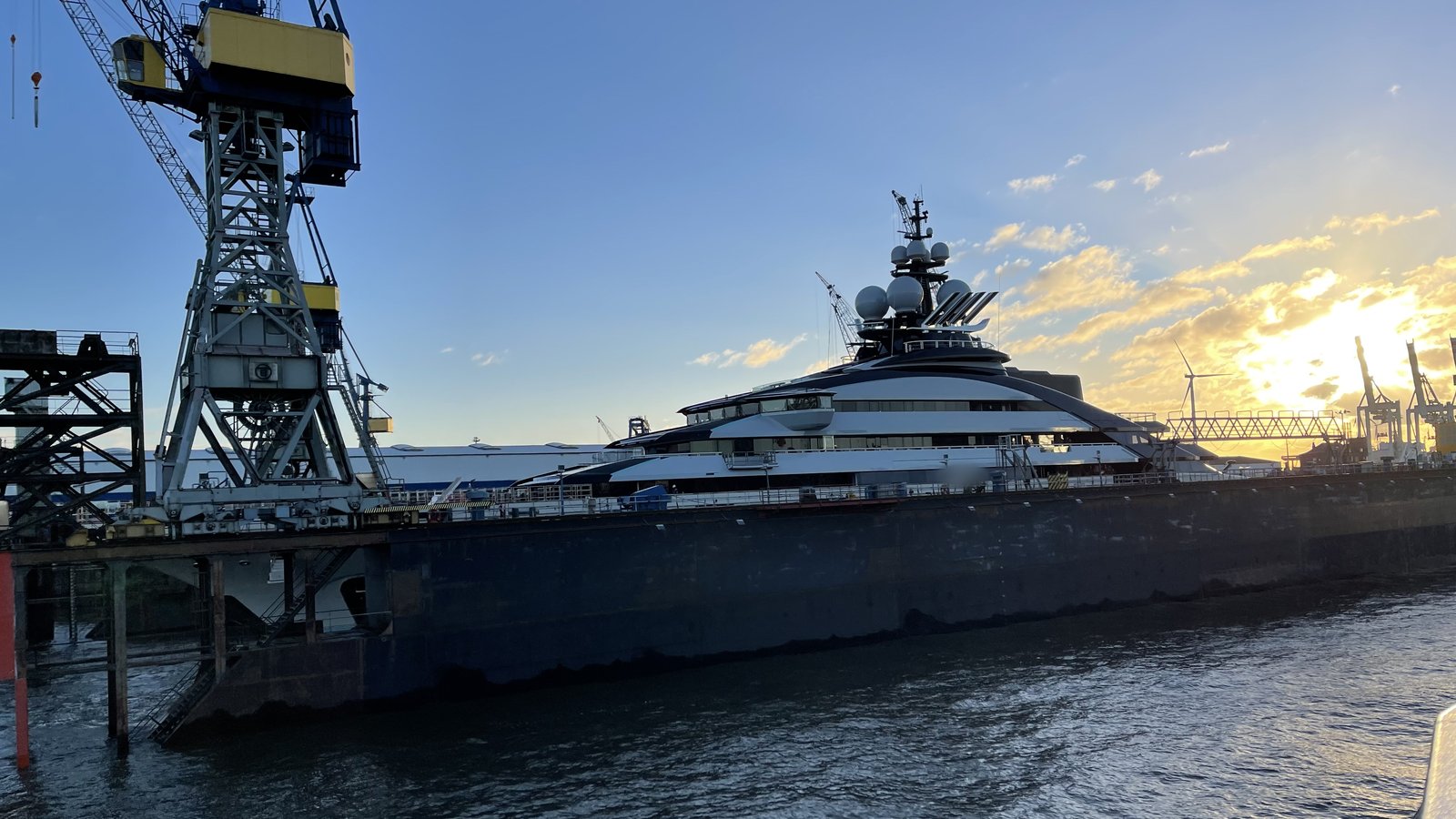
Between seasons, some yachts stay where they are for maintenance or shipyard periods. There are then generally no guests on board, and yachts often run with less crew (YPI Crew, yachting seasons).
Who keeps their job through the winter?
According to one agency, captains, officers, engineers and senior interior crew are usually on permanent, long-term contracts, while seasonal contracts are typical for junior crew (YPI Crew, FAQ).
How do rotation and leave work?
Rotation means fixed blocks on and off board; leave means a yearly allowance of days. Both are agency descriptions:
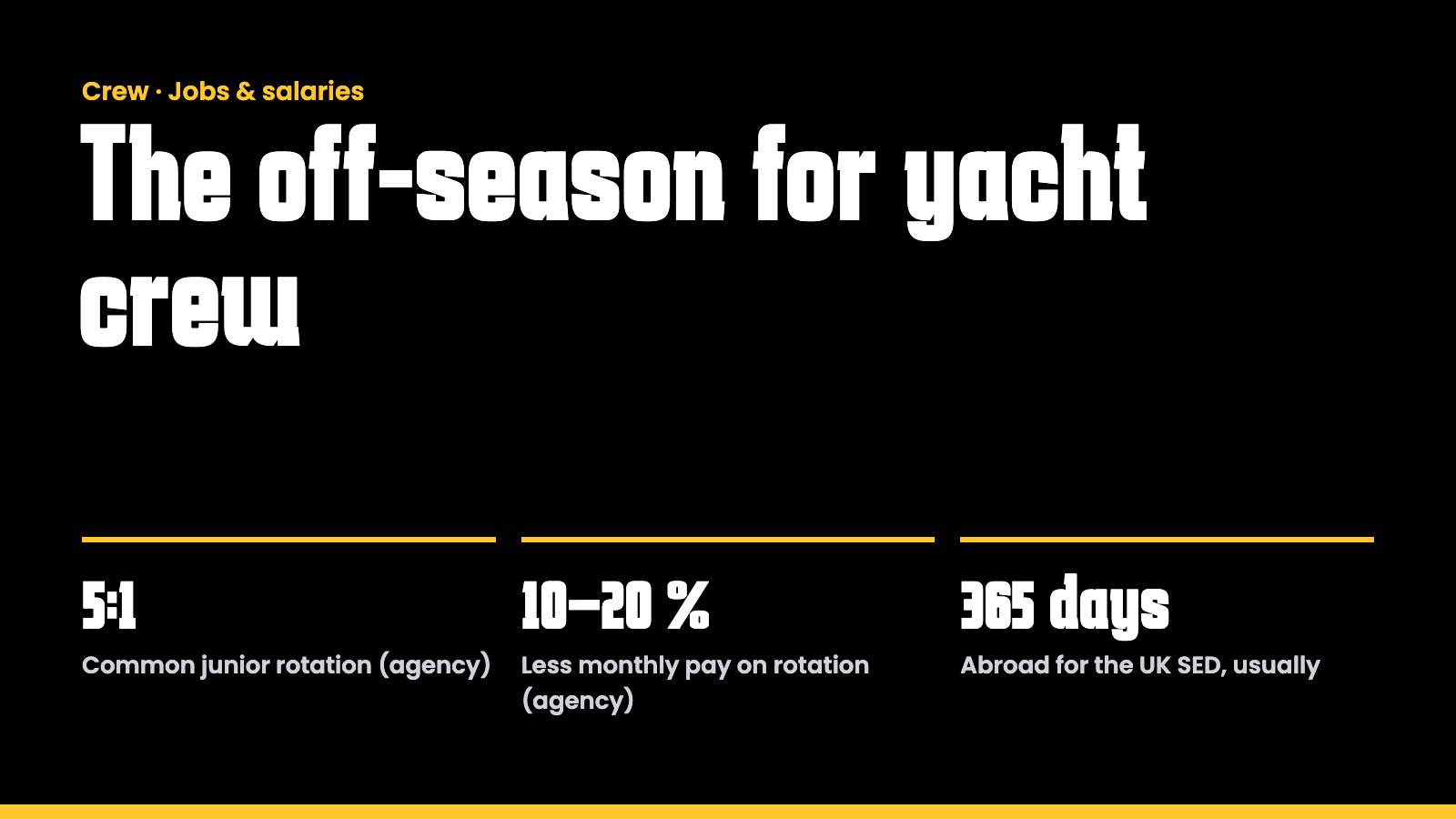
- 5:1 (five months on, one off) is the most common rotation for junior stewards (YPI Crew, rotation for stews).
- 3:1 is most likely on private yachts of 100 m and more; most charter yachts offer standard leave instead (same source).
- On one yacht, several models can apply: 5:1 for junior crew, 3:1 for intermediate positions and full rotation for positions of responsibility (YPI Crew, Salary Guide 2026).
- Time for time, for example 10 weeks on and 10 weeks off, is usually reserved for captains and heads of department (Quay Crew, crew resources).
- "60 days of leave" is an annual allowance, not a fixed rotation. Leave is often taken during shipyard periods, which slows work and brings in dayworkers (YOA Crew, 2025).
- A 3:1 rotation needs four crew for one position, a 5:1 rotation six (same source).
Do rotational jobs pay less?
According to one agency, rotational positions generally pay 10 to 20 % less per month (YPI Crew, Salary Guide 2026). Monthly salaries by position are in our yacht crew salaries overview.
How common is rotation?
An agency quoted in 2022 said most rotational jobs are on yachts of 70 m and more, and that about 20 to 25 % of roughly 500 open jobs offered some form of rotation (Dockwalk, 2022). Another agency links rotation to yachts over 3,000 GT or 3,000 kW, which often need crew with unlimited licences from the merchant navy, where rotation is common (YA Crew, 2019). Both are older, unofficial figures.
What is the legal minimum?
Under the MLC, at least 2.5 calendar days of paid leave per month of employment, and agreements to give up this minimum are generally prohibited (MLC, Standard A2.4). The maximum time on board before repatriation must be under 12 months (MLC, Standard A2.5.1). Which yachts this applies to is covered in our guide to the MLC.
What is daywork, and what does it pay?
Daywork is paid work by the day, often on yachts at the dock or in a shipyard, and the usual way to gain first experience (Bluewater, Starting out guide). One agency mentions wash downs, detailing and teak scrubbing found by dockwalking, for "a decent day rate" (Quay Crew). Dayworkers do not sleep on board (Dockwalk, 2021).
We found no reliable day rates, and no sources on how long refits last or how refit work is paid. We therefore give no figures.
Crew looking for daywork should have savings for roughly three months of accommodation, food and transport (agency quoted by Dockwalk, 2021), and in the US crew flood to Fort Lauderdale in October (Bluewater). How to start out is in our guide on becoming a deckhand or stewardess.
Can yacht crew claim the UK Seafarers' Earnings Deduction?
Probably, but only by inference. HMRC does not name yachts explicitly: "ship" is not defined in tax law, and only offshore oil and gas installations are expressly excluded (HMRC, HS205 (2025)). HMRC counts as seafarers anyone whose work is carried out on ships, "such as cooks, entertainers and couriers on luxury liners", and the ship must be capable of navigation and used in navigation (Perks v Clark) (HMRC, EIM33101). An exception for yachts is not mentioned.
The main conditions, as of helpsheet HS205 (2025), which covers the tax year ended 5 April 2025 and is published anew each year:
- Open to UK residents and to non-UK residents resident in an EU or EEA state (HS205); EEA residents claim on form R43M(SED) (HMRC guidance, 2022).
- Usually at least 365 days working outside the UK. You are absent on a day if you are outside the UK at midnight at its end.
- A return visit to the UK counts only if no single visit exceeds 183 consecutive days and UK days total no more than half of the period. 183 days abroad followed by 182 days in the UK do not qualify (all HS205).
- Holidays abroad count. HMRC's example: 330 days abroad, 30 in the UK, then a 7-day holiday abroad gives at least 365 days (EIM33007).
- The voyage must begin or end outside the UK; voyages without a call at an overseas port do not qualify (EIM33033), and the 12-mile territorial sea counts as UK (EIM33032).
- It is a deduction, not an exemption (EIM33001).
You enter the names of the ships you worked on and keep your discharge book and other evidence (HS205). HMRC may ask for flight tickets, hotel bills, passport stamps or ship's log extracts (EIM33082).
Does a long off-season at home affect residence?
It can. Spending 183 days or more in the UK in a tax year makes you UK resident, and the automatic overseas test for full-time work abroad does not apply to people working on board a ship, so crew have to settle residence through the other tests (HMRC, RDR3).
What about other countries?
These rules are written for commercial shipping. Whether yachts qualify is our reading, not an official statement:
- Ireland: an allowance of EUR 6,350 with at least 161 days at sea a year, but only on an EU or UK registered passenger ferry or freight vessel (Revenue, TDM 15-01-30). By its wording, yachts do not appear to qualify.
- Denmark: DKK 56,900, or DKK 105,000 on ships of 500 GT and more, if the ship is used solely for commercial carriage of passengers or goods under an EU/EEA flag (Skat, C.A.3.4.6.4). Again, yachts do not appear to fit the wording.
- Norway: a deduction for those whose main occupation is on board a ship in service for at least 130 days (Skatteetaten). Whether yachts count is open; we could not check the law itself.
- Germany: § 41a(4) EStG lets operators of merchant ships keep the payroll tax of their crew; it is an employer rule, not an allowance for seafarers (EStG § 41a). Yachts are not addressed.
For your own case, ask a tax adviser or HMRC (or your national tax office).
Sources
HMRC helpsheet HS205 (2025, updated 6 April 2026), HMRC Employment Income Manual (EIM33001–EIM33101), HMRC SED guidance (2022) and RDR3; Revenue (Ireland), Skat (Denmark), Skatteetaten (Norway), EStG § 41a; Maritime Labour Convention 2006 as amended (ILO). Rotation, season and daywork details: crew agencies and Dockwalk. All checked on 4 October 2026 and linked above.
Sources and image rights
- Images
- Toys & Crew
- Checked
- 4 October 2026 by Andreas Lakeberg
Disclaimer. We research every article carefully and to the best of our knowledge. Salaries, prices, rules and port regulations change, and we cannot guarantee that all information is complete, current or correct. Please check anything important with the original source or the responsible authority before you rely on it. To the extent permitted by law, we accept no liability for errors or omissions.