Tax for yacht crew: tax residence, the UK SED, Spain's 183 days and what to ask your adviser
Which country taxes yacht crew? How UK, Spanish and French residence rules work, what the UK SED needs, and questions for your tax adviser.


For yacht crew, the key question is where you are resident for tax purposes. The country of tax residence can usually tax your worldwide income.
This guide covers the UK, Spain and France, using only official sources. This article summarises the official rules; it is not tax advice.
Does the flag of the yacht decide where you pay tax?
- Residence comes first. There are no EU-wide rules on taxing income earned abroad; the country where you are resident for tax purposes can usually tax your total worldwide income, earned or unearned (Your Europe).
- UK: residents normally pay UK tax on all their income, whether from the UK or abroad; non-residents pay UK tax only on their UK income (GOV.UK, tax on foreign income).
- Spain, for non-residents: wages for work on board a ship in international traffic are taxable in Spain when they are paid by an employer resident in Spain or by a Spanish permanent establishment. This does not apply if the work is carried out entirely abroad and the wages are subject to a personal tax abroad. The rule points to the employer; it does not mention the flag (TRLIRNR, Art. 13.1 c).
- UK–Spain double taxation convention: pay for work on a ship in international traffic may be taxed in the state where the enterprise operating the ship is resident. Again, the article does not mention the flag. "International traffic" excludes a ship operated solely between places in the other state (UK–Spain convention, Art. 3 and 14).
How do you become tax resident?
Each country defines residence itself; as a rule of thumb, you are usually considered tax resident where you spend more than 6 months a year (Your Europe). The details differ.
UK (statutory residence test):
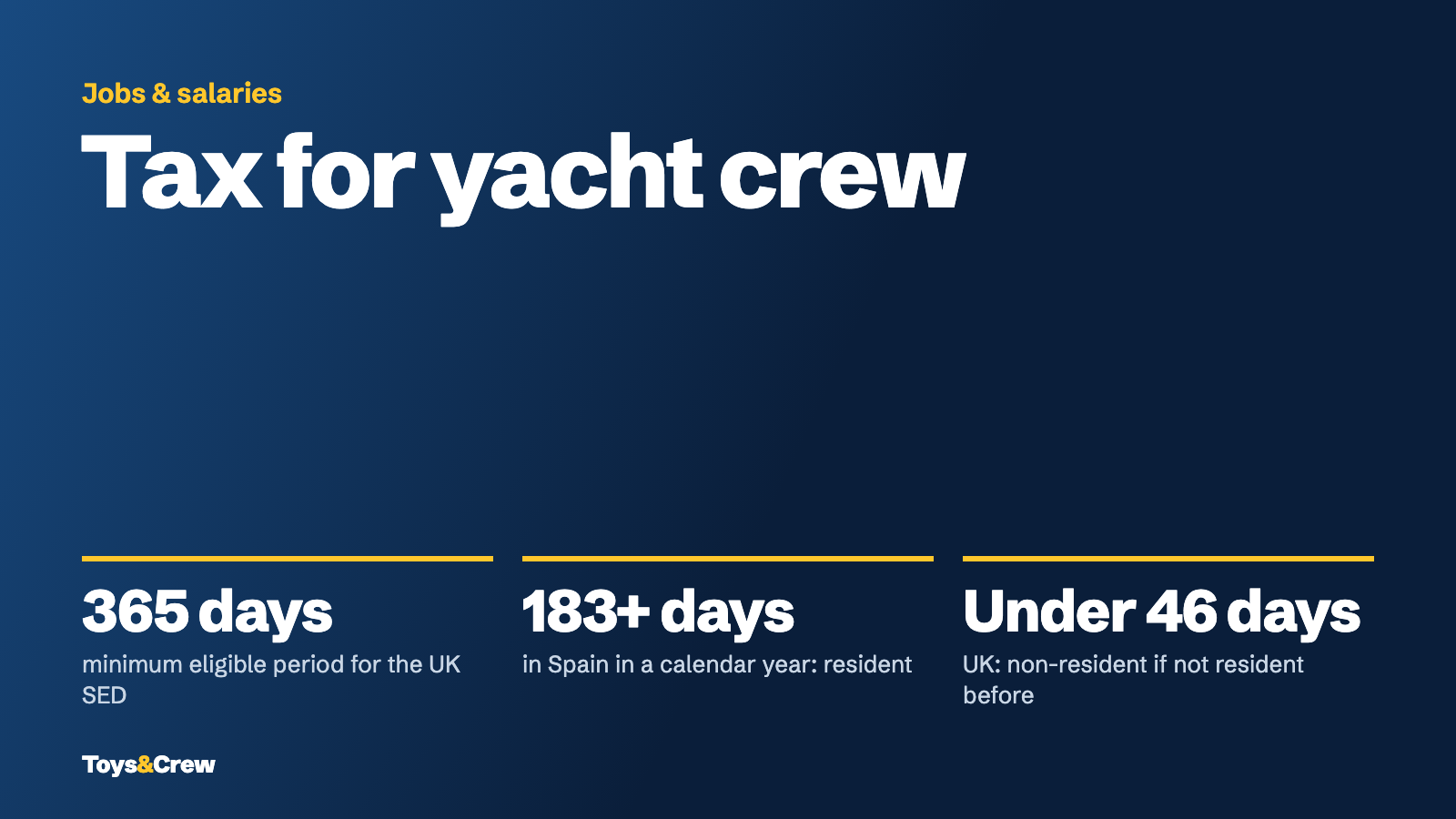
- If you were not UK resident in any of the earlier tax years the test looks at, you are automatically non-resident if you spend fewer than 46 days in the UK in the tax year (HMRC, RDR3).
- Otherwise the sufficient ties test counts your ties: a family tie, an accommodation tie, a work tie and a 90 day tie, plus a country tie if you were UK resident before (RDR3). Former UK residents can be resident with only 16 to 45 UK days if they have at least 4 ties (RDR3, Table A).
- Crew on ships: HMRC names mariners as an example of a "relevant job" on board, where the work is done during cross-border journeys. You are likely to have one if 80% or more of your journeys are cross-border (RFIG20780). With a relevant job and at least 6 cross-border trips in the tax year that begin or end in the UK, the automatic test for full-time work abroad does not apply, nor does the corresponding automatic UK test (RFIG20790). For the work tie, each day a cross-border trip starts in the UK counts as a UK working day of more than 3 hours (RFIG20800).
Spain (Art. 9 LIRPF):
- You are resident if you stay more than 183 days in Spain in the calendar year. Sporadic absences count towards those days unless you prove tax residence in another country (LIRPF, Art. 9.1).
- You are also resident, whatever the days, if the main centre or base of your economic activities or interests is in Spain. Residence is presumed, unless you prove otherwise, if your spouse (not legally separated) and dependent minor children usually live in Spain (LIRPF, Art. 9.1).
- How days are counted: according to the tax agency AEAT, citing the TEAC, the total is made up of certified presence, presumed days between two pieces of evidence, and sporadic absences. A certified day counts in full, with no minimum number of hours (AEAT, IRPF manual), and it does not matter whether the days are consecutive or interrupted by frequent entries and exits (AEAT on TEAC RG 4812/2020).
- You are resident or non-resident for the whole calendar year; moving does not split the tax period (AEAT, resident individual). Tax residence cannot be declared unilaterally; it has to be proven (AEAT, IRPF manual).
France (Art. 4 B CGI): you are tax resident in France if your household (spouse or PACS partner and children) stays in France, even if you work abroad for most of the year; if you work in France, unless the activity is only incidental; or if the centre of your economic interests is there (impots.gouv.fr). Employees sent abroad temporarily by their company are normally treated as French resident if their family stayed behind (BOFiP, BOI-IR-CHAMP-10).
A residence permit or administrative residence does not by itself make you tax resident (AEAT, resident individual). For visa day counts, see visas for yacht crew. If you work on rotation, keep track of where you spend your time off; see rotational contracts.
Is a Spanish NIE proof of tax residence?
No. The NIE is a personal identification number given, among others, to foreigners with economic or professional ties to Spain (Reglamento de Extranjería, RD 1155/2024, Art. 205). For tax matters you need a tax number (NIF), which for foreigners generally matches the NIE (AEAT, NIF). Tax residence is proven with a certificate from the tax authority of the country concerned, valid for a year (AEAT, resident individual). In Spain, AEAT issues the certificado de residencia fiscal online with an electronic certificate, DNIe or Cl@ve Móvil, or in person at its offices (AEAT, certificate). The UK equivalent is a certificate of residence, which confirms to a foreign tax authority that you are UK resident; it requires UK residence and a tax treaty with the other state (GOV.UK, certificate of residence).
What if two countries treat you as resident?
Then a double taxation convention decides, if there is one. Under domestic law you can be resident in more than one country at once; tax treaties set criteria that prevail over national rules, and without a treaty each country applies its own law (impots.gouv.fr). According to AEAT, treaties resolve dual residence in this order: permanent home, centre of vital interests, habitual abode, nationality, then agreement between the authorities (AEAT, resident individual). The UK–Spain convention starts with the state where you have a permanent home available; if you have one in both, your centre of vital interests decides (Art. 4(2)).
The same convention lets your country of residence keep the sole right to tax pay for work in the other state only if, among other conditions, you are there for not more than 183 days in any twelve month period (Art. 14(2)). If you have already paid tax abroad, UK residents can usually claim Foreign Tax Credit Relief in their return (GOV.UK, taxed twice).
What does the UK Seafarers' Earnings Deduction require?
The SED is one of two exceptions to the UK tax on residents' worldwide employment income (HMRC, EIM33000). The core conditions:
- an eligible period of at least 365 days, either a continuous absence from the UK or a combined period in which at least half of the days are days of absence (ITEPA 2003, s. 378); the details of return visits are in our off-season guide;
- you perform all or most of your duties on a ship, with other duties only incidental (ITEPA 2003, s. 384; HMRC, HS205);
- an offshore installation is not a ship, even while it is moving between locations (ITEPA 2003, s. 385; HS205). Whether a vessel is a ship depends on its design and capability, not its use at any one time (Perks v Clark, EIM33107).
How to claim:
- UK residents register for Self Assessment and file a tax return for the year (HMRC guidance). The amount goes in box 11 on page Ai 2 of the Additional information pages, the names of the ships in box 19 on page 7 of the SA100 (HS205).
- If you need a return for the first time, you must tell HMRC by 5 October after the tax year (GOV.UK, who must send a return). The online return for the last tax year is due by 11:59pm on 31 January 2027 (GOV.UK, deadlines).
- EEA residents who are not UK resident do not file a return; they claim on form R43(M)(SED), and only against their earnings as seafarers in UK waters (EIM33010).
- The SED is given in the year you receive the earnings (EIM33021). With more than one job for the same or associated employers, the deduction may be restricted; HMRC advises asking first (HS205).
- An NT tax code (form R44) is issued only after HMRC has processed your first claim; if it turns out you were not entitled, you repay the underpaid tax in one lump sum (HMRC guidance).
Which papers should you keep?
This list is put together from individual UK and Spanish sources:
- Discharge book pages or similar documents confirming periods of duty at sea; for EEA claims HMRC also lists a schedule of UK days with dates and flight tickets or travel documents, copies of draught of water and freeboard pages, day logs or voyage reports for each vessel, and your P60 (EIM33010). More on records of service in sea time and testimonials.
- SED records: do not send them with your return, but you may be asked for them later (HS205); HMRC may contact your employer to confirm the ship's voyages and crew (HMRC guidance).
- Retention: if you sent your tax return on or before the deadline, keep your UK records for at least 22 months after the end of the tax year; if you sent it late, keep them for at least 15 months after you sent the tax return (GOV.UK, records).
- Spain: evidence of presence for the day count, and a tax residence certificate from the country where you claim to be resident (AEAT).
Questions to ask your tax adviser
- In which country am I tax resident this year, and could a second country also claim me?
- Which treaty applies between those countries, and which tie-breaker decides in my case?
- Where is my employer resident, and where is the company that operates the yacht resident?
- Does my yacht count as a ship for the SED, and do my days add up to an eligible period?
- Do I have a relevant job for the UK residence test, and how many UK ties do I have?
- Should I register for Self Assessment, and do I have untaxed income, such as foreign income, that needs a return (GOV.UK)?
Sources
EU portal Your Europe; GOV.UK guides on foreign income, Self Assessment, records and certificates of residence; HMRC helpsheet HS205, SED guidance, Employment Income Manual (EIM33000, 33010, 33021, 33107), RDR3 and the Residence and FIG Regime Manual (RFIG20780 to 20800); ITEPA 2003, sections 378, 384 and 385; UK–Spain double taxation convention (synthesised text with the MLI); Spain: LIRPF Art. 9, TRLIRNR, RD 1155/2024 and AEAT pages and manual; France: impots.gouv.fr and BOFiP. All checked on 28 October 2026 and linked above.
Sources and image rights
- Images
- Mikhail Nilov / Pexels (conditions)
- Checked
- 29 October 2026 by Andreas Lakeberg
Know something we missed – a rule, a fee, a marina detail? Write to editor@toysandcrew.com. We check every tip against the source and note updates at the top of the story.
Disclaimer. We research every article carefully and to the best of our knowledge. Salaries, prices, rules and port regulations change, and we cannot guarantee that all information is complete, current or correct. Please check anything important with the original source or the responsible authority before you rely on it. To the extent permitted by law, we accept no liability for errors or omissions.