Electric jetboard or electric jet ski on a yacht? Battery, run time, weight and charging compared
Electric jetboards and jet skis for yachts compared: battery size, run time, weight, charging and what the makers publish on price and availability.

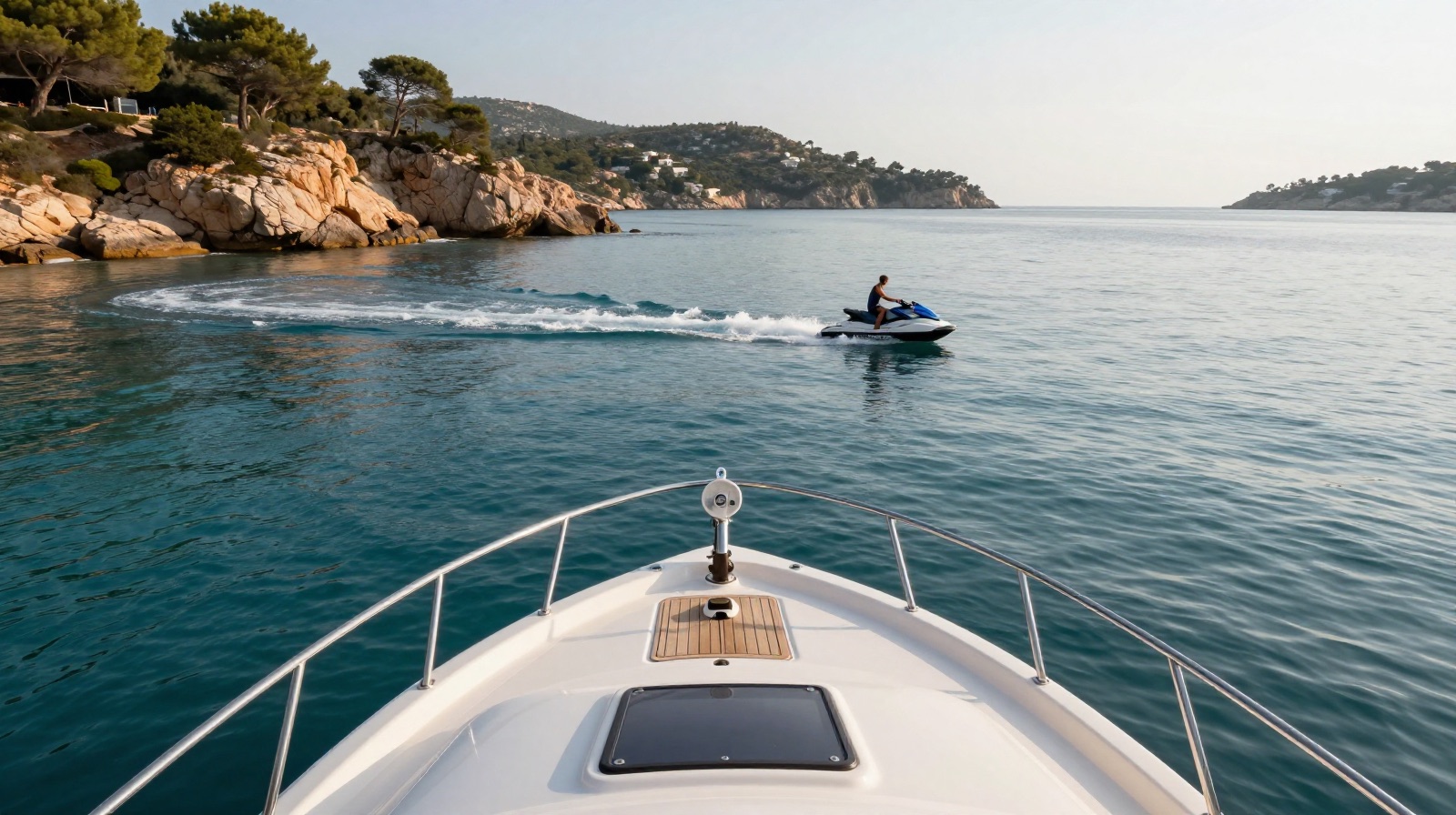
An electric jetboard is a one-person toy that weighs tens of kilograms. An electric jet ski carries two or three riders and, in Taiga's case, weighs several hundred. The boards in this comparison list weights between 16 and 44 kg, although the makers count batteries differently. They quote ride times of up to 60 minutes. The Taiga Orca jet skis weigh 357 and 371 kg. The ROXEN sits in between, with a 79 kg craft and a separate 33 kg battery. On a yacht, the bigger practical difference is charging. Where a jetboard battery size is published, it is 2.55 to 3.96 kWh, and JETSURF quotes a 3-hour charge. Taiga quotes about 14 hours on Level 1 charging and recommends a Level 2 charger to get its 6.6 kW charging rate.
This guide is based only on what the manufacturers publish on their own pages, in manuals and in press releases. All figures were checked on 7 October 2026. Where a maker gives no figure, the tables say "no figure". We do not estimate values. Disclosure: we also sell water toys under the name E-SURFER, including products from Awake, BRABUS x Awake, JETSURF, mo-jet and ROXEN. Taiga, Torque, Onean, YuJet, Narke and Lampuga are not in that range. We treat all brands the same way. For a wider look at boards, see electric jetboards on a yacht. For jet skis, see electric jet skis in 2026.
Which electric jetboards and jet skis can you actually get?
Before comparing numbers, check whether a model is still on sale. As of the manufacturers' pages in October 2026:
- Awake (RÄVIK Ultimate, Adventure, Explore) lists all three boards with full data on its product pages (Awake, RÄVIK Explore).
- BRABUS x Awake SHADOW EXPLORE is "limited to just 77 units worldwide" (Awake, SHADOW EXPLORE).
- JETSURF ELECTRIC 2, mo-jet, Torque, Onean and YuJet all publish data sheets or product pages for their electric boards. Torque describes itself as "designed by Australians" and names Torque Technology Group Limited as the company (Torque, battery pack).
- Lampuga has stopped trading: "Lampuga GmbH has ceased operations" (Lampuga). Its manuals and safety instructions are still relevant for yachts that already carry Lampuga boards.
- Taiga announced in September 2025 that "global deliveries of the new Orca lineup begin in 2026, with availability in Europe for the first time" (Taiga press release).
- ROXEN takes orders for 2027: "ROXEN is reservation for next season" (ROXEN).
- Narke says on its home page that it has "sold all of the GT95 Electrojets" (Narke).
- Sea-Doo has no electric model on its US overview for model year 2027. The page names Rotax engine options only (Sea-Doo, personal watercraft).
How do the electric jetboards compare?
The figures below are the manufacturers' own. "Weight" is the figure each maker lists. Awake lists board and battery separately, while JETSURF gives the battery weight in brackets next to the total.
| Model | Top speed | Ride time | Weight (as listed) | Charging time | Further published figures |
|---|---|---|---|---|---|
| Awake RÄVIK Ultimate | up to 55 km/h / 29.7 kn | up to 35 min | 16 kg | approx. 2.5 h* | |
| Awake RÄVIK Adventure | up to 50 km/h / 27 kn | up to 45 min | 23 kg | approx. 2.5 h* | Battery: Flex Battery XR 4: 2.55 kWh, 18.5 kg |
| Awake RÄVIK Explore | up to 40 km/h / 21.6 kn | up to 60 min | 21 kg | approx. 2.5 h* | Battery: Flex Battery XR 4: 2.55 kWh, 18.5 kg |
| BRABUS x Awake SHADOW EXPLORE | 55+ km/h | up to 60 min | 21 kg | approx. 2.5 h* | Battery: no figure |
| JETSURF ELECTRIC 2 | up to 55 km/h / 29.7 kn | 25–55 min | 32.9 kg (battery 18 kg) | 3 hours | Battery: 3 kWh (59 Ah) |
| mo-jet surf | up to 55 km/h / 29.7 kn | up to 40 min | 39.3 kg (mo-jet unit) | approx. 45 min (30 A quick charger), approx. 1.5 h (14 A charger) | Battery: 8.3 kg per battery, no kWh figure |
| Torque PRO RX26 | 61+ km/h | 50+ min | 38 kg | approx. 2.5 h* | Battery: 3.96 kWh (lithium-ion, 60 Ah) |
| Torque SPORT RX26 | 53+ km/h | 50+ min | 36 kg | approx. 2.5 h* | Battery: 3.96 kWh |
| Torque FRP RX26 | 53+ km/h | 50+ min | 44 kg | approx. 2.5 h* | Battery: 3.96 kWh (lithium-ion, 60 Ah) |
| Onean Carver X | approx. 45 km/h / 24.3 kn (75 kg rider) | up to 60 min | 23 kg without battery | 2.5 h | Battery: no figure |
| Onean Carver Twin | 30 km/h / 16.2 kn (75 kg rider) | up to 60 min | 20 kg without battery | 2.5 h | Battery: 40.0 Ah |
| YuJet Surfer / Surfer XT | up to 24 mph (XT) | 30 to 40 min (Surfer) | 15 kg without battery (Surfer) | 1.5 to 2 hours | Battery: 14.4 kg |
| Lampuga (existing boards) | no figure | no figure | no figure | approx. 2 h (only with 230 V input voltage) | Battery: 3.6 kWh |
\* Not published by the maker. Charging time from our own use of these boards. – For the Awake RÄVIK Ultimate battery entry, see the note on the Awake battery figure below.
Sources: Awake Ultimate, Adventure, Explore, SHADOW EXPLORE, JETSURF ELECTRIC 2, mo-jet surf, mo-jet battery, mo-jet quick charger, mo-jet standard charger, Torque PRO RX26, SPORT RX26, FRP RX26, Onean, Onean Carver Twin manual, YuJet spec sheet, YuJet Surfer XT, Lampuga manual.
Some details that the table does not show:
- Power output: all three Awake RÄVIK boards and the SHADOW EXPLORE list 11 kW. Onean lists a power of 10,000 W for the Carver X, 5,000 W for the Carver Twin and 750 W for the Manta, a slower leisure board. mo-jet gives a static thrust of approximately 100 kg.
- Acceleration: Torque quotes 0–50 km/h (0–27 kn) in 3 s for the PRO RX26 and in 4 s for the SPORT RX26.
- Awake battery figure: the Explore page gives 2.55 kWh for the Flex Battery XR 4. The same entry on the Ultimate page reads "18.5 kg 255 kWh". We use only the Explore figure.
- Rider weight: Awake gives "the recommended weight limit" as 110 kg, adding that "we have riders above that riding our boards with ease" (Awake FAQ). JETSURF lists a maximum load of 100 kg for the ELECTRIC 2. Lampuga gives a maximum payload of 100 kg.
How do the electric jet skis compare?
| Model | Riders | Power | Weight | Battery | Charging | Price / status |
|---|---|---|---|---|---|---|
| Taiga Orca P2 | 2 | 120 kW | 357 kg | no kWh figure published | 6.6 kW charging rate; Level 1 approx. 14 h | final price confirmed after reservation |
| Taiga Orca WX3 | 3 | 120 kW | 371 kg | no kWh figure published | as Orca P2 | from US $23,999 (press release, Sept. 2025) |
| Taiga Orca Carbon | no figure | up to 120 kW (up to 160 hp) | no figure | no kWh figure published | Level 2 approx. 3.5 h, Level 3 approx. 40 min | no figure |
| ROXEN | no figure | 22 kW | craft 79 kg, battery 33 kg | 5.25 kWh, swappable | 2.5–3 h, 230 V outlet | from €17,900 (excl. VAT and shipping); reservations for the 2027 season |
| Narke GT95 | 3 | 95 hp (71 kW) | dry weight 420 kg | 24 kWh, lithium-ion | 1.5 h (3 phase 16 A) | sold out |
Sources: Taiga Orca P2, Orca WX3, Orca Carbon, Taiga charging, Taiga FAQ, Taiga press release, ROXEN, ROXEN FAQ, Narke brochure.
Battery sizes can only be compared where they are published. The ROXEN pack, at 5.25 kWh, is 1.75 times the 3 kWh of the JETSURF ELECTRIC 2 (our calculation: 5.25 ÷ 3).
How long does charging take, and what does the yacht need?
This is where boards and jet skis differ most for crew. The charging times quoted by the manufacturers are:
- Boards: 3 hours for the JETSURF ELECTRIC 2, 1.5 to 2 hours for the YuJet Surfer, 2.5 hours for the Onean Carver X and Carver Twin, and approximately 2 hours in the Lampuga manual (only with 230 V input voltage). Awake and Torque publish no charging time; from our own use, a full charge takes about 2.5 hours. mo-jet quotes approximately 45 minutes with its 30 A quick charger, which has a European Schuko plug, and approximately 1.5 hours with its 14 A charger.
- ROXEN: 2.5–3 hours from a 230 V outlet.
- Taiga: about 14 hours on Level 1. "To maximize the 6.6kW charging rate, we recommend installing a standard Level 2 charger" (Taiga, charging). For the Orca Carbon, Taiga gives approximately 3.5 hours on Level 2 and approximately 40 minutes on Level 3. Fast charging uses "CCS1 in North America and CCS2 in Europe".
- Narke GT95: 1.5 hours on a 3 phase 16 A supply.
Two manufacturers mention yachts directly. Narke's brochure says its slow or fast charging can be matched to "the required hotel load level", meaning what the yacht's electrical system can spare. Taiga goes further and advertises using the Orca to "power hotel loads onboard yachts". Whether a yacht can run a Level 2 charger is a question for the chief engineer and the installer, not for the brochure.
A swappable battery changes the picture. ROXEN's FAQ on yacht tender use says "the swappable battery means a spare can be kept charged onboard" (ROXEN FAQ). JETSURF also describes the ELECTRIC 2 pack as swappable. mo-jet runs on two batteries of 8.3 kg each.
How to charge lithium packs safely on board is covered in lithium batteries for water toys on yachts. The manufacturers' own points:
- JETSURF: "Never charge the battery immediately after riding. Allow the battery to cool first."
- Lampuga: "Choose a charging area that is dry, ventilated and on a non-flammable surface."
- Torque: battery management systems "monitor temperature, voltage, and load".
Which is easier to launch and stow?
Weight decides how a toy goes over the side. The jetboards in our table list 16 to 44 kg. Some batteries are listed separately: 18.5 kg for the Awake Flex Battery XR 4 and 14.4 kg for the YuJet Surfer battery. The ROXEN lists 79 kg for the craft and 33 kg for the battery. The Taiga Orca models list 357 and 371 kg, and the Narke GT95 a dry weight of 420 kg. In other words, the Taiga Orca P2 alone weighs more than four times as much as the ROXEN craft (our calculation: 357 ÷ 79 is about 4.5). How jet skis are stowed and craned on yachts, and which yacht codes apply, is covered in jet skis on a superyacht.
The other trade-off is who rides. A board carries one person. The Taiga Orca P2 takes two riders and the WX3 takes three. YuJet also sells a jet ski attachment that turns its board into a sit-on craft, described as "use your surfboard as the engine of this new water pleasure craft" (YuJet). Learning time and guest suitability for boards are compared in jetboard or eFoil for yacht guests. Licence rules differ by country, see jetboard licence rules and jet ski rules from Spain to the Caribbean.
What do they cost?
Jet ski prices:
- Taiga Orca WX3: "Orca WX3 starts at US $23,999", according to the press release of 9 September 2025. Taiga's FAQ adds that after a reservation "a Taiga Sales Representative will contact you within 48 hours to confirm the price".
- ROXEN: "The ROXEN starts at €17,900 (excl. VAT and shipping)", according to its FAQ; orders are reservations for the 2027 season. The company "ships under EX Works (EXW) terms", so transport comes on top.
- For comparison, a petrol jet ski: Sea-Doo lists the 2027 GTX Limited at "starting at $23,849" (Sea-Doo). That is $150 less than the WX3 starting price (our calculation: 23,999 − 23,849). The two are different craft, so this is not a like-for-like comparison.
The jetboard makers list these prices:
- Awake: €9,990 ex. VAT for the RÄVIK Explore, €13,990 ex. VAT for the RÄVIK Adventure, €15,990 ex. VAT for the RÄVIK Ultimate and €15,900 ex. VAT for the BRABUS x Awake SHADOW EXPLORE.
- JETSURF ELECTRIC 2: regular price €12,490.00, "Excluding VAT, import tax and shipping".
- mo-jet surf: regular price €12,600.00.
- Torque: $8,299.00 for the PRO RX26, $7,999.00 for the SPORT RX26 and $7,599.00 for the FRP RX26.
- Onean: €10,990.00 + IVA (VAT) for the Carver X and €7,790.00 + IVA for the Carver Twin.
- YuJet: $5999 on the Surfer XT page.
Our earlier article on electric jetboards on a yacht covers models and prices in 2026.
How should the batteries be stored after the season?
Follow your own manufacturer, because their advice differs, including on the charge level:
- Taiga: "Stow your Orca away with at least 60% charge." According to the press release, the battery management draws so little power that the craft can "remain unplugged for up to several years in storage without needing to recharge".
- JETSURF ELECTRIC: "Charge the battery to a maximum of 50% before long-term storage" (JETSURF manual, section 11.2).
- Awake: "Store the battery separated from the board and charger. Store the battery in or around room temperature." (Awake winterization guide).
- ROXEN: "Remove the battery and store it indoors at room temperature."
- Onean: "In order to travel with the board, the battery must be below 20% of charge." Onean also recommends rinsing the jet "with fresh water after every use" (Onean manual).
- Lampuga: the safety instructions set a recommended maximum charge level for storage in hot weather (Lampuga safety instructions).
Service intervals matter too. ROXEN writes: "We recommend a service check-up after 12 months by Roxen Innovations or an authorized partner, but it is not required to keep the warranty." Narke specifies "seasonal maintenance required after every 100 hours of usage". End-of-season routines for boards are in how to store eFoils and jetboards.
What about petrol jetboards?
They avoid the charging question but bring petrol on board. JETSURF still builds combustion boards. The Titanium DFI SL lists 18.5 kg, a maximum load of 120 kg and a fuel capacity of 2.8 l (JETSURF, Titanium DFI SL). Their small onboard battery also needs charging, which "takes approximately 45 min. and can be done via a car cigarette lighter output or socket" (JETSURF, Adventure 2 DFI). For fuel, the manual says: "Always transport fuel only in canisters approved by the D.O.T. (USA) or CE" (JETSURF combustion manual). How yacht codes treat petrol for water toys is covered in jet skis on a superyacht.
Sources
Manufacturer product pages, manuals and FAQs from Awake (RÄVIK Ultimate, Adventure and Explore, BRABUS x Awake SHADOW EXPLORE, FAQ, winterization guide), JETSURF (ELECTRIC 2, Adventure 2 DFI, Titanium DFI SL, manuals for ELECTRIC 2 and combustion models), mo-jet (surf bundle, battery, chargers), Torque (PRO, SPORT and FRP RX26, battery pack), Onean (website and Carver Twin manual), YuJet (Surfer spec sheet, Surfer XT, jet ski attachment), Lampuga (home page, AIR manual, battery safety instructions), Taiga (Orca P2, WX3 and Carbon, charging page, FAQ, press release of 9 September 2025), ROXEN (product page and FAQ), Narke (home page and brochure) and Sea-Doo (US model overview and home page). All checked on 7 October 2026 and linked above.
Sources and image rights
- Images
- AI-generated image / Toys & Crew
- Checked
- 7 November 2026 by Andreas Lakeberg
Know something we missed – a rule, a fee, a marina detail? Write to editor@toysandcrew.com. We check every tip against the source and note updates at the top of the story.
Disclaimer. We research every article carefully and to the best of our knowledge. Salaries, prices, rules and port regulations change, and we cannot guarantee that all information is complete, current or correct. Please check anything important with the original source or the responsible authority before you rely on it. To the extent permitted by law, we accept no liability for errors or omissions.
Toys & Crew is published by Lakeberg GmbH, Berlin, the company behind E-SURFER, which began in 2017 as the first blog and YouTube channel about electric surfboards and today also sells eFoils and jetboards. We sell some of the brands we write about. That never decides what we cover or how we rate it.